
When a cancer diagnosis comes, the word 'radiation' often brings a specific image to mind: a large machine, a treatment room, and weeks of daily appointments.
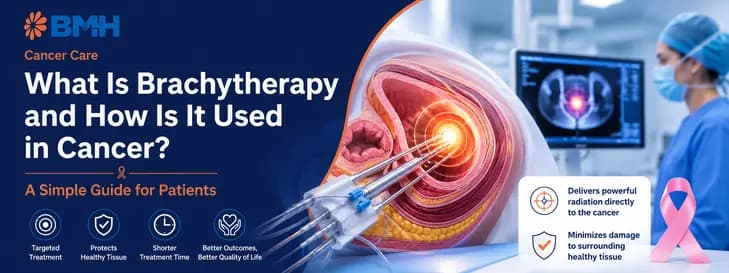
But for thousands of patients every year, radiation therapy looks very different. Brachytherapy, from the Greek word 'brachy,' meaning short distance, places a radioactive source directly inside or immediately adjacent to the tumour, delivering a concentrated dose of radiation to exactly where it needs to go. The result is a treatment that is shorter, more targeted, and for many patients, equally or more effective than conventional external beam radiation therapy (EBRT) alone.
According to the National Cancer Grid of India (NCGI) and the Indian Council of Medical Research (ICMR), chemoradiation combined with brachytherapy is the recommended standard of care for locally advanced cervical cancer, associated with 5-year survival rates of up to 75% in clinical trials at tertiary care centres in India.
This article explains what brachytherapy is, how it works, which cancers it is used for, what patients can expect, and how centres like NAVA Cancer Institute at Baby Memorial Hospital in Kozhikode are making this advanced treatment accessible to patients across Kerala, India, and beyond.
What Is Brachytherapy? A Clear Explanation
Brachytherapy is a form of radiation therapy where small radioactive sources often called seeds, wires, pellets, or applicators, are placed inside the body, either directly in the tumour or in a body cavity close to it.
Unlike external beam radiation, which travels through skin, tissue, and healthy organs to reach a tumour from outside the body, brachytherapy delivers radiation from within. This has one critical consequence: the dose of radiation drops off very steeply just millimetres away from the source, meaning surrounding healthy tissue receives a significantly lower dose.
Think of it this way: external radiation is like shining a torch at a target in a dark room, light reaches the target, but it also illuminates everything in between. Brachytherapy is like placing the torch directly on the target itself.
Brachytherapy has been used in cancer treatment for more than a century, but modern advances in imaging (CT, MRI), computer-based treatment planning, and precision applicator technology have transformed it into one of the most sophisticated tools in radiation oncology.
While the principle of brachytherapy remains the same, delivering radiation directly to the tumour, the treatment can be performed in different ways depending on the cancer type, tumour location, and the dose delivery method used.
Types of Brachytherapy: HDR, LDR, and PDR
Brachytherapy is categorised by two main factors: where the radioactive source is placed (intracavitary, interstitial, or surface), and how quickly the radiation dose is delivered (high-dose-rate, low-dose-rate, or pulsed-dose-rate).
1. High-Dose-Rate (HDR) Brachytherapy
HDR brachytherapy uses a single, highly active radioactive source, most commonly Iridium-192, that is temporarily placed inside the body for a matter of minutes per session using a remote-controlled afterloader machine. The source is computer-guided along a programmed path to deliver a precise dose, then automatically retracted. HDR is the most widely used form of brachytherapy today. Most patients undergo it as an outpatient procedure, with sessions often lasting 10–20 minutes. It is used for cervical, prostate, breast, head and neck, oesophageal, and lung cancers, among others.
2. Low-Dose-Rate (LDR) Brachytherapy
LDR brachytherapy delivers a lower dose of radiation over a longer period typically hours to days. For permanent LDR implants (most commonly used in prostate cancer), tiny radioactive seeds are permanently placed in the gland; they gradually lose their radioactivity over weeks to months while continuing to treat the tumour.
3. Pulsed-Dose-Rate (PDR) Brachytherapy
PDR is a hybrid approach, delivering radiation in short pulses (typically once per hour) over a period of days. It is mostly used in gynaecological and head and neck cancers and offers the radiobiological benefits of LDR while retaining the safety and precision of afterloaded HDR systems.
Understanding the treatment process can help patients feel more prepared and confident about what to expect before, during, and after brachytherapy.
How Brachytherapy Works: The Step-by-Step Process
A course of brachytherapy typically follows these stages:
1.Initial assessment and imaging:
The treatment team performs a clinical examination, CT or MRI scan, and detailed treatment planning. For gynaecological cancers, a pelvic examination under anaesthesia is often part of this stage.
2.Applicator placement:
A radiation oncologist places the applicator (a hollow tube, ring, or implanted needles) in or near the tumour. For intracavitary treatments such as cervical cancer, this is a ring-and-tandem or cylinder applicator placed in the vaginal canal and uterus. For interstitial treatments (like prostate or breast), fine hollow needles are implanted directly into tissue.
3.Treatment planning scan:
Once the applicator is in place, a CT or MRI scan is taken. The radiation oncology team uses this to create a 3D model of the tumour and surrounding organs, calculating the exact dose to be delivered to each point in space.
4.Radiation delivery:
For HDR, the afterloader machine feeds the radioactive source through the applicator along a computer-planned path. The process takes minutes. For LDR implants, the seeds are placed and the patient is monitored while the dose is delivered over hours or days.
5.Applicator removal and discharge:
For temporary implants (HDR and temporary LDR), the applicator is removed after treatment. Most patients are discharged the same day or after a short stay, depending on the protocol.
Also Read: 20 Questions To Ask Your Oncologist: Complete Guide


Which Cancers Is Brachytherapy Used For?
Brachytherapy is a recognised standard of care for several cancer types. The following table provides a quick reference:
| Cancer Type | Common Technique | Role in Treatment |
|---|---|---|
| Cervical | Intracavitary HDR (ring-tandem applicator) | Definitive treatment; standard of care for locally advanced disease |
| Prostate | LDR seed implant or HDR interstitial | Curative; often used as monotherapy or boost |
| Breast | Interstitial HDR or balloon (MammoSite) | Accelerated partial breast irradiation (APBI) post-lumpectomy |
| Endometrial / Uterine | Vaginal cylinder HDR | Adjuvant after surgery; reduces local recurrence |
| Head & Neck | Interstitial HDR needles | Boost or re-irradiation of oral cavity, tongue, lip lesions |
| Oesophageal | Intraluminal HDR | Palliative or curative in early lesions |
| Skin (non-melanoma) | Surface applicator HDR | Effective alternative to surgery in selected cases |
Because both brachytherapy and external beam radiation therapy use radiation to destroy cancer cells, many patients wonder how the two treatments differ and when one may be preferred over the other.
Brachytherapy vs. External Beam Radiation: What's the Difference?
Patients and families often ask how brachytherapy compares with the external beam radiation machine they've heard about. Here is an honest, clinical comparison:
1. Precision:
Brachytherapy delivers radiation from within, so dose conformity to the tumour shape is excellent and can be adjusted based on image-guided planning. External beam radiation, particularly IMRT and VMAT, is also highly precise, but the radiation still has to travel through intervening tissue.
2. Treatment duration:
A full course of brachytherapy may involve 3–5 HDR fractions over 1–2 weeks, compared with 25–35 daily fractions over 5–7 weeks for conventional external beam radiation. This is a significant practical advantage for patients who travel long distances for treatment.
3. Side effects:
Because healthy tissue receives a lower dose in brachytherapy, some side effects, particularly to the bladder and rectum in gynaecological treatments, can be reduced compared with external beam alone. However, brachytherapy requires applicator placement, which carries its own procedural considerations.
4. Use cases:
Brachytherapy and external beam are frequently complementary, not competing. Most locally advanced cervical cancer protocols, for example, involve 5–6 weeks of external beam chemoradiation followed by 3–5 sessions of intracavitary HDR brachytherapy as the boost.
What to Expect: Patient Experience During Brachytherapy
One of the most common anxieties patients bring to their first brachytherapy consultation is uncertainty about what the procedure will feel like. Here is a candid account based on typical patient experiences:
Before Treatment
The team will explain the procedure in detail. For intracavitary procedures (gynaecological cancers), bowel preparation may be needed. Anaesthesia local, regional, or general, depending on the procedure, is used for applicator insertion. Patients are encouraged to ask questions and to bring a family member or support person.
During Treatment
With HDR brachytherapy, the actual radiation delivery phase is brief, typically 10 to 20 minutes per fraction. The applicator is in place during this time. Patients lie still; the machine operates quietly with remote monitoring. There is no sensation from the radiation itself.
After Treatment
For temporary implants, the applicator is removed after treatment. Most HDR patients are discharged within a few hours. There may be mild discomfort at the applicator site for a day or two. For permanent seed implants (prostate LDR), patients go home with simple precautions and routine follow-up scheduled within a few weeks.
Side Effects
Common temporary side effects include fatigue, localised soreness, and urinary or bowel changes, depending on the treatment site. Serious complications are uncommon when treatment is delivered by an experienced team using modern image-guided planning. Your oncologist will discuss expected side effects in detail at the planning consultation.
Also Read: Which Is the Best Oncologist in Kozhikode for Expert Cancer Treatment?
Brachytherapy at Baby Memorial Hospital, Kozhikode: What Sets NAVA Apart
Choosing where to receive cancer treatment is one of the most important decisions a patient and their family will make. For patients in North Kerala and across India,NAVA Cancer Institute at Baby Memorial Hospital, Kozhikode has become a trusted destination, not just for the equipment it houses, but for the clinical depth behind it.
The GammaMedplus iX: Precision at the Core
NAVA uses the GammaMedplus iX HDR afterloader, an industry-standard system that enables MRI/CT image-guided 3D treatment planning for brachytherapy. This means every implant is individually designed around the patient's own anatomy, not a generic template. The dose to the tumour and to nearby organs like the bladder and rectum is calculated and optimised before a single fraction is delivered.
Prof. Dr. P.R. Sasindran: 37+ Years of Brachytherapy Experience
Prof. Dr. P.R. Sasindran, Head of Department and Senior Consultant in Radiation Oncology at Baby Memorial Hospital, brings over 37 years of experience in cancer radiotherapy, including advanced techniques such as IGRT, VMAT, IMRT, and HDR brachytherapy. Patients who have been through treatment consistently describe his consultations as thorough and unhurried, a quality that matters greatly when navigating a cancer diagnosis.
A Truly Multidisciplinary Approach
Cancer is rarely treated by a single specialist in isolation at NAVA. The institute's tumour board, bringing together medical oncologists, surgical oncologists, radiation oncologists, nuclear medicine specialists, and palliative care, meets to review complex cases and agree on treatment plans collectively. For a patient receiving brachytherapy as part of a combined modality approach, this means the entire treatment pathway is coordinated from the start.
Full-Spectrum Oncology Under One Roof
NAVA's broader technology stack ensures that brachytherapy, where indicated, is part of a seamlessly integrated treatment plan: TrueBeam image-guided radiation therapy (IGRT) for external beam treatment, Da Vinci X robotic surgery for minimally invasive resections, Discovery IQ PET-CT for staging and response assessment, and a dedicated paediatric oncology and bone marrow transplantation unit for blood cancers.
Accessibility for National and International Patients
One factor that distinguishes Baby Memorial Hospital from many high-quality cancer centres is its commitment to making treatment affordable, not as a compromise, but as a founding principle. Established in 1987 and grown to a 500-bed multi-specialty institution with over 40 departments, BMH has always served a regional population where cost is a genuine consideration.
For patients travelling from outside Kerala, including from other Indian states and from the large NRI community in the Gulf, the hospital's International Patient Services team handles travel coordination, treatment scheduling, language support, and accommodation guidance. Kozhikode is well-connected by air (Calicut International Airport), road, and rail, making access straightforward even for patients coming from significant distances.
Conclusion
Brachytherapy is one of the most evidence-backed, precisely targeted forms of cancer treatment available today. For patients with cervical, prostate, breast, and several other cancers, it can mean a shorter treatment course, less exposure of healthy tissue to radiation, and outcomes that clinical trials consistently show to be excellent, particularly when delivered at a centre experienced in image-guided brachytherapy planning.
Understanding what brachytherapy is, how it works, and what to expect can make an enormous difference to how patients approach their diagnosis. If you or a family member has been advised to consider brachytherapy, the most important step is a consultation with a radiation oncologist who can assess your specific situation and explain the options clearly.
At NAVA Cancer Institute, Baby Memorial Hospital, that kind of personalised, expert consultation is what every patient receives, whether they are coming from down the road in Kozhikode or flying in from abroad.
Have questions about brachytherapy? Speak with our specialist at NAVA Cancer Institute, Baby Memorial Hospital.