
When a cancer diagnosis arrives, the next question is almost always the same: what is the best way to treat it? For thousands of patients across India and beyond, the answer increasingly involves robotic-assisted surgery, and specifically, the Da Vinci Surgical System. Globally, over 3.1 million surgical procedures have now been performed using the Da Vinci system, a figure that underscores its proven reliability across urological, gynaecological, colorectal, and other oncological applications.
Kerala, long recognised for its high healthcare standards among Indian states, is now cementing its position as a destination for advanced robotic cancer surgery. Both government institutions and leading private hospitals have invested in this technology, making it accessible to patients who previously had to travel to metropolitan cities like Mumbai, Chennai, or Delhi.
This article explains how Da Vinci robotic surgery works, what cancers it treats, what patients can realistically expect, and why Baby Memorial Hospital in Kozhikode has emerged as one of the most trusted centres for robotic oncology in North Kerala and the wider region.
What Is the Da Vinci Surgical System And Why Does It Matter for Cancer?
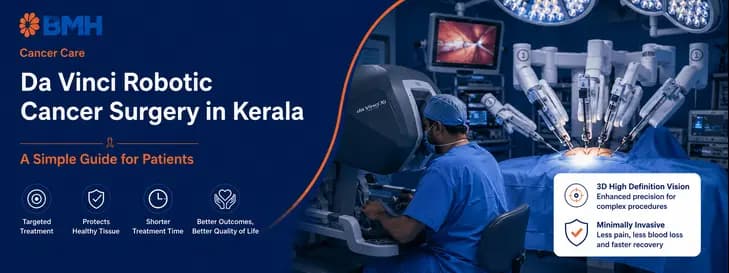
The Da Vinci Surgical System is not a robot that operates independently. It is a surgeon-controlled, robotic-assisted platform that translates the surgeon's hand movements, filtered, scaled, and stabilised into precise micro-movements inside the patient's body.
The surgeon sits at a console a few feet away, hands in control at all times, while the robotic arms hold the instruments and camera inside the patient through keyhole incisions.
Three elements make the system uniquely valuable for cancer surgery:
1. 3D High-Definition Magnification (Up to 10×)
The Da Vinci camera provides a three-dimensional, magnified view of the surgical field, clearer and more detailed than the naked eye, and far superior to the 2D flat view of conventional laparoscopy. In cancer surgery, where tumours often sit millimetres away from critical nerves, blood vessels, and organs, this clarity is the difference between a clean resection and an incomplete one.
2. Tremor Filtration and Scaled Movement
The system electronically filters natural hand tremors and can scale the surgeon's movements so a 1-centimetre hand movement translates to a 1-millimetre movement at the instrument tip. In oncological dissection, this precision is what enables nerve-sparing prostatectomy, partial nephrectomy that saves kidney tissue, and deep pelvic dissection for rectal cancer that would be difficult or impossible with conventional instruments.
3. Seven Degrees of Freedom (Greater Than the Human Wrist)
Conventional laparoscopic instruments can only move in four directions. The Da Vinci's wristed instruments articulate in seven degrees of freedom, more than the human wrist. This allows surgeons to work in tight, confined spaces like the pelvis, the retroperitoneum, and around the bladder neck with movements that simply cannot be replicated with straight instruments.
The first Da Vinci robotic surgery for a urological cancer in India was performed at AIIMS New Delhi in July 2006. Since then, India has trained over 500 robotic surgeons who have completed more than 12,800 robotic procedures nationally.
Baby Memorial Hospital's programme is part of that growing national expertise but with a critical difference: it sits within a fully integrated cancer centre in Kozhikode, not a standalone surgical unit.
Also Read: Understanding Robotic Surgery Benefits
Why Robotic Surgery for Cancer? The Clinical Advantages
Robotic-assisted oncological surgery is not simply a technological novelty. It translates into measurable, evidence-backed benefits for the patient:
-
Smaller Incisions, Less Trauma: Unlike open surgery, robotic procedures use several small keyhole incisions rather than a single large cut. This dramatically reduces soft tissue damage, blood loss, and postoperative pain.
-
Precision in Complex Anatomy: Tumours in the prostate, rectum, bladder, uterus, kidney, and other areas often sit close to critical nerves and blood vessels. The Da Vinci system's flexibility and precision allow surgeons to remove tumours while preserving adjacent healthy tissue, nerves, and organs, outcomes that are far harder to achieve with conventional surgery.
-
Shorter Hospital Stays: Most robotic oncological surgeries allow patients to be discharged in two to four days, compared to seven to ten days or more for equivalent open surgeries. This matters enormously for patients travelling from other states or abroad.
-
Faster Return to Normal Life: Reduced incision trauma means patients typically return to routine activities weeks earlier than after open surgery.
-
Lower Infection and Complication Risk: Smaller wounds with less exposure reduce the risk of surgical site infections and other postoperative complications.
Which Cancers Are Treated with Da Vinci Robotic Surgery?
The Da Vinci platform is used across a broad range of cancer types. The most common applications include:
1. Prostate Cancer (Robotic Radical Prostatectomy)
This is the most widely performed robotic oncological procedure globally. The precision of the robotic system is particularly valuable here, as the prostate sits close to critical nerves controlling urinary and sexual function. The success rate for robotic-assisted radical prostatectomy (RARP) in India is cited at 98%.
Notably, BMH's urology team recently set a benchmark in North Kerala by completing four advanced robotic prostate procedures an institutional milestone that signals the depth of the team's active surgical volume.
2. Rectal and Colon Cancer
The narrow confines of the pelvis make rectal cancer surgery technically demanding. Robotic assistance gives surgeons better angles, clearer visualisation, and more controlled movement than conventional laparoscopy.
3. Kidney Cancer (Partial or Radical Nephrectomy)
Robotic surgery allows surgeons to remove only the cancerous portion of the kidney in eligible patients, preserving maximum healthy kidney tissue.
4. Bladder Cancer (Radical Cystectomy)
Robotic cystectomy, removal of the bladder, is a highly complex procedure. The Da Vinci system enables more precise dissection and reconstruction.
BMH performs robotic radical cystectomy with intracorporeal urinary diversion, meaning the reconstruction is performed inside the body robotically, rather than through a separate open incision. This approach is associated with lower complication rates, reduced blood loss, and faster recovery compared to conventional open cystectomy.
5. Gynaecological Cancers
Endometrial (uterine) cancer, cervical cancer, and ovarian cancer are increasingly managed robotically, offering women faster recovery and reduced blood loss compared to open hysterectomy.
6. Lung Cancer
In eligible cases, robotic thoracic surgery allows removal of lung tumours through small incisions, avoiding the large chest-opening incision of traditional thoracotomy.
Robotic Cancer Surgery in India and Kerala: The Bigger Picture
India has steadily built its capacity for robotic oncological surgery. As of the most recent data available, over 500 trained robotic surgeons have performed more than 12,800 successful robotic surgeries across the country.
Kerala, in particular, has made significant strides. In early 2025, the state government inaugurated the Arogyam Anandam cancer prevention campaign and launched a Cancer Grid, a statewide network coordinating cancer patients, diagnostic labs, and treatment centres across all 14 districts.
Private hospitals in the region have gone further. Baby Memorial Hospital in Kozhikode has maintained a Da Vinci robotic surgical programme as part of its comprehensive oncology infrastructure, giving patients in North Kerala access to the same technology available in India's major metropolitan hospitals.


The BMH Da Vinci Programme: What Makes It Different in Kerala
Across Kerala, robotic surgery has expanded in recent years. But BMH's position is distinct and understanding why requires looking at the full picture, not just the robot.
1. A Dedicated Advanced Robotic & Laser Urology Centre
BMH is the only hospital in North Kerala to have a dedicated Advanced Robotic & Laser Urology Centre, a specialist unit structured around the Da Vinci Surgical System with its own multidisciplinary team, training framework, and sub-speciality depth. This centre is:
- Equipped with the Da Vinci Robotic Surgical System alongside next-generation Holmium Laser 160W platforms
- Backed by UROCARE TRUST for patient support and programme quality
- Trained in collaboration with AESCULAP ACADEMY, Germany, one of the world's leading surgical training institutes, ensuring that the BMH robotic surgery team operates to internationally benchmarked standards
This German-affiliated training collaboration is not a marketing footnote. It means BMH's robotic surgeons are trained on the same frameworks used in European centres of excellence, with an external quality benchmark that most Indian robotic programmes do not have.
2. NAVA Cancer Institute, Launched February 2026
In February 2026, BMH formally launched the NAVA Cancer Institute at its Kozhikode campus, a comprehensive, dedicated cancer treatment centre that brings together every oncology subspecialty under one framework. NAVA is not simply a rebrand of existing services. It is a structured cancer centre model built on:
- Multidisciplinary Tumour Board Reviews. Every complex case is jointly reviewed by surgical, medical, and radiation oncologists, radiologists, pathologists, and nuclear medicine specialists before treatment begins.
- Precision Diagnosis including real-time molecular pathology review, genomic marker testing (PD-L1, EGFR, ALK), and 4D radiation planning audits, the kind of diagnostic depth that directly influences treatment decisions.
- Personalised Treatment Pathways. Not protocol-driven one-size-fits-all treatment, but therapy tailored to tumour biology, patient health, and treatment goals.
- Survivorship Support. Nutrition, pain management, rehabilitation, and psychological well-being are built into the care model, not afterthoughts.
For a patient in North Kerala considering robotic surgery for cancer, NAVA's existence at BMH means that the robotic procedure is not happening in isolation, it is part of a structured, expert-reviewed, multidisciplinary treatment plan.
3. The Full Oncology Technology Stack
What BMH has that very few Kerala hospitals, and no other Kozhikode hospital can match is the combination of all of the following in one institution:
| Technology | What It Does for Cancer Patients |
|---|---|
| Da Vinci Surgical Robot | Precision, minimally invasive cancer surgery |
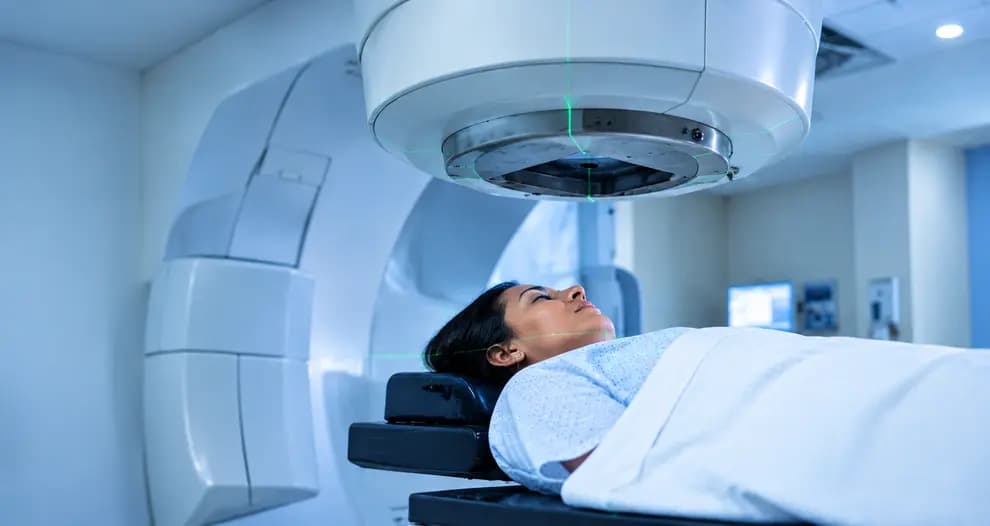
| TrueBeam LINAC (Varian) | High-precision image-guided radiation therapy, faster and more accurate than conventional LINAC |
| Brachytherapy | Internal radiation for cervical, prostate, and other cancers |
| PET-CT | Whole-body cancer staging, treatment response evaluation, restaging |
| Dual 1.5T MRI | Soft tissue tumour characterisation, surgical planning, radiation planning |
| Gamma Camera SPECT | Nuclear medicine imaging for functional assessment |
| Digital Mammogram | Breast cancer screening and diagnosis |
| Bone Marrow Transplant (BMT) Unit | Autologous, allogeneic, and haploidentical transplants for leukaemia, lymphoma, aplastic anaemia |
Also Read: PET Scan vs CT Scan vs MRI for Cancer: Which Is Right for You?
No other hospital in Kozhikode or North Kerala has this complete a technology stack for cancer care. A patient receiving robotic surgery for prostate cancer at BMH can have their staging PET-CT, their pre-operative MRI, their surgery, any adjuvant radiation on TrueBeam, and their follow-up imaging, all in one campus, coordinated by one multidisciplinary team.
4. Newsweek World's Best Hospitals 2026
In 2026, BMH Kozhikode was ranked among India's Best Hospitals in the Newsweek World's Best Hospitals 2026 list, published in partnership with Statista. This ranking evaluated over 2,500 hospitals across 32 countries, assessing medical expert recommendations, patient-reported outcome measures, and quality indicators.
For patients comparing options, this matters. It places BMH alongside some of the most respected hospitals globally, not as a local hospital making a local claim, but as an institution independently evaluated and ranked by an international methodology.
5. Over 38 Years and the First Cancer Programme in the Region
BMH was founded in 1987, starting as a 52-bed facility and growing into the institution it is today. Its oncology journey includes a collaboration with the American Oncology Institute (AOI), South Asia's leading cancer hospital chain, which brought international cancer care protocols, standards, and quality benchmarks to Kozhikode years before NAVA launched.
This institutional history means BMH's oncologists have not recently started managing cancer, they have been doing it for decades, at volume, with increasingly sophisticated tools. That clinical depth is what the Da Vinci platform sits on top of. The robot is only as good as the surgeon behind it.
Da Vinci Surgery Versus Conventional Surgery: The Honest Comparison
Patients comparing surgical options deserve an honest picture, not just the benefits of robotic surgery, but where it fits clinically.
| Factor | Open Surgery | Laparoscopic Surgery | Da Vinci Robotic Surgery |
|---|---|---|---|
| Incision Size | 10–30 cm | 3–5 small ports | 1–2 cm ports |
| Visualisation | Direct, 2D | 2D camera | 3D HD, up to 10× magnified |
| Instrument Flexibility | Full (surgeon's hands) | 4 degrees of freedom | 7 degrees of freedom, tremor-filtered |
| Blood Loss | Higher | Moderate | Minimal |
| Hospital Stay | 7–10 days | 3–5 days | 2–4 days |
| Recovery Time | 6–8 weeks | 3–4 weeks | 2–3 weeks |
| Nerve Preservation | Difficult in confined spaces | Challenging | Best possible in confined anatomy |
| Cancer Control | Equivalent | Equivalent | Equivalent |
| Best For | Very large tumours, complex reconstruction | Moderate complexity | Confined anatomy (pelvis, retroperitoneum), nerve-sparing |
A Caution: Robotic surgery is not the right choice for every cancer patient. Tumour size, stage, patient comorbidities, and anatomical factors all influence which approach is best. At BMH, every patient is individually assessed by the multidisciplinary tumour board, the recommendation is evidence-based and patient-specific, not a default to robotic surgery regardless of clinical fit.
Why Patients from Across India and the World Choose BMH
With advanced robotic cancer surgery, comprehensive oncology support, and patient-focused care, Baby Memorial Hospital has become a preferred destination for patients from Kerala, other Indian states, and overseas. The hospital brings together technology, expertise, and complete cancer care under one roof. Patients choose BMH not only for advanced treatment but also for the convenience, accessibility, and support that make their cancer journey easier.
For Patients from North Kerala and the Malabar Region
Earlier, patients seeking Da Vinci robotic cancer surgery often had to travel to metro cities, adding financial and emotional stress. BMH has changed this by bringing advanced robotic surgery, oncology care, intensive care, pathology, and radiation support closer to home.
For Patients from Other States
BMH attracts complex cancer cases from Karnataka, Tamil Nadu, Goa, and across South India. With excellent connectivity, lower travel costs, and comprehensive cancer facilities, patients can access quality care without travelling to distant metro hospitals.
For International Patients; Especially from the Gulf
With strong connections to Gulf countries, BMH is increasingly chosen by patients from the UAE, Qatar, Kuwait, Oman, and Bahrain. The International Patients Desk supports them with:
- Pre-arrival case review and cost guidance
- Medical visa and travel assistance
- Airport pickup and accommodation support
- Interpreter services
- Post-treatment follow-up coordination
For international patients, BMH offers advanced robotic cancer surgery with quality care, accessibility, and significantly lower costs compared with many Western and Gulf private hospitals.
Take the next step towards advanced cancer care at BMH with expert guidance, robotic surgery options, and dedicated support throughout your treatment journey. Chat with our assistant today!
Conclusion: In Kerala, BMH Sets the Standard
Robotic surgery for cancer is not a distant aspiration for patients in Kerala, it is available now, in Kozhikode, at a hospital ranked among India's best by Newsweek, equipped with the most complete oncological technology stack in North Kerala, and supported by a training partnership with one of Germany's leading surgical academies.
What BMH has built at its Kozhikode campus is rare, not just in Kerala, but in South India. A fully integrated cancer centre where the Da Vinci robot, NAVA Cancer Institute, TrueBeam radiation, PET-CT imaging, bone marrow transplant, and a genuinely multidisciplinary tumour board all work together as a single system for the patient.
Cancer is not a condition that benefits from fragmented care. The patient who has their staging scan at one hospital, their surgery at another, and their radiation at a third is navigating a system that was not designed with their outcome in mind. BMH's model is built differently and for patients in Kerala, and increasingly for patients from across India and internationally, that difference matters.
If you are navigating a cancer diagnosis and considering robotic surgery, the starting point is a case review, not a commitment, just a clinical conversation with people who do this every day.
Speak to BMH's Cancer Care Team. Share your reports with the NAVA Cancer Institute team at BMH for a clinical review.
Medical Disclaimer: This article is for informational purposes only and does not constitute medical advice, a diagnosis, or a treatment recommendation. Cancer treatment suitability including whether robotic surgery is appropriate, depends entirely on individual patient factors: cancer type, stage, anatomy, overall health, and tumour biology. Always consult a qualified oncologist or surgical specialist before making any treatment decision. Clinical statistics referenced in this article are drawn from peer-reviewed literature, government publications, and official hospital sources; individual outcomes may vary. If you are an international patient, consult with your treating physician in your home country before travelling for treatment.