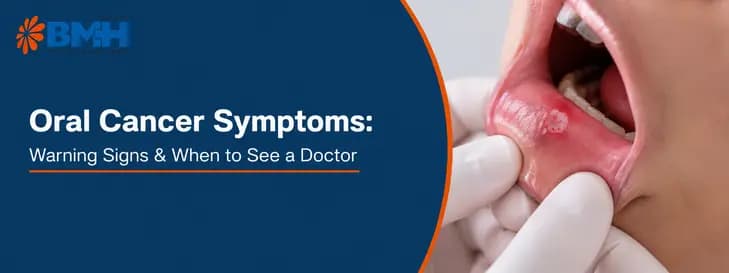

You've had the ulcer on the side of your tongue for three weeks now. It doesn't really hurt. You've stopped noticing it most days, until your tongue brushes against it while eating something spicy, and you remember it's still there. This is exactly the kind of symptom that gets waved off as "just a mouth ulcer," and in the overwhelming majority of cases, that's exactly what it is. But it's also the kind of symptom that oral cancer specialists see walking through their doors months too late, because it never hurt enough to feel urgent.
Oral cancer develops in the tissues of the mouth, lips, or throat and can progress silently without obvious symptoms in its early stages. Recognizing the warning signs, from persistent mouth sores to changes in speech or swallowing, is crucial for catching the disease when treatment is most effective.
This guide walks through the specific signs oral cancer produces, how to tell them apart from harmless look-alikes, exactly when a symptom crosses the line from "watch it" to "get it checked," and what happens during diagnosis if you do need to see a specialist.
What Is Oral Cancer, Exactly?
Oral cancer is a type of head and neck cancer that can affect the lips, tongue, cheeks, palate, gums, and the area beneath the tongue. It can also develop in the throat and voice box, though these are technically oropharyngeal cancers. Most oral cancers are squamous cell carcinomas, which originate in the thin, flat cells lining the mouth and throat.
The condition does not discriminate by age or background, though certain groups face higher risk. Many people delay seeking help because they mistake early symptoms for minor dental problems or common mouth irritations. This delay can allow cancer to progress to advanced stages, making treatment more challenging. Understanding that persistent changes in your mouth deserve professional attention, rather than home remedies, is the first step toward early detection and better outcomes.
The 10 Early Warning Signs of Oral Cancer
Not every symptom below means cancer. Most of the time, it won't. But these are the specific changes that clinicians ask about first, because they show up most consistently in confirmed cases.
1. A mouth sore or ulcer that hasn't healed in two weeks or more. Ordinary canker sores and bite injuries heal within 7–10 days. One that lingers, especially without a clear cause, deserves a second look.
2. A white patch (leukoplakia) or red patch (erythroplakia) on the gums, tongue, cheek lining, or floor of the mouth. Red patches carry a higher risk of being precancerous or cancerous than white ones.
3. A lump, thickening, or rough patch inside the mouth, on the lip, or as a swelling in the neck that doesn't go away.
4. Unexplained bleeding in the mouth that isn't from brushing too hard or biting your cheek.
5. Numbness or a persistent tingling sensation in the tongue, lip, or elsewhere in the mouth, a sign that a growth may be pressing on a nerve.
6. Loosening teeth or dentures that suddenly fit poorly, without a dental explanation like gum disease or a cavity.
7. Difficulty or pain when chewing, swallowing, or moving the jaw or tongue, often one of the later signs, but one people notice quickly because it affects eating.
8. A change in voice or ongoing hoarseness that doesn't resolve in a couple of weeks, particularly without a cold or laryngitis to explain it.
9. A feeling that something is stuck in the throat, or a sore throat that won't clear up.
10. Unintended weight loss, often a later sign, linked to reduced eating due to pain or difficulty swallowing.
Common Symptom vs. Harmless Look-Alike
Not every mouth ulcer, white patch, or hoarse voice is a sign of cancer. However, knowing which symptoms are usually harmless and which should not be ignored can help you decide when it's time to seek medical advice.
| What you notice | Usually harmless if... | More concerning if... |
|---|---|---|
| Mouth ulcer | Heals within 10 days, painful from day one, matches a known bite/injury | Lasts 2+ weeks, is painless, keeps recurring in the same spot |
| White patch | Wipes away, linked to a known irritant (rough tooth, denture) | Doesn't wipe off, is thickened or rough, persists after the irritant is removed |
| Lump/swelling | Tender, appears with a cold or dental infection, resolves in days | Painless, firm, fixed in place, growing over weeks |
| Voice change | Follows a cold, laryngitis, or shouting; clears in under 2 weeks | No infection, persists past 2–3 weeks, one-sided throat pain |
How to Do a 2-Minute Self-Exam at Home
You don't need special equipment for a basic monthly check, just a bright light, a mirror, and clean hands.
-
Face and neck: Look at your face and feel along your neck and under your jaw for any new lumps or swelling.
-
Lips: Pull your lower and upper lip out and inspect the inner surface and gumline.
-
Cheeks: Use a finger to pull each cheek out and examine the inner lining, front to back.
-
Roof of mouth: Tilt your head back and look at the hard and soft palate.
-
Tongue: Stick your tongue out and check the top, then gently hold it with gauze or a cloth and check both sides. Push it up to look underneath and at the floor of your mouth.
-
Gums: Run a finger along your upper and lower gums, feeling for any unusual lumps or rough patches.
You're looking for anything asymmetrical, a sore that doesn't match anything you remember injuring, a patch of colour that's different from the surrounding tissue, or a lump that feels different from the tissue around it. A self-exam is a screening habit, not a diagnostic tool, it tells you when to get a professional opinion, not whether something is or isn't cancer.
Also Read: When to See an Oncologist: Signs, Symptoms, and Screening


When to See a Doctor: The Two-Week Rule
The single most useful guideline, used by dentists and ENT specialists alike: if any mouth sore, patch, lump, or voice change lasts longer than two weeks, get it examined. You don't need to wait for pain, bleeding, or weight loss to justify the visit, those tend to be later signs, not earlier ones.
Who to see first depends on the symptom:
-
A dentist or oral surgeon for mouth sores, white/red patches, gum changes, or loose teeth.
-
An ENT (Ear, Nose, and Throat) specialist for voice changes, throat symptoms, or a neck lump.
-
Go the same week, not the same month, if you notice a combination, for instance, a painless ulcer plus a new lump in the neck, or a white patch plus numbness.
If you're a long-term tobacco, gutkha, or alcohol user, it's worth treating the two-week rule even more strictly, and adding a screening visit to your routine dental check-up regardless of symptoms.
Also Read: 20 Questions To Ask Your Oncologist: Complete Guide
If any of these warning signs sound familiar, the next step is choosing a centre that can confirm the diagnosis and coordinate treatment without unnecessary delays.
How NAVA Cancer Institute at Baby Memorial Hospital Approaches Oral Cancer Care
Early diagnosis is only part of the journey, the quality and coordination of care that follow are equally important. At NAVA Cancer Institute, Baby Memorial Hospital, Kozhikode, patients with suspected oral cancer are evaluated through a multidisciplinary approach, bringing together ENT surgeons, head and neck surgeons, medical oncologists, radiation oncologists, radiologists, and pathologists to develop a personalised treatment plan.
Key features of the institute include:
-
Comprehensive diagnosis with clinical examination, biopsy, imaging, and tumour board review under one roof.
-
Advanced treatment options, including Da Vinci Xi robotic surgery, TrueBeam image-guided radiation therapy, and GammaMedplus iX brachytherapy for eligible patients.
-
Specialised Head & Neck Cancer care supported by modern endoscopic and microscopic diagnostic equipment.
-
Dedicated services for Indian and international patients, including Gulf patients, with multilingual assistance and coordinated care to streamline consultations, treatment, and follow-up.
Oral Cancer Risk Factors You Can Actually Control
-
Tobacco, in any form, cigarettes, bidis, gutkha, khaini, and paan with tobacco all directly expose the mouth's lining to carcinogens.
-
Areca nut (betel nut/supari), even without tobacco, is an independent risk factor and is widely used across India.
-
Alcohol, particularly combined with tobacco use, which significantly compounds risk.
-
HPV infection, increasingly recognised as a risk factor for oropharyngeal cancers.
-
Prolonged, unprotected sun exposure, a specific risk factor for lip cancer.
-
Poor oral hygiene and ill-fitting dentures, which cause chronic irritation over time.
Conclusion
Most mouth ulcers, white patches, and sore throats are exactly what they look like minor, self-limiting, and gone within a couple of weeks. But the small number that aren't tend to share one thing in common: they were painless, easy to ignore, and given more time than they should have been.
The two-week rule exists precisely because it removes the guesswork, you don't need to diagnose yourself, you just need to know when "watch and wait" should become "get it checked."
If you're noticing a sore, patch, lump, or voice change that has outlasted two weeks, treat that as your cue to see a dentist, ENT specialist, or oncologist, rather than a reason to wait for it to hurt.
Chat with our care assistant to understand your symptoms better, or reach out directly to NAVA Cancer Institute at Baby Memorial Hospital, Kozhikode, to book an evaluation with a head and neck specialist.
Medical Disclaimer: This article is intended for general informational purposes only and does not constitute medical advice, diagnosis, or treatment. The symptoms described may be caused by a range of conditions, most of which are not cancer. Always consult a qualified dentist, ENT specialist, or oncologist for an accurate diagnosis and personalised treatment plan. If you are experiencing a medical emergency, seek immediate care.