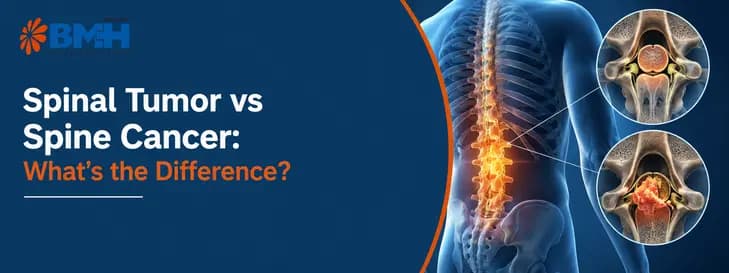

Not every spinal tumor is cancer, and not all spinal cancers begin as tumors in the spine itself. Many people use these terms interchangeably, but they describe different conditions with distinct causes and treatment pathways.
This guide breaks down the actual clinical difference, the symptoms that overlap (and the ones that shouldn't be ignored), how specialists diagnose the two, and what treatment realistically looks like, including what a multidisciplinary spine and cancer program, like the one at NAVA Cancer Institute, Baby Memorial Hospital (BMH), Kozhikode, does differently when a tumor turns out to be malignant.
What Exactly Is a Spinal Tumor?
A spinal tumor is simply an abnormal growth of cells in or around the spinal column, the vertebrae (bones), the spinal cord, the nerve roots, or the surrounding soft tissue and cartilage. The word "tumor" only describes the growth. It says nothing about whether that growth is dangerous.
Where Tumors Form Along the Spine
Doctors classify spinal tumors by location because the location often predicts behaviour and treatment approach:
-
Extradural (vertebral column) tumors, grow in the bones of the spine, outside the protective dura layer. Most metastatic and many primary bone tumors fall here.
-
Intradural-extramedullary tumors, grow inside the dura but outside the spinal cord itself, such as meningiomas and schwannomas.
-
Intramedullary tumors, grow within the spinal cord tissue itself, such as astrocytomas and ependymomas.
Benign vs Malignant, the Split That Actually Matters
This is the real fork in the road:
-
Benign spinal tumors grow slowly, don't spread to other parts of the body, and are non-cancerous. Many can be observed rather than treated aggressively, unless they're pressing on the spinal cord or nerves.
-
Malignant spinal tumors are cancerous. They can grow faster, invade nearby structures, and, in the case of metastatic disease, indicate cancer that has already spread from elsewhere in the body.
A tumor can be benign and still be serious. A slow-growing but centrally located tumor can compress the spinal cord and cause permanent nerve damage even without ever becoming cancerous. So "benign" doesn't automatically mean "leave it alone" it means the urgency and treatment strategy differ from cancer.
What Is Spine Cancer? Primary vs Metastatic, Explained
"Spine cancer" specifically refers to malignant spinal tumors and here's where most patient confusion actually starts, because spine cancer itself comes in two very different forms.
Primary Spinal Cancer (Rare)
A primary spinal cancer originates in the spine itself, in the bone, cartilage, or nerve tissue. Examples include chordomas, chondrosarcomas, and osteosarcomas. These are comparatively rare and behave very differently depending on subtype chordomas, for instance, tend to grow slowly but can recur even after treatment.
Metastatic Spinal Tumors (The Common Reality)
This is the category that actually accounts for the vast majority of what gets diagnosed as "spine cancer." A metastatic (secondary) spinal tumor happens when cancer that started elsewhere in the body, most often the breast, lung, or prostate, spreads to the spine.
This is the single most important fact in this whole comparison: if a scan shows a mass in your spine, statistically it is far more likely to be cancer that has spread there from another organ than a cancer that started in the spine itself. That's exactly why a spine tumor diagnosis should always trigger a search for the primary source, not just a plan to treat the spine in isolation.
Spinal Tumor vs Spine Cancer: Quick Comparison
The terms spinal tumor and spine cancer are often used interchangeably, but they do not mean the same thing. A spinal tumor may be benign or malignant, while spine cancer specifically refers to a malignant tumor.
Here’s a quick comparison:
| Aspect | Spinal Tumor (General Term) | Spine Cancer (Malignant Tumor) |
|---|---|---|
| Definition | Any abnormal growth in/around the spine | A cancerous spinal tumor, primary or metastatic |
| Can be benign? | Yes, often | No — by definition, always malignant |
| Origin | Spine tissue, or can be secondary | Spine tissue (primary) or spread from elsewhere (metastatic, ~90% of cases) |
| Growth pattern | Usually slow if benign | Often faster; can invade nearby bone/nerves |
| Spreads to other organs | No | Possible, especially with primary spine sarcomas |
| Typical first step | Imaging + monitoring or excision | Imaging + biopsy + full-body staging + tumour board review |
| Treatment team | Spine surgeon, sometimes alone | Spine surgeon + medical oncologist + radiation oncologist |
Also Read: A Complete Guide to Spinal Tumor Surgery and Recovery
Symptoms: Why They Feel Identical (and How to Read Between the Lines)
Here's the frustrating clinical reality, benign and malignant spinal tumors often cause the exact same early symptom: back or neck pain. What tends to differ is the pattern of pain:
-
Mechanical back pain (the everyday kind) usually eases with rest and worsens with specific movements or positions.
-
Tumor-related pain often does the opposite it can worsen at night, disturb sleep, and doesn't clearly connect to activity or injury.
As a tumor grows, it may press on the spinal cord or nerve roots, leading to additional symptoms: arm or leg weakness, numbness or tingling, difficulty walking, loss of bladder or bowel control, or visible spinal deformity.
Common Symptoms That Warrant Medical Attention
Both benign spinal tumors and spine cancer may cause similar symptoms, though their severity and speed of onset often differ. Most back pain is not cancer. But specific combinations of symptoms raise the probability enough that they shouldn't be brushed off:
-
A personal history of any cancer, combined with new back pain
-
Pain that steadily worsens over weeks rather than improving
-
Pain that wakes you up at night or is worse lying down
-
Unexplained weight loss alongside back pain
-
Progressive weakness, numbness, or bladder/bowel changes
-
Back pain in someone under 20 or over 50 with no clear injury


Is My Back Pain Cancer? A Realistic Self-Check
Most people with back pain do not have a spinal tumor, the vast majority of back pain is muscular, disc-related, or degenerative. But if you're checking this list and recognising more than one item, it's worth booking an evaluation rather than waiting it out:
-
Pain lasting more than 4–6 weeks despite rest.
-
Pain that doesn't improve, or gets worse with typical over-the-counter pain relief.
-
A known cancer diagnosis, past or present.
-
New neurological symptoms (weakness, numbness, balance issues).
-
Fever, night sweats, or unexplained weight loss alongside spine pain.
None of these confirm cancer on their own. But together, they're exactly the pattern that prompts doctors to order imaging rather than simply recommend physiotherapy.
How Doctors Actually Diagnose Spinal Tumors and Spine Cancer
For suspected spinal tumors, diagnosis usually involves more than one test, with each scan answering a different clinical question. The following investigations help doctors identify the tumor, understand its extent, and determine whether it may have spread.
1. Imaging: MRI, CT, and PET
MRI with contrast is the primary tool for visualising spinal tumors, it shows soft tissue, nerve involvement, and tumor borders with far more precision than an X-ray. CT scans are often used to assess bone involvement and plan surgery, while PET scans help identify whether cancer has spread beyond the spine, critical when a metastatic tumor is suspected, per Yale Medicine.
2. Biopsy and Tumour Marker Testing
Imaging can strongly suggest a diagnosis, but a biopsy, removing a small tissue sample, either surgically or via a needle, is usually needed to confirm whether a tumor is benign or malignant, and to identify the exact cancer type if it's metastatic. This matters because treatment for, say, a breast cancer metastasis to the spine looks very different from treatment for a primary spinal chordoma, even though both might look similar on an initial scan.
Also Read: Cancer Treatment Without Surgery: Best Non Surgical Options
Treatment Options Compared
The right treatment depends on the tumor type, size, location, symptoms, and whether it has spread. The table below summarises the common approaches for different spinal tumor situations.
| Situation | Common Treatment Approach |
|---|---|
| Small, asymptomatic benign tumor | Active monitoring with periodic imaging |
| Benign tumor causing pain/nerve pressure | Surgical excision (often minimally invasive or endoscopic) |
| Primary spinal cancer (e.g., chordoma) | Surgical resection, often combined with radiation |
| Metastatic spinal tumor | Treatment of the primary cancer + spine-directed radiation/surgery for pain and stability |
| Spinal cord compression (any cause) | Urgent surgical decompression, sometimes same-day |
Treatment decisions increasingly depend on a tumour board, a panel of specialists across surgery, radiation oncology, and medical oncology reviewing each case together, rather than a single surgeon deciding in isolation.
This is especially true for metastatic spinal tumors, where the spine team and the oncology team managing the original cancer need to coordinate closely.
Also Read: Early Stage Cancer Treatment Options That Actually Work
Why Patients From Across India and Abroad Choose BMH & NAVA Cancer Institute for Spine Tumor Care
When a spinal tumor is found on an MRI, families often have the same concerns: Is it cancer? Has it spread? What treatment is needed? At Baby Memorial Hospital (BMH), these questions can be addressed through coordinated care between the Spine Surgery department and NAVA Cancer Institute, helping patients avoid delays caused by managing multiple specialists or hospitals separately.
Spine tumor cases are evaluated by Dr. Sandesh Pacha, Senior Consultant Spine Surgeon, whose expertise includes tumour excision and minimally invasive spine procedures. When a tumor is malignant or metastatic, the case can be reviewed by NAVA Cancer Institute's multidisciplinary tumour board, bringing together relevant oncology specialists to plan the treatment sequence.
What makes this approach useful for patients?
-
Spine and cancer specialists work together: Surgical, radiation and medical oncology expertise can be coordinated with spine surgery when required.
-
Diagnostics and treatment under one roof: MRI, CT, biopsy, radiation therapy and other supporting services are available within the BMH campus.
-
Multidisciplinary treatment planning: Complex or malignant cases can be discussed through the tumour board to determine the appropriate order of surgery, radiation and systemic treatment.
-
Support for outstation and international patients: BMH's International Patients desk can assist with travel and care-related logistics.
-
Less coordination for families: Patients can access multiple specialties and services within the same hospital network rather than arranging every step independently.
For spinal tumors, where diagnosis, surgical planning and cancer treatment may need to happen in close coordination, this integrated approach can make the treatment journey more streamlined for patients and their families.
Conclusion
Most spinal tumors are not cancer, but when they are, the type matters enormously, because roughly 9 out of 10 diagnosed spinal tumors turn out to be metastatic rather than originating in the spine itself.
That single fact should shape how any spinal tumor diagnosis is approached: not just "how do we treat the spine," but "where did this actually come from, and who else needs to be involved in the plan."
If you or a family member has been told there's a mass on the spine, the right next step isn't panic, it's getting an MRI read, a biopsy if indicated, and a treatment team that includes both spine and oncology expertise from the start.
Chat with our care assistant to understand your next steps, or book a consultation with our spine and oncology team.
Medical Disclaimer: This article is intended for general informational purposes only and does not constitute medical advice, diagnosis, or treatment. Every spinal tumor case is different, and only a qualified physician who has reviewed your imaging, history, and test results can provide an accurate diagnosis and treatment plan. If you are experiencing symptoms described in this article, please consult a healthcare professional promptly.