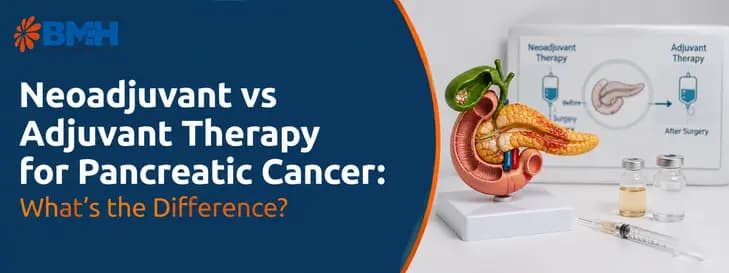

Pancreatic cancer is one of the most challenging cancers to treat, but advances in treatment approaches have improved how doctors fight this disease. Two important strategies, neoadjuvant and adjuvant therapy, work alongside surgery to give patients better chances of survival.
This guide breaks down what separates the two approaches, what the current evidence says about outcomes, how the decision is actually made on a tumour board, and what patients in Kerala and abroad can expect when working with a dedicated HPB (hepatopancreaticobiliary) oncology team such as the one at BMH's NAVA Cancer Institute in Kozhikode.
What Is Neoadjuvant Therapy?
Neoadjuvant therapy means chemotherapy, sometimes combined with radiation, is given before any attempt at surgery. The idea isn't to delay treatment; it's to front-load it.
Pancreatic tumours often shed cancer cells into the bloodstream long before they're visible on a scan. Starting chemotherapy first gives the treatment team a chance to act on those circulating cells and micrometastases before the disruption of surgery, while also using the tumour's response to chemotherapy as a real-time signal of how aggressive the disease actually is. If a tumour continues to progress despite treatment, that's information too, it may mean surgery would not have helped in the first place.
The most commonly used neoadjuvant regimens for pancreatic cancer are FOLFIRINOX (a four-drug chemotherapy combination) and gemcitabine plus nab-paclitaxel, chosen based on the patient's fitness, organ function, and how the tumour is positioned relative to nearby blood vessels.
What Is Adjuvant Therapy?
Adjuvant therapy is the more traditional model: surgery happens first, and chemotherapy follows once the patient has recovered, usually within 8–12 weeks of the operation.
The logic here is straightforward. If imaging shows the tumour is clearly resectable, with no involvement of the major blood vessels around the pancreas, removing it as soon as possible avoids the risk of the disease progressing during a preoperative treatment course. Chemotherapy afterward is meant to eliminate any microscopic disease left behind and reduce the chance of recurrence.
Also Read: Whipple Surgery for Pancreatic Cancer: How It Works, Recovery & Outcomes
Neoadjuvant vs Adjuvant: Side-by-Side Comparison
While both approaches are used to control pancreatic cancer, the timing, goals, benefits, and limitations of neoadjuvant and adjuvant therapy are quite different. The table below provides a quick side-by-side comparison to help you understand when each approach may be considered.
| Factor | Neoadjuvant Therapy | Adjuvant Therapy |
|---|---|---|
| Timing | Chemotherapy/chemoradiation before surgery | Chemotherapy after surgery |
| Best suited for | Borderline-resectable and locally advanced tumours | Clearly resectable tumours with no vascular involvement |
| Main advantage | Higher R0 (margin-negative) resection rates; treats micrometastases early | Avoids delaying surgery in straightforward cases |
| Main limitation | Small risk of disease progression during treatment, delaying surgery | Roughly half of patients never complete the planned course due to post-surgical complications |
| Typical regimens | FOLFIRINOX, gemcitabine + nab-paclitaxel, sometimes with radiation | FOLFIRINOX (modified), gemcitabine + capecitabine |
| Who decides | Multidisciplinary tumour board, based on CT staging and CA 19-9 trends | Multidisciplinary tumour board, post-operative pathology review |


How Oncologists Decide: Resectable, Borderline, or Locally Advanced
The decision doesn't come down to personal preference, it follows how the tumour is staged on contrast-enhanced CT imaging.
1. Resectable tumours
It shows no contact, or only minimal contact, with the major arteries and veins around the pancreas. For these, surgery-first followed by adjuvant chemotherapy is still a widely accepted path, though a growing number of centres now offer neoadjuvant therapy even here, since recent trial data suggests it may improve outcomes without increasing surgical risk.
2. Borderline-resectable tumours
They have some involvement of nearby vessels, enough that a clean (R0) resection is uncertain if surgery is done immediately. This is the group where neoadjuvant therapy has moved from "option" to "preferred standard," because shrinking the tumour first meaningfully increases the odds of a margin-negative resection.
3. Locally advanced or initially unresectable tumours
They have significant vascular involvement that rules out immediate surgery. Here, neoadjuvant chemotherapy is used with the specific goal of downstaging the tumour enough that surgery becomes possible later, sometimes referred to as a "conversion" approach.
Why Patients Choose BMH's NAVA Cancer Institute for Pancreatic Cancer Care
If you or someone you love has been diagnosed with pancreatic cancer, treatment decisions can feel overwhelming. Pancreatic cancer often requires more than one type of treatment, and the sequence of chemotherapy, radiation therapy, and surgery can vary depending on the tumour stage, location, and resectability.
At Baby Memorial Hospital's NAVA Cancer Institute, pancreatic cancer care follows a multidisciplinary approach, bringing different specialists together to evaluate each case and develop an individualized treatment plan.
A Multidisciplinary Team Approach
Pancreatic cancer can involve complex decisions about whether surgery should be performed first or whether treatment should begin with chemotherapy or chemoradiation. A multidisciplinary tumour board allows specialists to review these factors together, including:
- Medical oncologists to assess systemic treatments such as chemotherapy
- Surgical oncologists and HPB surgeons to evaluate whether the tumour can be safely removed
- Radiation oncologists to determine whether radiation may have a role
- Radiologists to assess pancreatic-protocol CT or MRI findings and tumour involvement
- Pathologists to confirm the diagnosis and relevant tumour characteristics
This collaborative review can be particularly important for borderline-resectable or locally advanced pancreatic cancers, where the treatment sequence may influence whether surgery becomes possible.
Individualized Treatment Sequencing
There is no single treatment sequence that applies to every person with pancreatic cancer. Depending on the clinical situation, the team may recommend:
- Neoadjuvant therapy before surgery to treat cancer systemically and assess how the tumour responds before an operation.
- Surgery followed by adjuvant therapy when the tumour is considered resectable and upfront surgery is appropriate.
- A combination of chemotherapy and radiation therapy in selected cases.
- Further systemic treatment when surgery is not currently feasible.
The decision is based on factors such as tumour stage, vascular involvement, overall health, imaging findings, and response to initial treatment.
Support for Patients Travelling to Kozhikode
For patients coming from outside Kozhikode or from other countries, coordinating cancer treatment can involve more than medical appointments. BMH's international patient services can help with practical aspects of the treatment journey, including:
- Treatment coordination
- Assistance with appointments and hospital processes
- Treatment cost estimates
- Travel and accommodation guidance
- Support for international patients during their hospital stay
This can make the process easier for families who need to coordinate multiple consultations and treatment sessions.
Ultimately, the right treatment plan depends on the individual patient's diagnosis and clinical assessment. NAVA Cancer Institute at BMH provides a multidisciplinary setting where pancreatic cancer cases can be reviewed by relevant oncology and surgical specialists before a treatment sequence is finalized.
Cost of Treatment: India vs. Global Pricing
For international patients weighing where to be treated, cost is rarely a minor factor, and it shouldn't have to come at the expense of protocol quality.
According to IBEF (India Brand Equity Foundation, a Government of India trade promotion body), the cost of surgery in India runs at roughly one-tenth of equivalent procedures in the US or Western Europe, a gap driven by lower operational costs rather than a difference in clinical standards.
For a treatment pathway like pancreatic cancer, which often involves months of chemotherapy plus a major operation, that difference is the reason many international patients are able to access FOLFIRINOX-based protocols and HPB surgery that would otherwise be financially out of reach.
Conclusion
Neoadjuvant and adjuvant therapy aren't competing treatments, they're two sequencing strategies built for two different tumour situations, and the right one depends entirely on precise, honest staging.
For resectable tumours, surgery-first still holds up. For borderline-resectable and locally advanced disease, the evidence increasingly favours starting with chemotherapy, both because it improves the odds of a clean resection and because it sidesteps the very real risk of never completing chemotherapy after surgery.
If you or someone you love has just received a pancreatic cancer diagnosis, the single most useful question to ask your oncology team isn't "which drug" it's "why this sequence, for this tumour." A team that can answer that clearly, backed by a proper multidisciplinary tumour board, is the team worth trusting with the decision.
if you have questions about your scan results or which treatment sequence might apply to your situation, Chat with our care assistant to get your case reviewed by our multidisciplinary pancreatic cancer tumour board.
Medical Disclaimer: This article is intended for general informational purposes only and does not constitute medical advice, diagnosis, or treatment recommendations. Pancreatic cancer treatment decisions must be individualized based on a patient's specific staging, pathology, and overall health, as determined by a qualified oncology team. Always consult a licensed oncologist or your treating physician before making any treatment decisions.