- English
- عربي / Arabic
- മലയാളം / Malayalam

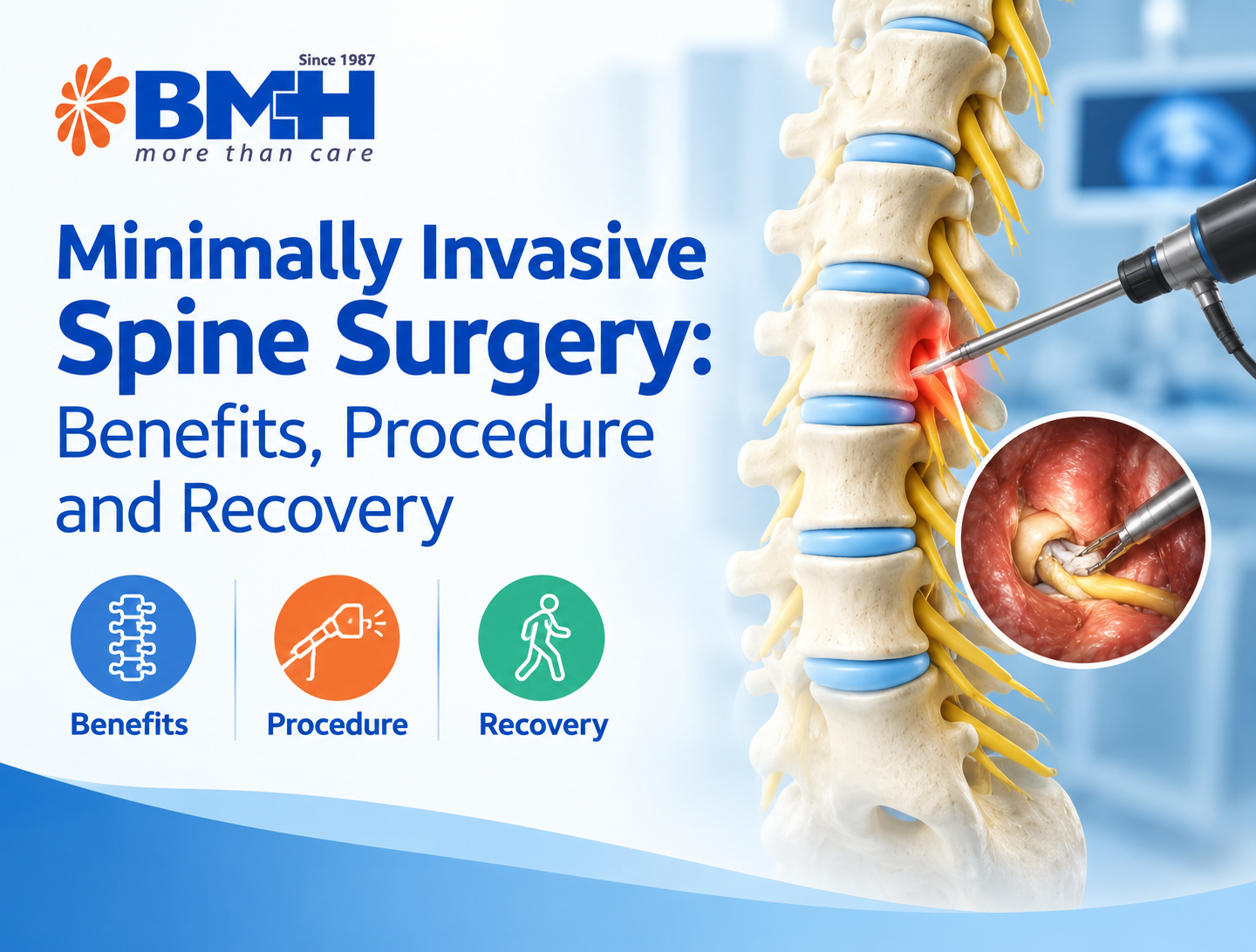
Spine surgery once almost automatically brought one picture to mind.
A long incision. A large operation. And weeks of difficult recovery.
That is no longer the only way some spine problems can be treated.
Today, selected conditions can be managed through minimally invasive spine surgery, where the surgeon reaches the problem through smaller openings and works between or around the muscles rather than making a wide exposure of the spine.
Smaller, however, does not automatically mean better.
The important question is whether the technique can treat your particular spine problem properly. For the right patient, it may mean less disruption to surrounding tissue, less blood loss and an earlier return to movement. For another patient, an open operation may still give the surgeon better access and a safer result.
It is not simply a shorter skin cut.
That is part of it, but not the whole story.
In traditional open surgery, muscles around the spine may need to be moved aside to reach the vertebrae, discs and nerves. Minimally invasive techniques use narrow pathways, specialised instruments and imaging to reach the same area while limiting how much surrounding tissue has to be disturbed.
Sometimes a tubular retractor creates that pathway. In other procedures, an endoscope—a thin instrument carrying a camera and light—is used.
This is where terms such as keyhole spine surgery come from.
The operation is still spine surgery.
The route in is simply different.
A slipped or herniated disc is probably the condition many people hear about first.
If disc material presses against a spinal nerve, it can produce pain travelling into the leg, along with tingling, numbness or sometimes weakness. When appropriate non-surgical treatment has not helped, removing the part pressing on the nerve may be considered.
Some patients can have this done through an endoscopic discectomy or another minimally invasive discectomy technique.
Minimally invasive approaches may also be used for selected cases of spinal stenosis, certain spinal fusion procedures, spinal instability and some other conditions.
But not every disc problem needs an operation.
And not every operation should be minimally invasive.
That distinction matters.
An MRI can show a large disc bulge.
The patient may barely have symptoms.
Another MRI may show what looks like a smaller problem, yet the patient has severe pain running down one leg.
So surgeons don't operate on an MRI image alone.
Your spine surgeon Kozhikode will usually look at where the pain travels, whether there is numbness or weakness, how your reflexes and movement are affected, and whether the abnormality on imaging explains those symptoms.
Previous treatment matters too.
If medicines, activity modification, physiotherapy or other appropriate non-surgical measures are working, surgery may not be necessary simply because an MRI mentions a disc bulge.
The scan shows the anatomy.
The patient tells the rest of the story.
The exact steps depend on what needs fixing.
Take a lumbar disc pressing on a nerve.
Instead of exposing a large area of the spine, the surgeon makes a small opening and reaches the affected area using specialised instruments. Imaging helps identify the correct spinal level.
With an endoscopic technique, a small camera gives the surgeon a magnified view of the operating area. The piece of disc irritating the nerve can then be carefully removed.
The goal is not to empty the entire disc.
It is to free the nerve.
For other conditions, the procedure may involve removing bone that is narrowing the space around nerves or stabilising part of the spine with screws and other implants. Most of these operations can also be performed through minimally invasive approaches.
So “minimally invasive” describes the way the surgeon gets there.
What happens once they get there depends entirely on the problem.
This is where minimally invasive surgery can offer an advantage in suitable patients.
Because less muscle and soft tissue may need to be disturbed, some minimally invasive procedures are associated with less blood loss, smaller scars, shorter hospital stays and quicker early recovery compared with the equivalent open operation.
Pain after surgery may also be less in some cases.
But don't turn that into “painless spine surgery.”
It isn't.
There is still an incision. Tissue still needs to heal. And the spine has still undergone an operation.
The benefit is about reducing unnecessary tissue disruption while achieving the surgical goal.
Not pretending surgery happened without surgery.
Sometimes.
Not always.
Certain minimally invasive disc procedures can be performed as day-care or short-stay surgery in appropriately selected patients. More complex procedures involved operations may still require a hospital stay.
Your age, general health, the type of anaesthesia, the procedure performed and how comfortably you can move afterwards all influence discharge.
Before going home, the team usually wants to know that pain is reasonably controlled and that you can move safely.
The size of the incision does not decide discharge by itself.
The person does.
After many minimally invasive spine procedures, walking begins fairly early.
Slowly at first.
A few steps. Then a little more.
Staying in bed for days is generally not the goal unless there is a specific medical reason for it.
You may feel soreness around the incision. Some nerve symptoms can improve quickly after decompression, while numbness, tingling or weakness may take longer because an irritated nerve does not necessarily recover the moment pressure is removed.
This is important to know before surgery.
The operation can free the nerve.
The nerve still needs time.
Recovery depends heavily on the operation performed.
Someone having a straightforward discectomy will not follow exactly the same recovery timeline as someone undergoing a spinal fusion.
Walking is usually increased gradually. The wound needs to stay clean according to the surgical team's instructions, and prescribed medicines should be taken as directed.
Heavy lifting and repeated bending or twisting may be restricted for a period.
Desk work may be possible earlier for some patients. A job involving lifting, driving for long hours or heavy physical work usually needs more time.
Don't race another patient's recovery.
Two small incisions can hide two very different operations.
Not everyone needs the same rehabilitation plan immediately after surgery.
For some people, early walking and gradually returning to everyday activity are enough initially. Others benefit from structured physiotherapy once the surgeon feels the spine is ready.
The work may focus on mobility, posture, flexibility and rebuilding the muscles that support the back.
There is another part too.
Confidence.
People who have lived with severe back or leg pain for months can become understandably afraid of bending, walking or exercising. Rehabilitation helps them learn what movement is safe again.
That matters more than it sounds.
Yes.
A small incision does not remove surgical risk.
Possible problems depend on the operation but can include infection, bleeding, nerve injury, leakage of spinal fluid, blood clots, persistent symptoms or recurrence of a disc herniation. Some procedures may occasionally need conversion to a more open approach if the surgeon cannot safely complete the work through the smaller access.
And sometimes surgery works technically, but not every symptom disappears.
This is one reason patient selection is so important.
A minimally invasive operation done for the wrong problem is still the wrong operation.
Some soreness is expected.
A little tiredness is too.
But increasing redness or discharge from the wound, fever, rapidly worsening pain or new weakness deserves medical attention.
New loss of bladder or bowel control or numbness around the genital or inner-thigh area needs urgent assessment.
Don't wait for the routine follow-up appointment with symptoms like these.
Is my pain actually coming from the abnormality seen on my MRI?
Have we tried the appropriate non-surgical treatments first?
Can my operation be performed through a minimally invasive approach?
What would be the advantage over open surgery in my case?
Will you use an endoscope, tubular system or another technique?
How long might I stay in hospital?
When can I return to work, driving and exercise?
And perhaps the most useful question:
What symptom do you expect this surgery to improve?
That keeps the conversation focused on what the operation is actually meant to achieve.
The smallest incision is not necessarily the best spine operation.
The right operation is the one that deals safely and effectively with the actual problem.
For selected patients, minimally invasive spine surgery can reach a compressed nerve or unstable part of the spine while limiting disruption to surrounding muscles and tissues. That may make the early recovery easier and allow movement to return sooner.
But the fundamentals have not changed.
Find the source of the symptoms.
Make sure the scan agrees.
Try appropriate non-surgical care when it is safe to do so.
And if surgery becomes necessary, choose the approach that gives the surgeon what is needed to fix the problem.
Keyhole or open.
The goal remains exactly the same.
Get the patient moving comfortably again.
The terms are often used together. Keyhole surgery generally refers to operations performed through small openings using specialised instruments, while minimally invasive spine surgery includes several techniques designed to limit disruption to surrounding tissues.
Some herniated discs can be treated using endoscopic discectomy, particularly when disc material is pressing on a nerve and the anatomy is suitable. Not every disc herniation requires surgery or is appropriate for an endoscopic approach.
No. Post-operative discomfort can still occur. The smaller surgical approach may reduce tissue disruption and early pain in suitable procedures, but it remains an operation and healing takes time.
Many patients are encouraged to begin walking relatively early, sometimes on the day of surgery, depending on the procedure and their condition. Your surgical team will decide what is safe for you.
It depends on what was done. Recovery after a simple disc procedure can be considerably different from recovery after a minimally invasive spinal fusion. Work demands, general health and nerve recovery also affect the timeline.
Yes. Removing the portion of disc pressing on a nerve can relieve symptoms, but it cannot guarantee that the same disc or another disc will never herniate in the future.
No. Some conditions are well suited to minimally invasive techniques, while complex deformity, extensive compression or other spinal problems may require a more open approach. The best technique is the one that allows the problem to be treated safely and adequately.