- English
- عربي / Arabic
- മലയാളം / Malayalam

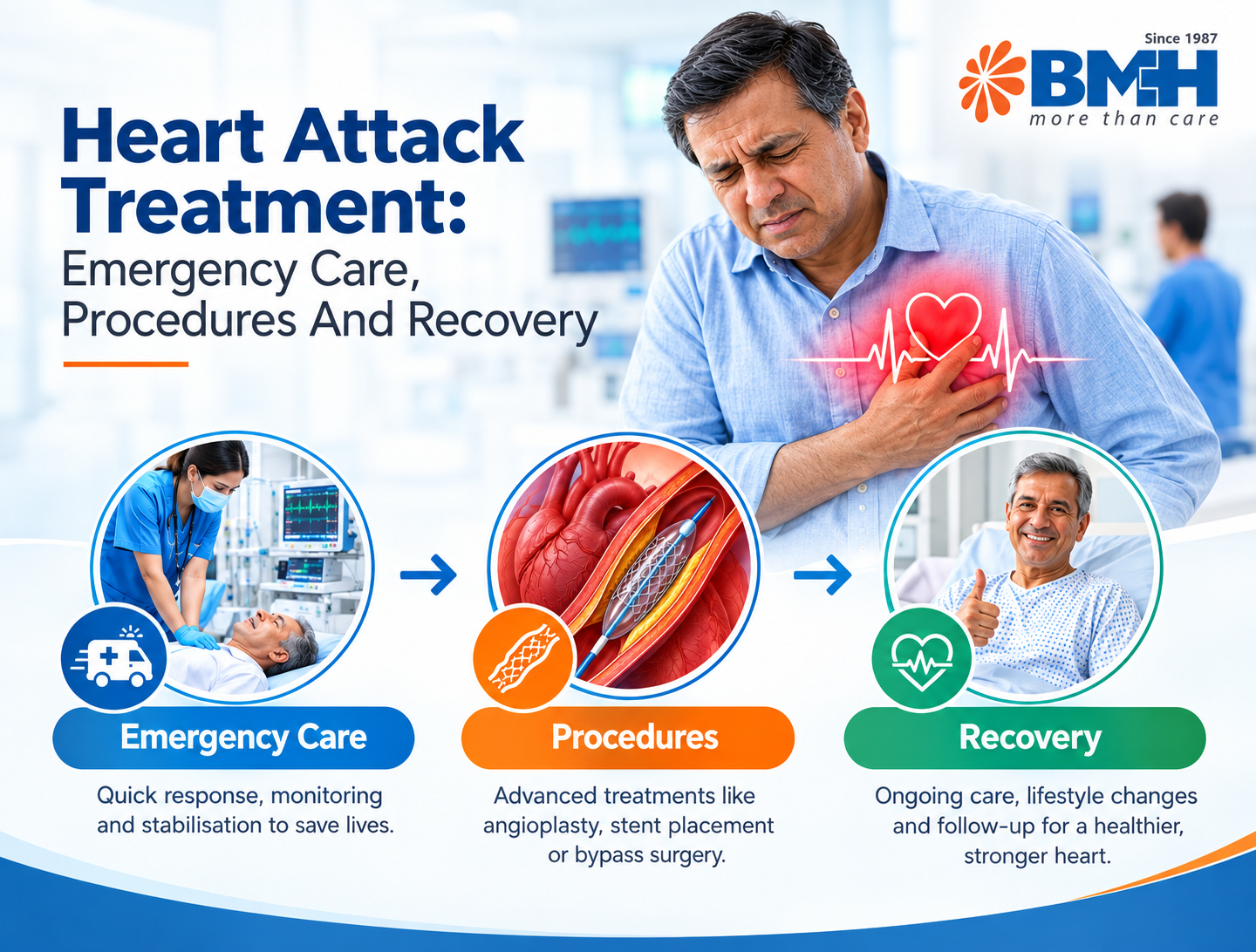
A heart attack, medically called a myocardial infarction, usually happens when blood flow through a coronary artery becomes suddenly blocked. The heart muscle beyond that blockage begins losing oxygen. The longer it stays that way, the greater the chance of permanent damage.
So, heart attack treatment starts with one immediate goal.
Get blood moving again. Fast.
If you think you may be having a heart attack, seek emergency medical care immediately.
Do not drive yourself if emergency transport is available. And don't wait for the pain to become unbearable before taking it seriously.
Some heart attacks are dramatic.
Some aren't.
A person may simply feel an unusual heaviness in the chest, become sweaty or suddenly find it difficult to breathe. Women may also experience unusual tiredness, nausea, upper-back pressure or other less obvious symptoms.
Aspirin may be advised in suspected heart attack because it reduces platelet clotting, but it is not suitable for everyone. Emergency guidance recommends calling for medical help first; aspirin may then be advised if there is no allergy, bleeding concern or other reason it should be avoided.
Don't take an aspirin and sit at home waiting for it to work.
The hospital is where you need to be.
Things move quickly.
An ECG is usually one of the first tests because it shows the heart's electrical activity and can reveal changes caused by reduced blood flow.
Blood is also taken to measure cardiac troponin. Troponin is released when heart muscle is injured, so its level can help confirm whether a heart attack has occurred.
Your blood pressure, oxygen level and heart rhythm are monitored at the same time.
These first findings help doctors answer an important question: what type of heart attack is this, and how urgently does the artery need to be opened?
That decision shapes the next stage of cardiac emergency care.
You may hear doctors use the terms STEMI and NSTEMI.
A STEMI generally involves an artery that is acutely blocked and produces characteristic ECG changes. Restoring blood flow quickly is critical.
An NSTEMI is also a heart attack, but the ECG pattern and degree of blockage may be different. It still needs hospital treatment and careful assessment, and many patients undergo coronary angiography and subsequent treatment based on what doctors find.
The names sound technical.
The principle isn't.
Find out what is blocking the blood supply and decide the safest way to restore it.
For many heart attacks, the quickest route to the problem is through an artery in the wrist.
A thin catheter is guided towards the heart and contrast dye is used to show the coronary arteries. Once doctors locate the blockage, a small balloon can be expanded to open the narrowed area.
Usually, a stent is placed there too.
Think of it as a tiny scaffold left inside the artery to help keep the newly opened channel open.
This treatment is called percutaneous coronary intervention, or PCI.
Current acute coronary syndrome guidance favours wrist, or radial, access over groin access for PCI because it reduces bleeding and vascular complications in suitable patients.
Sometimes immediate PCI is not available within the required time, particularly when a patient is far from a centre that can perform emergency angioplasty.
For certain STEMI patients, clot-dissolving medicines may then be considered if there are no reasons that make them unsafe.
These medicines are not appropriate for every heart attack.
And they are not simply an alternative someone chooses because they would rather avoid a procedure.
Timing, the type of heart attack, bleeding risk and access to PCI all matter. The emergency cardiac team makes that decision.
Angioplasty is not automatically the answer to every blocked artery.
An angiogram may show several difficult blockages, disease in important locations or anatomy that is better treated surgically.
Then coronary artery bypass grafting, or CABG, may enter the discussion.
During bypass surgery, healthy blood vessels from elsewhere in the body are used to create new routes around blocked coronary arteries.
The choice between PCI and bypass depends on the pattern and complexity of coronary disease, other health conditions and the patient's clinical situation.
This is where people sometimes misunderstand a successful angioplasty.
The pain is gone.
The stent is in.
Surely the problem is fixed?
The immediate blockage may be fixed. The tendency to develop coronary artery disease is still there.
Medicines therefore become a major part of myocardial infarction treatment after the emergency has passed.
People with acute coronary syndrome commonly receive antiplatelet medicines to reduce the chance of another clot forming. For patients without a high bleeding risk, current guidance generally recommends dual antiplatelet therapy—aspirin plus a P2Y12 inhibitor—for at least 12 months after an acute coronary syndrome, though the exact plan is individualised. High-intensity cholesterol-lowering treatment is also recommended.
Other medicines may be prescribed depending on blood pressure, heart function, rhythm and other conditions.
Take them exactly as advised.
Especially after a stent, stopping antiplatelet medication without speaking to your cardiologist can be dangerous.
The heart has just been through an injury.
So even after blood flow has been restored, doctors continue watching closely.
Heart rhythm is monitored because abnormal rhythms can occur after a heart attack. Blood pressure and symptoms are followed. An echocardiogram may be used to see how well the heart is pumping and whether any area of heart muscle has been weakened.
Some people feel surprisingly well by the next morning.
Others are exhausted.
Both can happen.
How quickly you recover depends on the size and location of the heart attack, how soon blood flow was restored, heart function and whether complications occurred.
Hospital discharge can feel strange.
For several days there were monitors, nurses and doctors everywhere.
Then suddenly you're home.
It is common to feel tired during the early days. Walking usually starts gently and increases over time according to the medical team's advice.
If angioplasty was performed through the wrist or groin, that area needs a little care too. Heavy lifting may be restricted for a short period.
Work?
Driving?
Exercise?
Sex?
There is no single calendar that fits everyone. A smaller uncomplicated heart attack treated quickly is very different from a large heart attack that has weakened the heart. Ask for specific advice before leaving hospital rather than guessing once you get home.
Rest has its place.
So does movement.
Cardiac rehabilitation brings supervised exercise, education, risk-factor management and psychological support together in one programme. Current guidelines recommend referral after acute coronary syndrome because cardiac rehabilitation supports recovery and reduces the chance of returning to hospital.
It also solves a problem many people face after a heart attack.
Fear.
Every faster heartbeat can suddenly feel suspicious. A flight of stairs becomes something to negotiate with.
Rehabilitation helps you learn what your recovering heart can safely do and gradually rebuild confidence.
A heart attack tells you something important about your arteries.
Listen to it.
Blood pressure needs attention. So does cholesterol. Diabetes needs good control if you have it. Smoking needs to stop, not merely reduce.
Food and physical activity matter too, but this is not about creating a perfect life overnight.
Start with what carries the greatest risk.
Keep taking the medicines.
Attend follow-ups.
Move as advised.
Then build from there.
A cardiologist Kozhikode can review heart function, medications and risk factors during follow-up and adjust the recovery plan as your strength returns.
New chest pressure after a heart attack should not be casually dismissed as "probably gas."
Neither should sudden breathlessness.
Seek urgent medical attention if chest pain returns, particularly if it resembles the original heart attack symptoms. Fainting, severe breathlessness, sudden weakness, or a very fast or irregular heartbeat with feeling unwell also need prompt assessment.
You have already had one warning from your heart.
Don't negotiate with the second.
Which artery caused my heart attack?
How much heart muscle was affected?
Was my heart's pumping strength reduced?
How long do I need each of my medicines?
What happens if I accidentally miss an antiplatelet dose?
When can I start walking longer distances?
When can I drive and return to work?
How do I enrol in cardiac rehabilitation?
A heart attack has two timelines.
The first is measured in minutes.
Recognise the symptoms. Reach emergency care. Identify the blocked artery. Restore blood flow.
The second is measured in months and years.
Take the medicines. Rebuild strength. Control cholesterol, blood pressure and diabetes. Stop smoking. Attend cardiac rehabilitation and keep your follow-up appointments.
Both matter.
Because good heart attack treatment is not only about surviving the emergency.
It is about protecting the heart that comes home with you.
Seek emergency medical help immediately. Do not wait to see whether the pain settles, and do not delay emergency care while trying home remedies.
No. Treatment depends on the type of heart attack, the coronary anatomy and the patient's condition. Some people need PCI and a stent, some may require bypass surgery, and treatment in other cases may involve medicines.
As quickly as medically possible when emergency reperfusion is indicated. Heart muscle remains at risk while its blood supply is blocked, which is why suspected heart attack requires immediate hospital assessment.
There is no fixed duration. An uncomplicated heart attack treated promptly may require a relatively short stay, while a larger heart attack, bypass surgery or complications can keep someone in hospital considerably longer.
Usually, yes, but activity should return gradually according to your medical team's advice. Cardiac rehabilitation provides a supervised way to rebuild fitness and confidence after a heart attack.
Antiplatelet medicines reduce the chance of a clot forming inside the stent and lower the risk of another cardiovascular event. Do not stop them without speaking to your cardiologist.
Yes. Angioplasty or other emergency treatment deals with the immediate problem, but coronary artery disease can continue. Medicines, cardiac rehabilitation and management of smoking, cholesterol, blood pressure, diabetes and other risk factors help reduce future risk.