- English
- عربي / Arabic
- മലയാളം / Malayalam

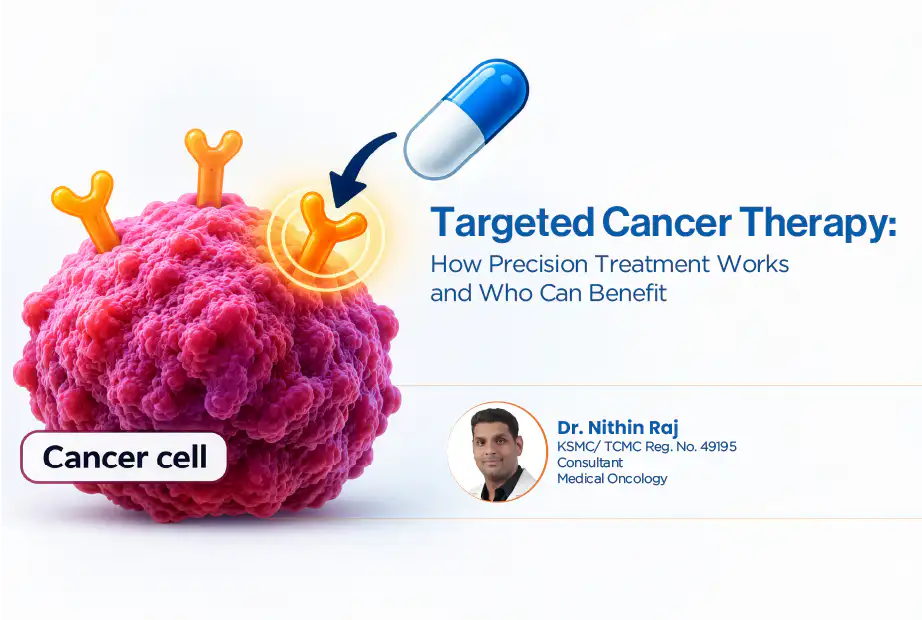
Targeted cancer therapy uses medicines directed at particular features that help cancer cells grow or survive. These features may include an altered gene or a protein found in higher amounts on the cells. The treatment is chosen according to the cancer's biology as well as its type and stage. It can be helpful for selected patients, but it is not suitable for every cancer and does not guarantee a response.
The process usually begins with understanding the diagnosis and deciding whether testing can identify a useful treatment target.
Why two people may receive different treatments
Cancers that begin in the same organ can have different biological features. A treatment that helps one person with lung cancer, for example, may not be appropriate for another person whose tumour does not have the relevant change.
Precision oncology uses information from the tumour, along with the patient's health and treatment history, to guide decisions. This may help avoid a medicine that is unlikely to work. It can also identify a treatment option that would not be obvious from the organ name alone.
The results still need clinical interpretation. Finding a change does not necessarily mean that an effective, approved, and accessible medicine is available for it.
Some medicines block signals that tell cells to grow. Others act on blood vessel formation or attach to proteins on the surface of cancer cells. Certain treatments deliver a cancer-killing medicine through an antibody that recognises a particular target.
Small-molecule medicines can act inside cells, while monoclonal antibodies commonly bind to specific targets on or around them. These descriptions explain broad groups; the expected benefit and side effects depend on the individual drug.
Targeted therapy for cancer is different from choosing a medicine because it is newer. The important question is whether there is evidence that it helps in your precise diagnosis and treatment setting.
A biomarker is a measurable feature that can help guide care. Testing may examine a tissue sample from a biopsy or operation. In some circumstances, a blood-based test can look for tumour-related material circulating in the bloodstream.
The oncologist decides whether to test for a small number of markers or use a broader panel. The choice depends on the cancer type, stage, previous treatment, and what decisions the result could change. A broader test is not automatically necessary for everyone.
Ask whether an existing sample is sufficient, how long the result may take, and whether treatment should start while you wait. An inadequate sample may require another biopsy, with a separate discussion of benefits and risks.
Testing may identify a target with an established treatment option. It may identify a change for which the significance is uncertain, or find no useful target. A negative blood-based test does not always exclude a relevant tumour change; tissue testing may still be considered when appropriate.
Tumour testing is also different from testing for an inherited cancer risk. Some findings raise the possibility of an inherited change, but confirmation requires the appropriate assessment and sometimes genetic counselling. Do not assume that a tumour result means your children have inherited the same risk.
Request an explanation in plain language and keep the report. It may be useful if treatment changes later or you seek another opinion.
Targeted cancer treatment has a role in selected breast, lung, bowel, blood, skin, and other cancers. Examples include treatment directed at HER2 in certain breast cancers or specific gene changes in some lung cancers. Eligibility depends on the exact diagnosis and current evidence.
It may be used after surgery to reduce recurrence risk, as part of treatment before surgery, or to control advanced disease. The goal differs between these settings. It can be given alone or alongside other treatments.
Ask whether the intended aim is cure, reducing the chance of recurrence, slowing disease, or relieving symptoms. Knowing the aim helps you understand how benefit will be measured.
Some cancer targeted therapy drugs are tablets or capsules taken at home. Others are given through a vein during hospital visits. Schedules vary, and treatment can continue for a fixed period or while it remains helpful and tolerable.
Oral treatment still needs close supervision. Follow instructions about food, storage, missed doses, and handling. Do not crush tablets or double a dose unless the team specifically advises it. Tell the oncology pharmacist about other prescriptions, herbal products, and supplements because interactions can affect safety or effectiveness.
A written schedule helps when several medicines have different timings. Ask whom to contact if vomiting, diarrhoea, or another problem makes it difficult to take treatment.
When the right target is present, a medicine may control cancer, shrink it, delay progression, or improve outcomes in a defined setting. Some patients experience substantial benefit, while others have little response. The expected effect should be discussed using evidence relevant to your cancer.
Resistance can develop. Cancer cells may change or use other ways to keep growing, so a treatment that worked earlier may stop controlling the disease. A new biopsy or further testing may help guide the next decision, but it is not always needed or possible.
Targeted treatment can also be expensive. Ask about testing, medicine, monitoring, and travel costs, together with insurance or assistance arrangements that may apply.
Targeted does not mean free of side effects. Depending on the drug, problems may include rash, diarrhoea, fatigue, high blood pressure, liver changes, or effects on the heart. Some medicines affect wound healing or increase bleeding risk.
The team should explain the risks of your specific treatment and what monitoring is planned. Early reporting often helps manage a problem before it becomes more severe. Do not hide symptoms because you worry that the medicine will be stopped permanently.
Seek urgent advice for fever according to your treatment instructions, severe diarrhoea, inability to drink, unusual bleeding, or a rapidly worsening rash. Chest pain, severe breathing difficulty, or facial swelling requires emergency assessment.
Follow-up may involve symptom review, examination, blood tests, and scans at planned intervals. Some medicines require heart checks or blood pressure monitoring. Feeling better is valuable, but it is not the only measure of response.
Ask when the first assessment will occur and what would lead to continuing, adjusting, or changing treatment. Supportive care for pain, nutrition, and emotional strain remains important throughout. It can be offered alongside treatment intended to control the cancer.
At Baby Memorial Hospital, targeted cancer therapy is planned around the individual cancer rather than the diagnosis alone. The medical oncology team reviews the biopsy, stage of disease, previous treatment and relevant biomarker or molecular test results to understand whether a targeted medicine has a role in the treatment plan.
When targeted therapy is appropriate, care includes treatment planning, administration of intravenous or oral medicines as required, regular blood tests and monitoring for treatment response and side effects. Medical oncology also works alongside surgical oncology, radiation oncology, pathology, imaging and other specialties when the treatment plan requires combined care.
The aim is to make precision treatment genuinely personal: identifying the right target, understanding what the medicine can realistically achieve, and supporting the patient throughout treatment and follow-up.
1. What is targeted cancer therapy?
Targeted therapy uses medicines designed to act on specific genes, proteins or other biological features that help certain cancers grow. It is used only when the cancer and treatment setting are suitable for the particular medicine.
2. How do doctors know whether I can receive targeted therapy?
Biomarker or molecular testing may be performed on tumour tissue and, in selected situations, a blood sample. The oncologist interprets the results together with the cancer type, stage and previous treatment before recommending therapy.
3. Is targeted therapy the same as chemotherapy?
No. Chemotherapy generally acts on rapidly dividing cells, while targeted medicines act on particular features or pathways associated with a cancer. Some patients may receive both as part of the same treatment plan.
4. Does targeted cancer treatment have side effects?
Yes. Side effects depend on the medicine and can include rash, diarrhoea, fatigue, high blood pressure and changes affecting the liver or heart. Regular monitoring helps identify and manage these problems early.
5. Can targeted therapy cure cancer?
That depends on the cancer and the treatment setting. Targeted therapy may be used to reduce recurrence risk in some cancers or to shrink, control or slow advanced disease in others. Your oncologist should explain the specific goal before treatment begins.