- English
- عربي / Arabic
- മലയാളം / Malayalam

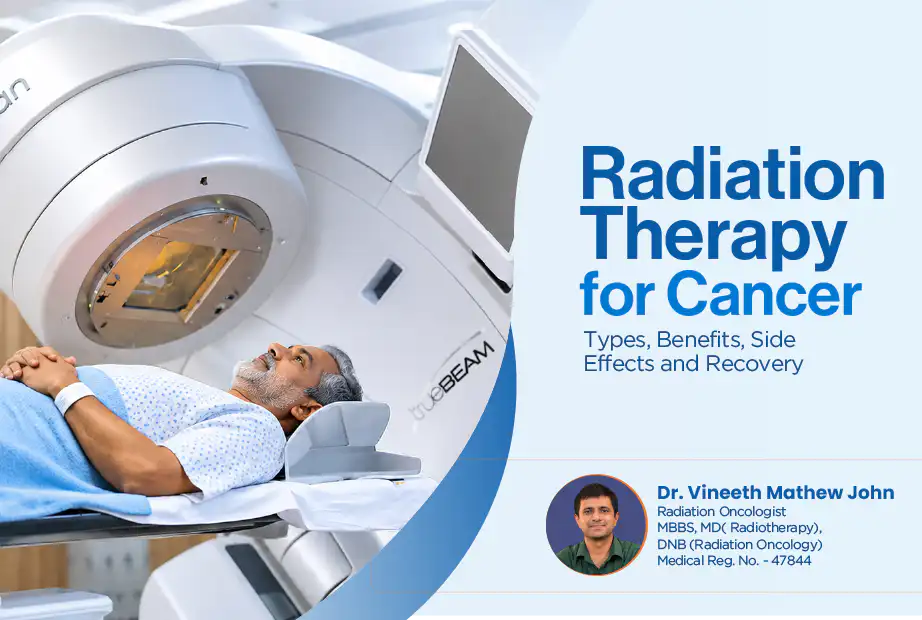
Radiation therapy for cancer uses carefully planned doses of radiation to damage cancer cells and limit their ability to grow. It can be used to treat cancer with curative intent by lowering the risk of recurrence, or with a palliative intent to relieve symptoms such as pain. The area treated, dose, and number of sessions depend on the diagnosis and the purpose of treatment. Your radiation oncology team plans the course to treat the diseased area, while limiting exposure to nearby healthy tissues.
Radiotherapy may be the main treatment (definitive therapy), given alongside medicines concurrent radiotherapy), or used before or after surgery (Neoadjuvant or adjuvant radiotherapy). After surgery, radiotherapy can treat an area where microscopic cancer cells may remain. In another setting, it may shrink a tumour or help control bleeding or pain.
The recommendation to use radiation as a treatment modality depends on the cancer type, location, stage, and previous treatment. Your overall health and the sensitivity of nearby organs also matter. Treatment aimed at symptom relief can also be valuable even when curing the cancer is not possible.
While discussing radiation as a form of treatment, ask what the treatment is intended to achieve and how success will be assessed. That helps you understand why the proposed course may be short or extended over several weeks.
External beam radiation therapy refers to a treatment form where radiation originates from a machine placed at a distance from the patient’s body, that directs radiation towards a planned area of the body. It is a form of a treatment where radiation is delivered to a specific part of the body and does not involve radiating the entire body. Techniques can shape and adjust the dose to fit the target and protect surrounding structures.
Read Also: Modern Medical Oncology: Personalized Chemotherapy and Immunotherapy
You may hear terms such as intensity-modulated radiotherapy (IMRT), image-guided treatment (IGRT), or stereotactic radiotherapy (SRT). These describe different ways to plan or deliver treatment. A technique is selected for its suitability, rather than because a more technical name guarantees a better result.
Radiation may be administered over several days; with treatment on each day (session) lasting for few minutes. Treatment is delivered from Monday to Friday generally, with exceptional cases being treated on Saturday too.
During a session, you lie in the planned position while the machine moves around you. You cannot feel the radiation beam itself, although holding a position may be uncomfortable for some people.
Brachytherapy places a radiation source inside or close to the treatment area. It is used for selected cancers and may involve the insertion of instruments named applicators into certain areas of the body during a procedure. Some sources are temporary; others are placed permanently in specific treatment settings.
Certain cancers can also be treated with radioactive medicines given by mouth or injection. These are different from external beam treatment and have their own guidelines about preparation, monitoring, and safety.
Feel free to ask your doctor as to what form of treatment is being proposed. The word radiation covers treatments with very different practical arrangements, including whether admission is needed and whether temporary precautions apply to people around you.
The planning appointment
Before external beam treatment, the team commonly performs a planning scan. You may need a mask, mould, or other support to help you remain in the same position each time. Small skin marks or tattoos may be used to align your body with the treatment machine.
After the planning CT scan is completed, your Radiation Oncologist will mark the site that requires treatment on your body while also marking those normal tissues around which need to be protected from radiation. This process is called contouring. Following this, Physicists determine beam alignment and technique to ensure that the diseased site receives the dose planned while ensuring that the normal tissue around it receive very little radiation.
Read Also: Radioiodine Therapy (I-131) for Thyroid Cancer | Benefits, Procedure & Safety Guide
Preparation can include instructions about voiding urine, bowel emptying, eating, or drinking, depending on the body area to be treated. Following them consistently ensures that the plan created by the Radiation Oncologist and Physicist is delivered to the diseased area at each treatment session. Tell the staff at the treatment machine if pain or anxiety makes the required position difficult.
There may be a gap between planning and the first treatment while the dose is calculated and checked. Ask about the expected schedule and what to do if symptoms change during that period.
Staff confirm your identity and position you carefully. They may use the treatment machine as a scanning device and take images to check alignment of your body with the treatment machine before delivering the dose. The treatment team usually leaves the treatment room during the beam delivery but watches and communicates with you throughout the procedure by making use of cameras and speakers installed in the room where the machine is placed. If you are uncomfortable or need some help, you may talk to the treating team by simply talking. A powerful microphone placed in the room will capture your voice and relay it to the treating team monitoring you outside the treatment room.
Although the radiation treatment itself may take only a few minutes; positioning and checks make the appointment longer. Treatment schedules vary widely. Some courses involve daily weekday sessions, while selected treatments use fewer visits.
External beam cancer radiation treatment does not make you radioactive. You can generally be around family members immediately after the treatment. Internal sources or radioactive medicines may require temporary precautions., Your treating team will counsel you regarding the ‘dos & don’ts’.
Radiotherapy can provide local cancer control, reduce recurrence risk in selected situations, or relieve symptoms. Its benefit depends on the type and location of cancer and intent of treatment It may work along with surgery or systemic medicines rather than by replacing them.
Radiation also affects some healthy cells within the treated area. Planning reduces unnecessary exposure but cannot remove every risk. Previous radiation to the same region can affect what is safe later, so it is important that you bring with you, details of treatment that you have undergone previously.
Discuss with your doctor, the expected benefits alongside possible short-term and late side-effects. The most useful explanation relates to your treated area and dose, not a general list of everything radiotherapy could cause.
Fatigue is common, although its severity varies. Skin in the treatment area may become sore, dry, itchy, or darker. Hair loss, when it occurs, usually affects the area exposed rather than all the hair on the body.
Treatment near the mouth or throat can cause soreness and difficulty swallowing. Abdominal or pelvic treatment may cause bowel or bladder symptoms like the need to urinate repeatedly or mild loose motions. Radiation to other areas of the body has different potential effects. Some symptoms build during the course of treatment and continue for a time after it finishes.
Radiation treatment side effects are not proof that the treatment is working or failing. Tell the team what you notice so they can offer suitable support.
Use skin products recommended by the team treating you and avoid rubbing or irritating the treatment area. Ask about washing, clothing, sun exposure, and any dressings. Do not apply unfamiliar creams immediately before treatment without checking with your treating team.
Try to maintain food and fluid intake. If swallowing, nausea, or bowel symptoms make this difficult, request early dietary support. Gentle activity can help some people manage fatigue, balanced with rest and the team's advice.
Report pain rather than simply enduring it. Before starting, ask about fertility, sexual health, and pregnancy precautions if they are relevant. Some effects need discussion before treatment begins because options with regard to preservation of fertility or pregnancy may be time-sensitive.
Call promptly for difficulty swallowing fluids, persistent vomiting, severe diarrhoea, dehydration, or pain that is not controlled. Follow the team's instructions for fever, particularly if you are also receiving chemotherapy or another medicine that affects immunity.
New onset of severe breathlessness, chest pain, major bleeding, seizures, or confusion requires urgent assessment. Do not assume a new symptom is an expected radiation effect. Keep the service's contact instructions available to you and the person helping at home.
If you miss a treatment session, contact the department. The team can explain how to adjust the schedule safely.
Recovery is gradual. Some side effects improve over the weeks after treatment, while others take longer. Certain late effects can appear months or years later, depending on the treated tissues. Follow-up therefore continues beyond the last session of radiation treatment.
Ask when the first response assessment is planned. Scans performed too soon can be difficult to interpret because tissues are still reacting. Keep a record of the treatment site and course for future medical care.
At Baby Memorial Hospital, radiation therapy is planned as part of coordinated cancer care, with the radiation oncology team working alongside medical oncology, surgical specialists and other supporting departments when required. Treatment planning considers the cancer type, location, stage and nearby healthy tissues so that the radiation dose can be delivered as precisely and safely, as possible.
Care continues throughout the treatment course, not only during radiation sessions. The team monitors side effects, nutrition, pain and other treatment-related concerns and adjusts supportive care when needed. After the course is completed, follow-up is planned to assess recovery, treatment response and any effects that may need longer-term monitoring.