- English
- عربي / Arabic
- മലയാളം / Malayalam

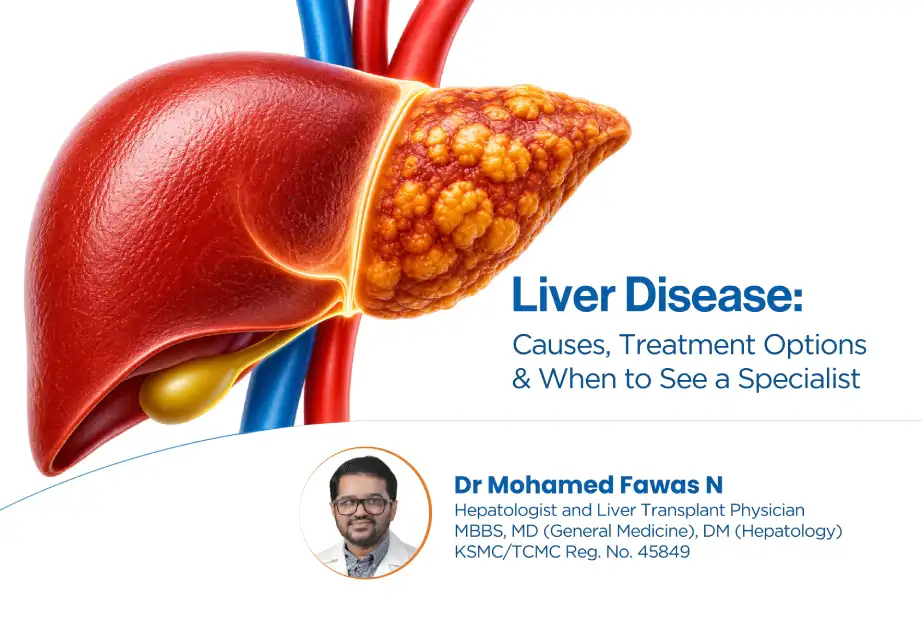
The liver is one of the hardest-working organs in the body. It processes food, stores energy, clears medicines and toxins, and makes the proteins that help blood clot. It is also remarkably resilient, and it has a strong ability to heal when the cause of the problem is removed.
Most liver problems develop slowly. This is actually good news: it means there is usually plenty of time to find the cause and treat it. Many liver conditions can be controlled well, and some can be reversed completely.
The most important message we want to share as liver specialists is simple: there is no single “liver medicine” for every liver problem. Treatment depends on two questions – what is affecting the liver, and whether any scarring has developed.
Signs that your liver may need attention
Liver problems can sometimes cause:
These symptoms are common and very often have other, simpler causes. A doctor can examine you and decide whether any tests are needed.
Sometimes a liver finding shows up by chance on a blood test or ultrasound done for another reason. “Fatty liver” on an ultrasound report is a very common example. Please don’t panic if this happens. Most mildly abnormal liver results turn out to be minor or easily managed; a smaller number need further checks.
Our advice: if a liver test stays abnormal when repeated, or if you notice yellowing of the eyes, see your doctor. Bring your old reports too. How the results change over time often tells us more than a single report.
Most healthy people do not need routine liver tests or scans. We recommend a liver check mainly for people with a higher chance of liver disease, such as those who:
For most of these people, the first step is simple: routine blood tests, and sometimes a score calculated from those results (called FIB-4) that tells us whether any scarring is likely. In many cases, this is enough to reassure the person that the liver is fine. Further tests are only needed if these first results suggest a problem.
Symptoms that need prompt medical attention
A few symptoms should be seen by a doctor the same day rather than waiting for a routine appointment:
vomiting blood, or passing black, tar-like stools
These are uncommon, but they are easier to treat when care starts early. Take the patient’s medicine list and any liver reports along.
If someone has taken too much paracetamol, or swallowed something that may be harmful, seek medical advice straight away, even if they feel fine. Effective treatment is available and works best when given early.
What causes liver disease?
Fatty liver disease
This is the most common liver condition we see. Its medical name is metabolic dysfunction-associated steatotic liver disease (MASLD). It is linked with excess weight (especially around the waist), type 2 diabetes, high cholesterol and high blood pressure. For most people it stays mild and improves with lifestyle changes. Only a smaller group go on to develop inflammation and scarring, and this is why people with risk factors benefit from a check.
Viral hepatitis
Hepatitis B and hepatitis C are infections that can affect the liver over many years. They spread mainly through blood, and hepatitis B can also pass from mother to baby and through sexual contact. Hepatitis A and E usually cause a short-term illness that most people recover from fully; they spread through contaminated food or water.
Alcohol
Alcohol can affect the liver, and the amount that causes harm differs from person to person. People who already have fatty liver or hepatitis can be affected by smaller amounts.
Medicines, supplements and herbal products
Occasionally, prescribed medicines, painkillers, body-building supplements or herbal and traditional remedies can affect the liver. In our experience, products sold as “natural” or “liver cleansing” are an often overlooked cause. Natural does not always mean safe.
Other causes
These include autoimmune hepatitis (where the body’s own immune system affects the liver), diseases of the bile ducts, and some inherited conditions. These are less common.
When you see your doctor, mention everything you take: prescribed medicines, over-the-counter tablets, herbal, Ayurvedic or other traditional preparations, supplements and alcohol. A complete list is one of the most useful things you can give us.
How we check the liver
Tests are chosen to suit each person – not everyone needs all of them.
Blood tests. “Liver function tests” measure liver enzymes, bilirubin (the substance that causes jaundice) and albumin (a protein made by the liver). Depending on your history, we may also test for hepatitis viruses or other conditions.
Ultrasound. This simple, painless scan can show fat in the liver and changes in its shape or surface.
FibroScan (elastography). This painless test, done much like an ultrasound, measures how stiff the liver is, which helps us estimate scarring. It is used when blood tests suggest scarring might be present, and it means most people never need a biopsy.
Other scans and biopsy. A small number of people need a CT or MRI scan, or a liver biopsy (a tiny sample of liver tissue).
One thing we often explain in clinic: liver enzyme numbers alone do not tell the whole story. A doctor looks at the overall pattern, together with your history and other test results. A useful habit is to ask your doctor two questions – what is the cause, and is there any scarring?
Treating fatty liver
For most people, fatty liver is treated through lifestyle changes – and these work well. In people who are overweight, losing about 5% of body weight can reduce liver fat, and losing around 7–10% can also reduce inflammation and, in some people, scarring.
What helps:
steady, gradual weight loss if you are overweight – crash diets are hard to keep up and are no substitute for a sensible, supervised plan
regular physical activity – brisk walking on most days is a good start
cutting down on sugary drinks, sweets, fried snacks and large portions of refined foods such as white rice and maida-based items, while still eating enough protein, vegetables and fibre
good control of diabetes, blood pressure and cholesterol
avoiding or limiting alcohol
A dietitian can help you adapt your usual meals rather than give up familiar food. Slim people can also have fatty liver, so body weight alone does not tell the whole story.
Newer medicines are now available for some patients with more advanced fatty liver disease, depending on local approvals and medical criteria. This is a specialist decision. There is no need to start a medicine – or a “liver tonic” – simply because an ultrasound report mentions fatty liver.
Hepatitis C can now be cured in most people with a short course of tablets, usually taken for 8–12 weeks. If scarring was present before treatment, regular check-ups continue after the cure.
Hepatitis B usually cannot be cleared completely, but it can be well controlled, and most people with it live normal lives. Not everyone needs medicine; many people only need regular monitoring. When treatment is needed, it is usually a once-daily tablet that keeps the virus under control. Please don’t stop hepatitis B medicine without your doctor’s advice, as stopping suddenly can cause a flare-up of the infection.
Autoimmune liver disease is treated with medicines that calm the immune system, and usually responds well. Bile duct diseases have their own specific treatments.
Medicine-related liver problems. If a medicine is suspected, the doctor who prescribed it will decide how to stop or replace it safely. Please don’t stop prescribed medicines on your own. In most cases, the liver recovers once the cause is removed.
This is why liver treatment is chosen after finding the cause, not from symptoms alone. Two people with jaundice may need quite different care.
Vaccination and protecting your family
Vaccines can prevent hepatitis A and hepatitis B. People who already have liver disease are often advised to have them. Ask your doctor which vaccines are right for you; others, such as flu and pneumonia vaccines, may also be suggested.
If you are diagnosed with hepatitis B or C, ask whether your close family members need testing or vaccination. There is no vaccine for hepatitis C. The right advice depends on the type of virus, so your medical team will guide you.
Alcohol: why stopping helps, and how to stop safely
If alcohol is contributing to a liver problem, stopping is one of the most effective treatments available, and the liver often improves noticeably. For people with cirrhosis or other long-term liver disease, we generally advise avoiding alcohol altogether.
If you drink heavily or every day, please talk to a doctor before you stop, so that it can be done safely and comfortably. Stopping suddenly can cause withdrawal symptoms, which are best managed with medical help.
Support works better than willpower alone. Counselling, medicines that reduce craving, and family support (with your consent) all help. Setbacks are common – share them honestly so we can adjust the plan. Our aim is to help you get healthier, not to judge you.
Living with cirrhosis
Cirrhosis means there is significant scarring in the liver, which changes how it works. Many people with cirrhosis feel well and lead active lives for many years, especially when the cause is controlled. When the cause is treated – for example, when hepatitis C is cured or alcohol is stopped – the liver can improve. Advanced scarring may not disappear completely, but treatment can prevent it getting worse.
Some people with cirrhosis develop complications. These can be managed:
Fluid in the tummy or legs (ascites and oedema): managed with a low-salt diet, water tablets (diuretics) and sometimes drainage of the fluid.
Swollen veins in the food pipe (varices): we check for these with an endoscopy when needed and can treat them with medicines or small bands to prevent bleeding.
Confusion (hepatic encephalopathy): this happens when the liver cannot clear certain toxins well. It is treated with medicines and by correcting triggers such as infection, constipation or dehydration.
Liver cancer screening is not needed for the general public. It is recommended only for people at higher risk – mainly those with cirrhosis and some people with long-term hepatitis B. For them, an ultrasound, often with a blood test, every six months helps pick up any change early, when treatment works best.
When is a liver transplant considered?
Only a small number of people with liver disease ever need a transplant. It may be discussed when the liver is no longer working well enough, when complications keep coming back despite treatment, or for some liver cancers. Being referred for a transplant means being assessed – it does not mean an operation is automatically planned.
The transplant team looks at your overall health, how much you are likely to benefit, donor options (a deceased donor, or a living donor who is often a family member), and your ability to manage long-term follow-up. A transplant is major surgery and needs daily medicines for life to prevent rejection. Today, a transplant gives many patients a good quality of life for many years.
From our experience, it helps to have this conversation early, while the patient is still relatively well. It gives families time to understand the process, consider donor options and plan support without feeling rushed.
Making the most of a visit to a liver specialist
See a liver specialist (hepatologist) if the cause of a liver problem is unclear, tests stay abnormal, scarring is suspected, you have hepatitis B or C, or you have been diagnosed with cirrhosis.
For a consultation at BMH, please bring:
During the visit, ask for:
Between visits, check with your doctor before taking painkillers, supplements or any new medicine, and please don’t stop prescribed treatment on your own.
For most people, the next step is clear and manageable: treating the cause, checking for scarring, or managing a specific problem. Knowing which applies to you makes follow-up easier to understand and gives you and your family confidence about what to do.
Frequently asked questions
1. Do I need a liver check-up if I feel well?
Not usually. Routine liver tests are recommended mainly for people with higher risk, such as those with diabetes, excess weight with other metabolic risks, regular alcohol use, a family member with hepatitis B, or a family history of liver disease. Your doctor can advise if this applies to you.
2. Can fatty liver disease be reversed?
Often, yes. Fat in the liver can reduce with gradual weight loss, regular exercise, and good control of diabetes, cholesterol and blood pressure. If scarring has developed, it may not reverse fully, which is why people with risk factors should also have it assessed.
3. When should I see a liver specialist?
If your liver tests stay abnormal, you develop jaundice, tests suggest scarring, you are diagnosed with hepatitis B or C, or you have long-term liver disease. Tummy swelling, confusion or bleeding should be seen by a doctor promptly.
4. What tests are used to diagnose liver disease?
Usually liver blood tests to begin with, and tests for hepatitis viruses if needed. An ultrasound or FibroScan may be added depending on the results. Other scans or a liver biopsy are needed only occasionally.
5. Is cirrhosis always permanent?
Cirrhosis is significant scarring of the liver. Treating the cause can stop it getting worse and often improves how the liver works, though advanced scarring may not disappear completely. Many people with well-managed cirrhosis live active lives with regular follow-up.
6. When does liver disease need a transplant?
Only in a small number of cases – when the liver is no longer working well enough, complications keep returning despite treatment, or for some liver cancers. A transplant team decides after a detailed assessment, not on the basis of one blood test or symptom.
7. Do liver tonics or detox products help?
There is no good evidence that over-the-counter liver tonics, detox products or “liver cleanses” treat liver disease, and some can harm the liver. Please check with your doctor before taking any of them.