- English
- عربي / Arabic
- മലയാളം / Malayalam

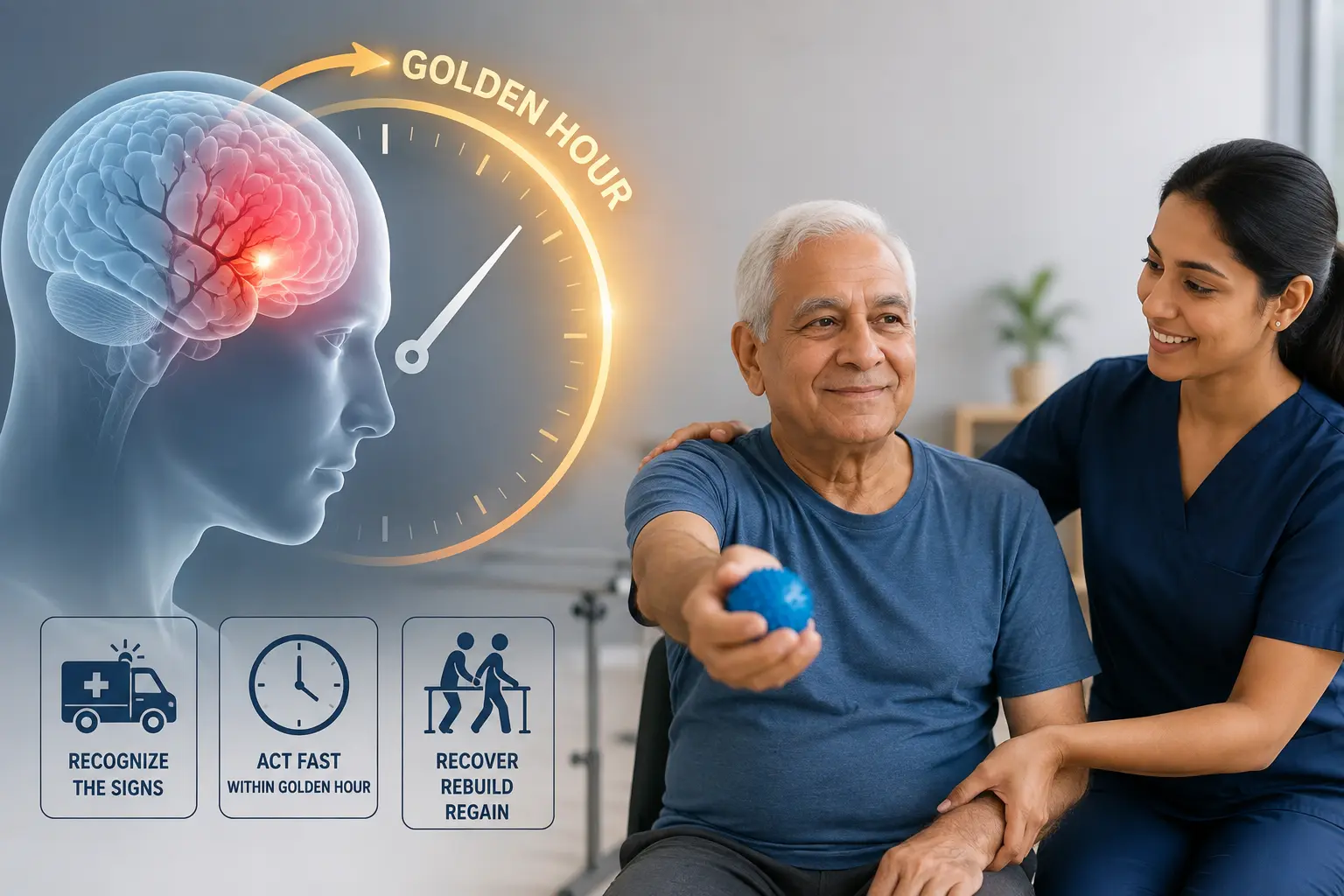
A stroke rarely gives a family time to prepare.
A person may be speaking normally and, moments later, struggle to form a sentence. A cup may suddenly fall from one hand. One side of the face may begin to droop. Sometimes the person remains conscious and insists that nothing serious has happened.
But inside the brain, blood flow may have stopped or a blood vessel may have ruptured.
What happens next matters enormously. The first hour after symptoms begin is often called the golden hour because assessment and treatment started during this period can save threatened brain tissue. However, the term does not mean that treatment becomes useless after exactly 60 minutes. Different stroke treatments have different time windows, and selected patients may still benefit several hours later. The central rule of stroke management remains the same: reach a stroke-ready hospital immediately.
The earliest part of golden-hour treatment begins before the patient reaches the hospital.
Stroke symptoms usually appear suddenly. They may include facial drooping, weakness or numbness on one side, difficulty speaking, loss of vision, poor balance, confusion or an intense headache with no obvious cause.
The BE FAST method can help families recognise these signs:
The exact time at which the patient was last known to be normal should be noted. Doctors use this “last known well” time to decide whether certain emergency treatments can be given safely.
The golden hour is not one injection or one procedure. It is a rapid sequence of decisions.
The medical team must first stabilise the patient, confirm that the symptoms are caused by a stroke, identify the type of stroke and determine which treatment can be started safely.
As soon as the patient arrives, the stroke team checks breathing, oxygen levels, blood pressure, pulse, blood glucose and level of consciousness. Low blood sugar can sometimes produce symptoms that resemble a stroke, so glucose testing forms part of the early evaluation.
Doctors also perform a focused neurological examination. They assess speech, facial movement, arm and leg strength, vision, sensation and coordination. A structured tool such as the National Institutes of Health Stroke Scale may be used to measure the severity of the neurological deficit.
At the same time, the team asks when the symptoms started, which medicines the patient takes, whether blood thinners are being used and whether there has been recent surgery, bleeding or head injury.
These steps happen quickly because they determine whether emergency cerebrovascular accident treatment can proceed safely.
The team cannot decide on treatment from symptoms alone.
An ischaemic stroke occurs when a clot blocks an artery supplying the brain. A haemorrhagic stroke occurs when a blood vessel ruptures and bleeds into or around the brain. The symptoms may look similar, but the treatments are fundamentally different.
An urgent CT scan or MRI brain is commonly used to detect ischemic or hemorrhagic stroke changes in the brain. CT angiography may then be performed to look for a blockage in one of the brain’s major arteries.
This imaging stage is central to golden-hour stroke management. A clot-dissolving medicine cannot be given until bleeding has been ruled out.
Most strokes are ischaemic. In these cases, the immediate goal is to restore blood flow before more brain tissue becomes permanently damaged.
Eligible patients may receive an intravenous clot-dissolving medicine such as alteplase or tenecteplase. The medicine travels through the bloodstream and helps dissolve the clot obstructing blood flow to the brain.
For many patients, intravenous thrombolysis is considered within 4.5 hours of the time they were last known to be well. Current guidance also allows selected patients with an unknown onset time or presentation between 4.5 and 9 hours to be considered when advanced imaging shows that salvageable brain tissue may remain.
The patient must first be checked for conditions that could raise the risk of serious bleeding. The team reviews brain imaging, blood pressure, current medication, recent operations and previous bleeding history.
The hospital aims to complete this process without avoidable delay. The traditional door-to-needle benchmark is to begin intravenous thrombolysis within 60 minutes of hospital arrival, although stroke centres increasingly work toward even faster treatment.
This is an important distinction: the golden hour refers to rapid action, while the overall eligibility window for thrombolysis may extend beyond one hour.
A clot-dissolving medicine may not be enough when a large artery in the brain is blocked.
In selected patients, doctors perform mechanical thrombectomy. A specialist passes a thin catheter through an artery, usually from the groin or wrist, guides it toward the blocked brain vessel and uses a device to remove the clot. Blood flow may then return immediately.
Thrombectomy should be performed as quickly as possible. Some patients can benefit within six hours, while carefully selected patients with suitable brain imaging may benefit up to 24 hours after they were last known to be well. This longer window should never be interpreted as permission to wait. Earlier restoration of blood flow generally offers a better chance of preserving brain function.
Some patients receive thrombolysis followed by thrombectomy. Others may undergo thrombectomy without thrombolysis when clot-dissolving medicine is unsuitable.
The same treatment cannot be used for a haemorrhagic stroke.
Here, the priority is to limit further bleeding, control pressure inside the skull and protect the remaining brain tissue. Doctors may carefully lower very high blood pressure, reverse the effects of blood-thinning medicines and manage breathing, seizures or raised pressure within the brain.
Neurosurgical or endovascular treatment may be required when there is a ruptured aneurysm, a vascular abnormality, significant pressure on the brain or bleeding that can be treated surgically.
This is precisely why families should not give aspirin at home. A medicine that may later help prevent clot-related strokes can worsen active bleeding in the brain.
Once the immediate danger has been addressed, stroke management moves into another phase.
The patient is usually admitted to a stroke unit for close monitoring. The team watches for changes in neurological function, swelling in the brain, difficulty swallowing, abnormal heart rhythms, infections and blood clots in the legs.
A swallowing assessment is particularly important before food, water or oral medicines are given. Stroke can weaken the muscles involved in swallowing, allowing food or liquid to enter the lungs.
Doctors also investigate why the stroke happened. Testing may identify uncontrolled blood pressure, diabetes, high cholesterol, narrowing of the neck arteries or an irregular rhythm such as atrial fibrillation. Finding the cause guides treatment and helps reduce the chance of another stroke.
Emergency treatment may restore blood flow, but it cannot always reverse every effect of the stroke immediately.
A patient may need to relearn how to stand, walk, speak, swallow, dress or use an affected hand. This is where stroke rehabilitation begins.
Rehabilitation may involve:
The rehabilitation plan should reflect the abilities the individual has lost and the life they hope to return to. WHO recognises rehabilitation as an essential part of organised stroke care rather than an optional service after discharge.
Recovery is rarely a straight line.
A patient may make rapid progress in the first few weeks and then improve more slowly. One movement may return before another. Speech may recover gradually. Fatigue may continue even when the person appears physically well.
Families often focus on visible disability, but stroke can also affect concentration, mood, sleep, behaviour and confidence. These changes deserve medical attention too.
Regular follow-ups with your neurologist can help monitor recovery, modify medicines and address new symptoms. Patients may need treatment for blood pressure, cholesterol, diabetes or atrial fibrillation. Depending on the cause of the stroke, antiplatelet or anticoagulant medication may also be prescribed.
The goal is not only to survive the first stroke. It is to prevent the next one.
Seek emergency medical care immediately when a person suddenly develops:
Do not wait for the symptoms to settle. A transient improvement may represent a transient ischaemic attack or an evolving stroke, both of which require urgent evaluation.
The golden hour in stroke care is not simply a warning that time matters. It is an organised treatment pathway.
The patient must reach the hospital quickly. The medical team must establish the symptom timeline, assess neurological function, perform urgent brain imaging and determine whether the stroke has resulted from a clot or bleeding. Eligible patients may then receive thrombolysis, mechanical thrombectomy or emergency treatment to control haemorrhage.
That is what effective cerebrovascular accident treatment involves: the right decision, made for the right patient, without avoidable delay.
Care continues after the emergency has passed. Structured stroke rehabilitation, prevention of another stroke and regular guidance from an experienced neurologist can help patients regain function and rebuild independence.
A stroke may begin in a moment. Recovery takes longer. Both stages deserve the same urgency, coordination and attention.