
- English
- عربي / Arabic
- മലയാളം / Malayalam

A hernia can be surprisingly quiet.
There may be a small bulge in the groin that appears when you stand and disappears when you lie down. Maybe it becomes more obvious while coughing. Or you notice a dragging feeling after lifting something heavy.
Then slowly, that bulge starts getting in the way.
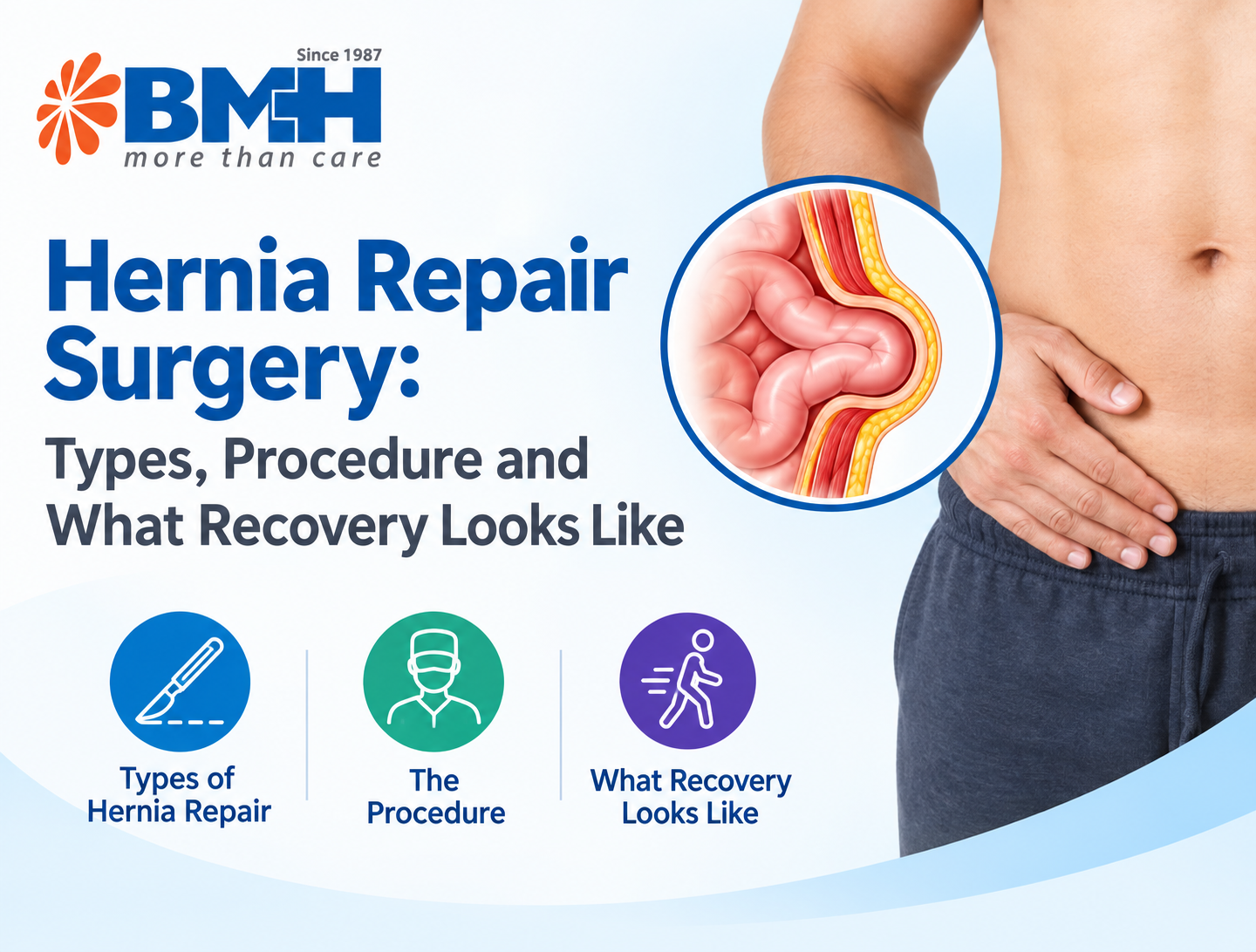
A hernia develops when tissue, often fat or part of the intestine, pushes through a weak area in the surrounding muscle or abdominal wall. It does not usually repair itself once that opening has developed. But this does not mean every hernia needs an operation tomorrow.
Hernia repair surgery becomes necessary depending on the type of hernia, its symptoms, whether it is getting larger and, importantly, whether the tissue inside it is becoming trapped.
So first, understand what you are dealing with.
The groin is one of the most common locations.
An inguinal hernia develops when tissue pushes through a weak area in the lower abdominal wall around the groin. It is particularly common in men.
But hernias can appear elsewhere too.
An umbilical hernia develops around the belly button. An incisional hernia can appear through a weak area left by a previous abdominal operation. Femoral hernias occur lower in the groin and are more common in women.
The location matters because the risks and the way the hernia is repaired can differ.
That is why inguinal hernia treatment should not simply be copied from what worked for a friend with another kind of hernia.
Not necessarily straight away.
This is a reasonable question, especially when the hernia is small and hardly troublesome.
Some men with an inguinal hernia that causes little or no discomfort may be managed with watchful waiting after assessment. Surgery can be planned if pain develops or the hernia begins interfering with everyday life.
A painful or enlarging hernia is a different conversation.
And there is another situation where waiting is not sensible.
If the contents of the hernia become trapped and cannot move back into the abdomen, the hernia is irreducible. If its blood supply becomes compromised, it is strangulated.
That can become an emergency.
A hernia that suddenly becomes very painful needs attention.
Particularly if the lump has become firm, tender or can no longer be pushed back when it previously could.
Vomiting, increasing abdominal swelling or difficulty passing stool or gas along with a painful hernia can also suggest bowel obstruction.
Don't spend the night watching it.
Seek urgent medical assessment.
A strangulated section of bowel can lose its blood supply and needs prompt treatment.
The idea is fairly simple.
Put the tissue back where it belongs.
Then strengthen the weak area it came through.
How the surgeon reaches that weakness is where the operations start to differ.
There are two main approaches: open repair and minimally invasive repair, which includes laparoscopic /robotic techniques.
Neither is automatically the right answer for everyone.
In open surgery, the surgeon makes an incision over or near the hernia.
The protruding tissue is returned to the abdomen and the weak area is repaired. In many adult groin hernia operations, a surgical mesh is used to reinforce the abdominal wall and reduce the chance of the hernia returning.
The incision is then closed.
Open repair remains a well-established operation and may be particularly suitable for certain large or complex hernias, some emergency cases, or patients in whom a minimally invasive approach is not appropriate.
And despite the word "open," this does not automatically mean a difficult recovery.
Many uncomplicated repairs are still short-stay procedures.
The destination is similar.
The route is different.
During laparoscopic hernia surgery, several small openings are made rather than one larger incision over the hernia. A camera allows the surgeon to see inside the abdomen, while long instruments are used to return the hernia contents and reinforce the weak area, commonly with mesh.
General anaesthesia is usually used.
One advantage of the laparoscopic approach is that the surgeon can work from inside the abdominal wall. It can be particularly useful when hernias are present on both sides of the groin or when a previous open hernia repair has recurred.
Some patients also experience less early postoperative pain and return to normal activities sooner.
Still, small cuts do not automatically make it the better operation.
The hernia and the patient decide that.
Mesh sometimes worries patients.
So, it helps to understand why it is there. Mesh is a lifelong implant it needs no removal
Instead of pulling weakened tissues tightly together under tension, mesh provides reinforcement across the area where the hernia developed. Modern adult groin hernia repair commonly uses mesh because it lowers recurrence compared with many older tissue-repair techniques.
Mesh-related problems can occur, including infection and persistent discomfort, but serious complications are uncommon.
There are also situations where a non-mesh repair may be considered ,especially if the hernial contents are infected.
Your surgeon can explain why one technique is being recommended for your particular hernia rather than another.
Before the operation, the team reviews your medicines, allergies, blood tests and any other medical conditions.
You will be told when to stop eating and drinking.
Blood-thinning medicines deserve particular attention. Do not stop them yourself. Your surgeon and the doctor managing those medicines will decide whether anything needs changing before surgery.
Once anaesthesia has been given, the hernia is repaired using the planned approach.
Then you wake up in recovery.
The first questions are usually much more ordinary.
Can you drink?
Can you pass urine?
Can you get up and walk safely?
Is the pain controlled?
For many straightforward hernia repairs, those answers help determine when you can go home.
Some soreness is normal.
So is a pulling or tight sensation around the repair, particularly when standing up, coughing or changing position.
After laparoscopic surgery, some people also notice temporary bloating or discomfort around the shoulder. The gas used to create working space inside the abdomen can irritate the diaphragm and cause referred shoulder pain for a short while.
Walking helps.
Not a five-kilometre walk on day one.
Just getting up regularly and moving around rather than staying in bed all day.
Pain medicines are used as advised, and the wound should be kept according to the instructions given at discharge.
This can be confusing.
The operation is finished, but there is still a lump.
Sometimes temporary swelling, bruising or a collection of fluid called a seroma develops around the repaired area. It can make patients wonder whether the hernia has immediately returned.
Often, it hasn't.
These changes commonly settle with time, although a new or enlarging swelling should still be shown to your surgical team rather than diagnosed at home.
Sooner than many people expect.
Walking and ordinary light activities generally return first. Desk-based work may be possible relatively early after an uncomplicated repair if you feel comfortable.
Heavy physical work is another matter.
Lifting, gym training and strenuous activity should return according to your surgeon's advice and the type of repair performed. There is little value in feeling good after ten days and deciding that this is the perfect moment to move a refrigerator.
Let the repair settle.
Driving can usually resume when you are no longer affected by sedating pain medicines and can comfortably perform an emergency stop and other driving movements.
The exact timeline varies.
Ask before discharge.
Most postoperative discomfort gradually settles.
Occasionally, pain around the groin continues for longer after an inguinal hernia repair. This may relate to scar tissue, nerves or other causes and deserves assessment if it persists.
Do not simply assume that long-lasting pain is something you have to accept because you had surgery.
Mention it during follow-up.
A general surgeon Kozhikode can examine the repair, look for recurrence or other causes and decide whether further treatment is needed.
A little bruising does not usually mean something has gone wrong.
Increasing redness, warmth or pus around the wound is different.
Contact your surgical team if you develop fever, worsening rather than improving pain, repeated vomiting, increasing abdominal swelling or significant wound discharge.
Sudden breathlessness or chest pain needs urgent medical attention.
And if the hernia-like swelling returns?
Have it checked.
A hernia is a weakness in the abdominal wall.
That sounds simple.
The decision around repairing it can be a little less simple.
Where is it? Is it painful? Is it becoming larger? Can it still reduce? Has it been repaired before? Is it on one side or both? And what is the person's general health like?
Those questions help determine whether surgery is needed and whether open or laparoscopic hernia surgery makes more sense.
The operation then does two things that matter most: return the protruding tissue and strengthen the weak area.
Recovery does the rest.
Walk early. Give the wound time. Return to heavier activity sensibly. And don't ignore a hernia that suddenly changes character.
Planned hernia repair surgery and emergency hernia surgery are very different experiences. When there is time to plan, use it.
1. Does every inguinal hernia need immediate surgery?
No. Some men with a small inguinal hernia causing minimal or no symptoms may be suitable for watchful waiting after surgical assessment. Painful, enlarging or complicated hernias are more likely to need repair.
2. Can medicines cure a hernia?
No medicine can close the weakness in the abdominal wall. Medicines may sometimes relieve discomfort or related symptoms, but they do not repair the hernia itself.
3. Which is better: open or laparoscopic hernia surgery?
Neither approach is best for every patient. Hernia type, whether it is on one or both sides, previous operations, general health and the surgeon's assessment all influence the choice.
4. Is mesh always used during hernia repair?
Mesh is commonly used in adult hernia repair because it reinforces the weak area and helps reduce recurrence. Some situations may be suitable for non-mesh repair, and your surgeon can explain which approach fits your case.
5. Can a hernia return after surgery?
Yes, recurrence is possible, although modern repair techniques have reduced the risk. Hernia type, surgical technique, tissue quality and other patient factors can influence recurrence.
6. How soon can I walk after hernia surgery?
Patients are generally encouraged to begin gentle walking soon after an uncomplicated repair. Activity can then be increased gradually according to comfort and the surgeon's advice.
7. When does an inguinal hernia become an emergency?
Seek urgent medical care if a hernia suddenly becomes very painful, firm or irreducible, particularly when accompanied by vomiting, abdominal swelling or inability to pass stool or gas. These can indicate obstruction or strangulation.