- English
- عربي / Arabic
- മലയാളം / Malayalam

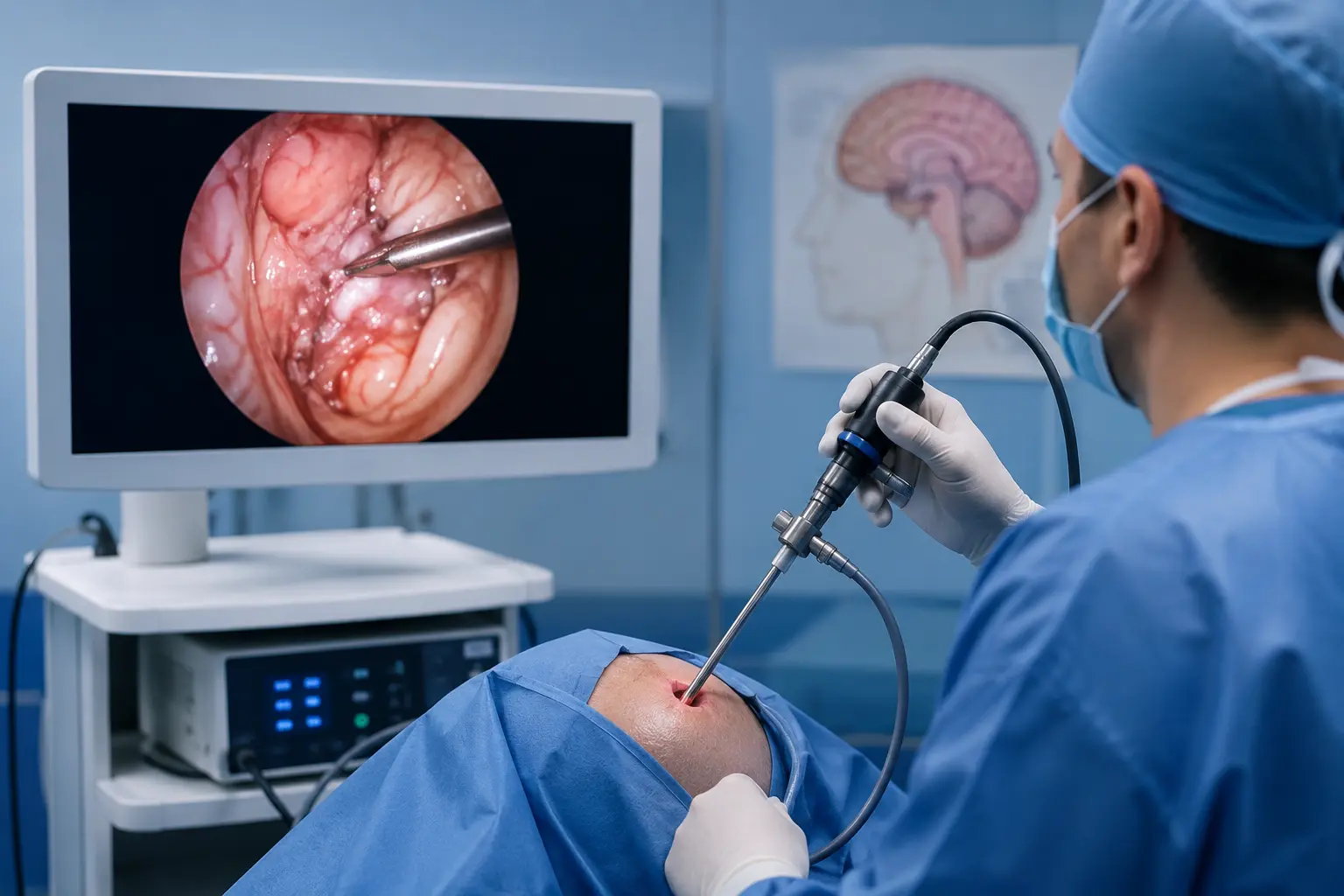
Not every brain condition requires a large surgical opening. Advances in neurosurgery have made it possible to treat selected brain disorders through much smaller incisions using specialised endoscopes and high-definition imaging. This approach, known as endoscopic neurosurgery, allows surgeons to access certain areas of the brain with minimal disruption to surrounding tissues.
For suitable patients, minimally invasive neurosurgery can offer effective treatment while reducing surgical trauma, shortening hospital stays and supporting a quicker recovery. However, like any surgical technique, it is not appropriate for every brain condition. The choice depends on the location of the problem, its size and the overall health of the patient.
Endoscopic neurosurgery is a surgical technique that uses a thin tube fitted with a camera and specialised surgical instruments to reach the brain through a small opening or natural pathway, such as the nasal passages in selected cases.
The high-definition camera provides a magnified view of the surgical field, allowing the neurosurgeon to perform precise procedures while avoiding unnecessary damage to healthy brain tissue.
Rather than replacing conventional brain surgery, this technique expands the treatment options available for carefully selected patients.
Not every neurological condition can be managed with an endoscope. The decision depends on whether the affected area can be safely reached through a minimally invasive approach.
Some conditions that may be treated using endoscopic neurosurgery include:
Each case is carefully evaluated using MRI and CT imaging before deciding whether an endoscopic approach is suitable.
One of the most common forms of keyhole brain surgery involves creating a small opening in the skull instead of the larger opening used in conventional surgery.
Through this opening, specialised instruments and an endoscope are introduced to access the affected area. The camera provides clear visualisation, enabling the surgeon to perform delicate procedures through a much smaller surgical corridor.
For some skull base tumours, surgery may even be performed through the nose using an endoscopic transnasal approach, eliminating the need for an external incision.
The biggest advantage of minimally invasive neurosurgery is that it achieves the surgical objective while reducing tissue disruption.
Potential benefits include:
While these advantages are important, the primary goal always remains safe and complete treatment of the underlying brain condition.
No. Endoscopic surgery is highly effective, but only when the condition is suitable for this approach.
Factors that influence the decision include:
If an endoscopic approach cannot safely remove or treat the condition, conventional microsurgery may still provide the best outcome.
The surgical plan is always based on what offers the highest level of safety rather than the smallest incision.
Every patient undergoes a detailed preoperative evaluation.
MRI and CT scans help the neurosurgical team understand the anatomy and plan the safest surgical route. Blood investigations, anaesthetic assessment and neurological examination are also completed before surgery.
During this stage, patients are informed about:
This planning helps ensure that endoscopic neurosurgery is performed with maximum precision.
Although minimally invasive techniques reduce surgical trauma, they do not eliminate surgical risks.
Possible complications include:
The actual risk depends on the condition being treated and the complexity of the procedure.
Before surgery, the neurosurgical team explains these risks in detail and discusses the expected outcomes with the patient and family.
Recovery varies depending on the type of surgery and the condition being treated.
Many patients undergoing keyhole brain surgery experience less postoperative discomfort and shorter hospital stays compared to traditional open procedures. However, recovery also depends on the patient's age, overall health and the complexity of the surgery.
Follow-up imaging may be performed to assess the surgical results, and regular outpatient visits help monitor recovery and identify any need for further treatment.
Successful minimally invasive neurosurgery requires more than specialised equipment. It depends on careful patient selection, advanced imaging, surgical expertise and coordinated postoperative care.
An experienced neurosurgeon Kerala evaluates every patient individually, choosing the approach that provides the safest and most effective treatment rather than automatically opting for a minimally invasive technique.
This personalised approach ensures that every patient receives treatment based on their condition rather than the procedure itself.
Endoscopic neurosurgery has transformed the treatment of many brain conditions by making surgery less invasive without compromising precision or safety. For carefully selected patients, keyhole brain surgery and other forms of minimally invasive neurosurgery can provide excellent outcomes with faster recovery and reduced surgical trauma.
At Baby Memorial Hospital, our experienced neurosurgeon Kerala team uses advanced imaging and modern neurosurgical techniques to determine the most appropriate treatment for every patient, ensuring care that is both safe and personalised.
1. What is endoscopic neurosurgery?
Endoscopic neurosurgery is a minimally invasive surgical technique that uses a thin camera and specialised instruments to treat selected brain conditions through small openings or natural pathways.
2. What is keyhole brain surgery?
Keyhole brain surgery is a neurosurgical approach performed through a small opening in the skull, allowing surgeons to access certain brain conditions with less tissue disruption.
3. Is minimally invasive neurosurgery suitable for every brain tumour?
No. Minimally invasive neurosurgery is recommended only when the tumour's size and location make the procedure safe and effective.
4. Does endoscopic brain surgery have fewer risks?
While it often reduces surgical trauma and recovery time, it still carries risks such as bleeding, infection and neurological complications. The overall risk depends on the patient's condition.
5. When should I consult a neurosurgeon?
If you have been diagnosed with a brain tumour, hydrocephalus or another condition that may require surgery, consulting an experienced neurosurgeon Kerala can help determine the most suitable treatment approach.