- English
- عربي / Arabic
- മലയാളം / Malayalam

Choosing a hospital in Kozhikode begins with the care you need. A planned consultation, a complicated operation, and a sudden medical emergency call for different arrangements. The right hospital should have the relevant team, suitable facilities, and a clear plan for the period after treatment. For patients and families, practical questions about appointments, costs, and follow-up are part of that decision.
If you are looking for the best hospital in Kozhikode, use those needs as your starting point. A broad claim about quality is less helpful than knowing how your particular condition will be assessed and managed.
For a new symptom without an established diagnosis, a physician or family medicine consultation may be a sensible first step. You do not need to identify the exact specialty yourself. Describe the symptom when booking and ask which service can assess it.
If another doctor has recommended surgery or specialist care, bring the referral and investigation results. The hospital needs to know whether the visit is for a first assessment, a second opinion, or continuation of an existing treatment.
Emergency symptoms require a different response. Severe chest pain, signs of stroke, major injury, severe breathing difficulty, or reduced consciousness should be assessed immediately at an appropriate emergency facility. Do not delay urgent care while comparing reviews or appointment slots.
Hospitals in Kozhikode offer different combinations of services. For heart concerns, you may need cardiology; for persistent neurological symptoms, neurology; and for joint or sports injuries, orthopaedics. Digestive problems can require medical gastroenterology, surgical gastroenterology, or both, depending on the diagnosis.
Cancer care often involves more than one discipline. Medical oncology, surgery, pathology, imaging, and sometimes radiation oncology contribute to a plan. The relevant question is how those teams will work together for your diagnosis, rather than whether the hospital has a long department list.
Ask whether the consultant regularly manages your condition and whether associated services are available at the same location. Some care may need a referral within a hospital network or to another centre.
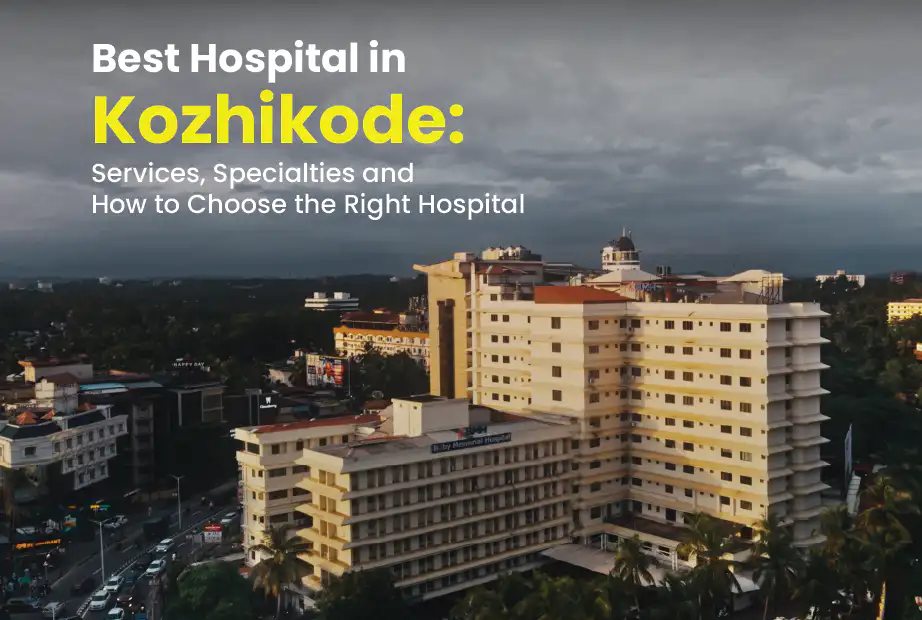
Baby Memorial Hospital Kozhikode is located on Indira Gandhi Road at Arayidathupalam. At Baby Memorial Hospital Kozhikode, care is organised across multiple specialties so patients can move from diagnosis to treatment and follow-up within the same hospital when their condition requires multidisciplinary support. BMH Kozhikode provides services across cardiology, neurology and neurosurgery, orthopaedics, gastroenterology, urology, oncology and several other medical and surgical specialties.
The hospital has 490 operational beds, including 100 ICU beds, 23 emergency beds and 161 day-care beds, along with 16 operation theatres and three Cath Labs. Diagnostic facilities include MRI, PET-CT, Gamma Camera SPECT, digital mammography and digital X-ray. BMH also provides robotic and minimally invasive surgical services and dedicated oncology facilities.
This combination becomes particularly useful when a condition needs more than one specialist, an operation followed by critical-care monitoring, or continuing rehabilitation and follow-up. For patients comparing options for the best hospital in Kozhikode, the more useful question is therefore not simply how many services a hospital lists, but whether the required specialists, diagnostics, treatment and support can come together around their particular condition.
Bring your current records so the enquiry can focus on the care you actually need. The next useful step is a clinical assessment, particularly when the diagnosis or treatment recommendation remains uncertain.
Baby Memorial Hospital Kozhikode offers advanced robotic-assisted and minimally invasive surgical procedures using the da Vinci Xi Robotic Surgical System. This technology supports surgeons in performing selected complex procedures with enhanced precision, flexibility and control.
Robotic-assisted and minimally invasive surgical procedures are available across the following specialities:
Key features of the da Vinci Xi Robotic Surgical System include:
• High-definition, magnified 3D surgical visualisation
• Enhanced precision and instrument dexterity
• Greater flexibility and control during surgical procedures
• Advanced minimally invasive surgical capabilities
• Improved access to complex anatomical regions
• Support for better preservation of surrounding healthy tissues
The suitability of robotic-assisted surgery depends on the patient's condition, the procedure required and the surgeon's clinical assessment. Patients can consult the relevant specialist to understand the available surgical approaches, expected benefits and alternatives.
Laboratory and imaging support can reduce the need to travel between facilities, but convenience should be linked to a clinical purpose. Ask which tests are needed before the consultation and which should wait until the doctor has examined you.
If you already have a recent scan, take both the report and the images. Sometimes they can be reviewed without repeating the examination. A repeat may still be necessary if the earlier study does not answer the current question, the condition has changed, or better detail is required.
Find out how reports are delivered and who will discuss them. A test result is only one stage of care; knowing what action follows it is equally important.
For an operation, the surgeon's assessment is only part of the preparation. Anaesthesia review, nursing care, infection prevention, and appropriate postoperative monitoring also matter. Some patients need access to critical care or input from another specialty because of existing illnesses.
Ask where you will recover immediately after surgery and how the team decides when you are ready to go home. If a complication occurs, find out how it will be recognised and managed. These are reasonable questions, even for procedures described as routine.
The consent discussion should cover expected benefits, material risks, alternatives, and the consequences of waiting. Leave enough time to understand that discussion before a planned admission.
A useful consultation should leave you understanding the working diagnosis and the reason for the next step. If the explanation is unfamiliar, ask the doctor to use simpler words or show you the relevant scan finding.
Tell the team which language you are most comfortable using. With your permission, a family member can help remember instructions or ask questions. You should still have space to discuss private concerns and make decisions about your care.
Keep a short written list of priorities. If your main worry is returning to work, looking after a parent, or managing treatment alongside diabetes, say so. Those concerns can affect a workable care plan.
Request a written estimate for planned treatment. Check whether it covers the surgeon, anaesthesia, room category, medicines, implants, investigations, and follow-up. Ask what is excluded and what circumstances could increase the final bill.
Insurance arrangements should be confirmed separately. A hospital's participation in an insurer's network does not guarantee approval for every treatment. Ask about pre-authorisation, exclusions, deposits, and the documents needed.
Compare estimates for equivalent care. A lower figure may cover a different procedure or fewer days of admission. An itemised explanation helps families plan without assuming that the first number is a fixed final total.
Healthcare services Kozhikode families rely on should include a clear route back to advice after discharge. Ask when the follow-up appointment is due, which medicines continue, and which symptoms need an urgent call.
Some recoveries need physiotherapy, dietary support, wound review, or repeated blood tests. If you live outside the city, ask which visits need to be in person and which parts can be coordinated closer to home. Do not assume remote follow-up is available for every condition.
Keep the discharge summary and updated medicine list together. This helps another doctor understand the treatment if you need care unexpectedly.
For repeated visits, consider the journey at the times you are likely to travel. A treatment that requires several appointments can create different needs from a single consultation. Ask about scheduling before making work or family arrangements, especially when someone else will accompany you.
Confirm the hospital location, registration process, and arrival time. Bring identity and insurance documents if needed, along with prescriptions, allergy information, and reports. Patients who need wheelchair access, assistance transferring, or extra time should mention it when booking.
For fasting tests, request the exact instructions in advance. Avoid arriving without food because you assume every consultation requires fasting. If a procedure may involve sedation, check whether an adult must accompany you home.
The most useful hospital choice is one that connects the right clinical service with care you can understand and continue. When approaching BMH Kozhikode, start with your diagnosis or main symptom and ask how the team would organise the next stage. That conversation gives you a clearer basis for choosing than a general ranking alone.
FAQ
1. How do I choose the best hospital in Kozhikode for my condition?
Start with the specialty you need. Then consider the relevant specialists, diagnostic facilities, treatment options, emergency or critical-care support where necessary, and how follow-up will be managed. At BMH Kozhikode, multiple medical and surgical specialties work alongside diagnostic, emergency and critical-care services, making it possible to coordinate care when a condition requires more than one specialist. The right starting point is to share your symptoms or diagnosis so the BMH team can guide you to the appropriate specialty and next step.
2. What specialties are available at BMH Kozhikode?
Baby Memorial Hospital Kozhikode offers 56 medical and surgical specialities, covering a wide range of healthcare services. These include Cardiology, Neurology, Neurosurgery, Orthopaedics, Urology, Medical Gastroenterology, Surgical Gastroenterology, Oncology and several other specialities. Patients can consult the hospital to identify the appropriate department and specialist for their healthcare needs.
3. Does BMH Kozhikode provide emergency and critical care?
Yes. BMH Kozhikode lists 23 emergency beds and 100 ICU beds as part of its hospital infrastructure. (Baby Memorial Hospital)
4. Does BMH Kozhikode offer robotic-assisted surgery?
Yes. Baby Memorial Hospital Kozhikode offers robotic-assisted and minimally invasive surgical procedures using the da Vinci Xi Robotic Surgical System. These procedures are available across Urology, Obstetrics and Gynaecology, Surgical Oncology, Surgical Gastroenterology, and General and Laparoscopic Surgery. The system provides high-definition 3D visualisation, enhanced precision, flexibility and control during selected surgical procedures. The suitability of robotic surgery is determined by the treating surgeon based on the patient's condition.
5. What should I bring for my first hospital consultation?
Bring previous prescriptions, investigation reports, scan images, your current medicine list and relevant discharge summaries. Insurance and identification documents may also be required.
6. What should I check before a planned hospital admission?
Understand the proposed treatment, expected hospital stay, recovery plan and follow-up. You should also request a treatment estimate and clarify insurance approval, inclusions and possible additional expenses before admission.