- English
- عربي / Arabic
- മലയാളം / Malayalam

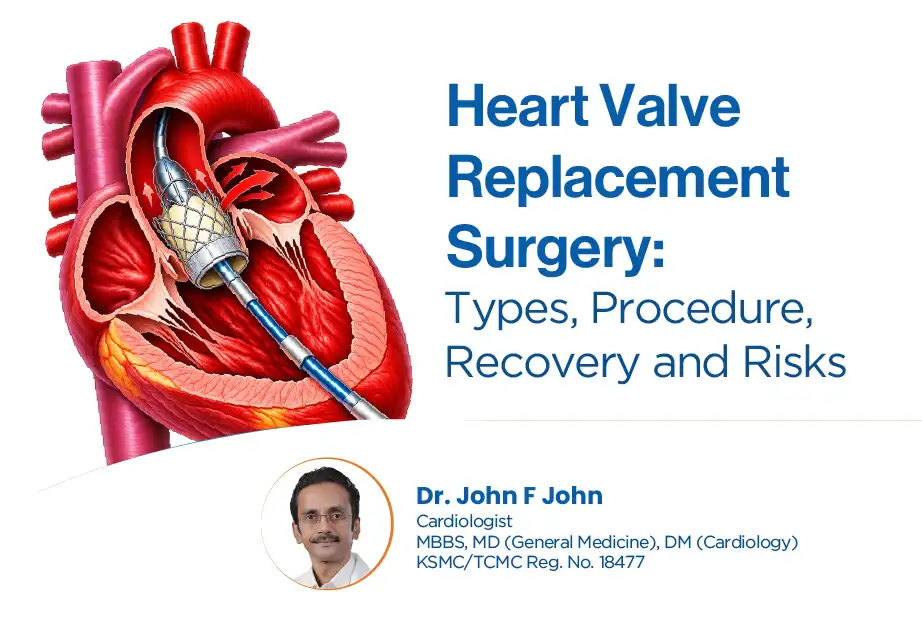
Heart valve replacement surgery treats a valve that has become too narrow or too leaky to support healthy blood flow. The damaged valve is replaced with a mechanical or tissue valve. Some patients need an operation through the chest, while selected aortic valve problems can be treated through a catheter. The choice depends on which valve is affected, its anatomy, your age and health, and the expected benefits over time.
Your heart team considers whether a valve can be repaired, whether replacement is needed, and which route best fits your situation.
Heart valves keep blood moving in the correct direction. A narrowed valve makes it harder for blood to pass through. A leaking valve allows some blood to move backwards, increasing the heart's workload.
Symptoms can include breathlessness, chest discomfort, faintness, fatigue, or swelling. Some severe valve problems are identified before obvious symptoms develop. An echocardiogram helps assess the valve and how the heart is responding.
Medicines may relieve symptoms or treat related conditions, but they do not reliably correct a severely damaged valve. The timing of intervention balances current symptoms, the risk of further heart damage, and the risk of treatment.
A repair preserves the patient's own valve and may be suitable for particular problems, especially some mitral valve conditions. Replacement is considered when repair is unlikely to give a reliable result or when the type of damage makes it unsuitable.
Ask why the team recommends one option. The answer should relate to the valve's anatomy, the expected durability, and the centre's assessment. Sometimes the final decision is confirmed during the operation after direct examination.
If you have more than one heart problem, the team may also consider whether other treatment should happen during the same operation. That can influence the choice of approach and recovery.
Mechanical valves are made from durable materials and can last a long time. Their main trade-off is the need for lifelong anticoagulation, usually with warfarin, to reduce clot formation. Regular blood testing is needed to keep treatment within the prescribed range.
Anticoagulation creates a continuing balance between clotting and bleeding risk. Other medicines, illness, and dietary changes can affect warfarin control. Direct oral anticoagulants are not a substitute for warfarin in people with mechanical heart valves.
Discuss pregnancy plans, access to monitoring, occupation, and bleeding history before choosing a valve. These practical circumstances can matter as much as age.
Tissue valves are made from biological material. They generally avoid the lifelong valve-related warfarin requirement associated with mechanical valves, although temporary treatment or anticoagulation for another condition may still be necessary.
Tissue valves can deteriorate over time and may need another intervention. Durability varies with the valve, the patient's age, and other factors. The possibility of a future procedure should be discussed before the first replacement.
There is no universally best valve for every patient. Ask how each option fits your expected lifespan, other illnesses, treatment preferences, and ability to manage follow-up.
TAVR, also called TAVI, places a tissue valve through a catheter, commonly introduced through an artery in the groin. It is used mainly for selected patients with severe aortic stenosis. It is not a general replacement technique for every damaged heart valve.
The heart team reviews scans, access vessels, valve anatomy, surgical risk, and longer-term considerations. Some patients are better suited to surgical replacement, particularly if another heart operation is also needed or the anatomy is unsuitable.
TAVR avoids a large chest incision in many cases, but it still has important risks. These include bleeding, stroke, vascular injury, leakage around the valve, and a possible need for a pacemaker.
Assessment can include echocardiography, blood tests, ECG, CT imaging, and assessment of the coronary arteries when indicated. The team reviews kidney function, lung health, frailty, and other conditions that may affect treatment.
Tell the team about medicines, allergies, previous operations, and dental or other infections. Dental assessment may be advised because infection can affect heart valves. Follow specific directions about anticoagulants and other medicines rather than changing them yourself.
Ask how long admission is likely to last, who will update your family, and what help you may need at home. Preparation should include the period after discharge as well as the procedure itself.
Surgical heart valve surgery is performed under general anaesthesia. The surgeon reaches the heart through a standard or selected smaller incision and usually uses a heart-lung machine during the repair or replacement work.
The damaged valve is removed or treated as planned, and the replacement is secured. The team checks its function before completing the operation. Afterwards, monitoring begins in a specialist recovery or intensive care setting.
You may initially have a breathing tube, chest drains, monitoring lines, and temporary pacing wires. Staff remove these as your condition allows. Pain control and supported breathing exercises help you begin recovery.
Valve replacement surgery can improve symptoms and protect heart function when appropriately timed. For some severe valve conditions, it improves survival. The expected benefit depends on the disease, other heart damage, and overall health.
Risks include bleeding, infection, stroke, kidney injury, abnormal rhythms, valve dysfunction, and death. Risks differ between surgical and catheter approaches and between patients. Ask for an individual explanation rather than relying on a general percentage.
The discussion should also cover the risks of not treating the valve. Understanding both sides helps you make a decision when symptoms are mild but the test findings are concerning.
Hospital stay and recovery differ between open surgery and TAVR. After chest surgery, healing and a gradual return to strength commonly take several weeks or longer. Follow restrictions on lifting and driving, especially if the breastbone was divided.
Cardiac rehabilitation can support safe activity and recovery. Take medicines exactly as prescribed and attend blood tests, particularly if you use warfarin. Tell healthcare and dental professionals that you have a replacement valve; preventive antibiotics may be needed for certain dental procedures.
Seek urgent care for new severe breathlessness, chest pain, stroke symptoms, or significant bleeding. Fever, worsening wound changes, or increasing swelling should be reported promptly.
Ask how often echocardiography will be needed after replacement and whether you will receive a valve identification card. Keep the type and date of the implant recorded. These details can help future teams plan dental treatment, another operation, or investigation of a new symptom.
Heart valve replacement cost depends on the valve, surgical or catheter approach, investigations, intensive care, hospital stay, and any additional procedures. Ask for an itemised estimate and clarify implants, follow-up, and insurance requirements. TAVR and conventional cardiac surgery should not be compared as identical packages.
BMH provides surgical heart valve repair and replacement, including mechanical and biological valve replacement. Minimally invasive cardiac surgery is also available for selected valve procedures. For suitable patients with severe aortic stenosis, the cardiac team offers TAVI/TAVR, where the replacement valve is delivered through a catheter rather than conventional open-heart surgery.
Planning is supported by facilities for echocardiography, TEE, cardiac CT and other cardiac investigations. BMH also has digital Cath Labs, dedicated cardiac operation theatres, cardiac anaesthesia and critical-care teams, and dedicated cardiac ICU facilities for monitoring after treatment.
Care continues after the procedure. The cardiac team monitors recovery, medicines, wound healing and valve function, while cardiac rehabilitation and structured follow-up help patients return to activity safely. Patients with mechanical valves also need continuing anticoagulation monitoring, while all valve-replacement patients need regular cardiac review and echocardiography as advised.
The cost of heart valve replacement at BMH varies according to the type of valve, whether treatment is surgical or catheter-based, investigations, ICU requirements, hospital stay and any additional procedures needed. The care team can provide an estimate based on the treatment plan rather than treating every valve replacement as the same package.
The operation may replace the valve in a day. But looking after that valve is longer-term work.
1. How do doctors decide between a mechanical and tissue heart valve?
The choice depends on age, expected valve durability, other medical conditions, bleeding risk, pregnancy plans and whether lifelong anticoagulation can be managed safely. Your cardiac team will discuss the advantages and trade-offs of both options.
2. Is TAVR better than open-heart valve replacement?
Not for everyone. TAVR is mainly used for suitable patients with severe aortic stenosis. Valve anatomy, age, surgical risk, other heart conditions and long-term considerations help determine whether TAVR or surgical replacement is more appropriate.
3. How long does recovery take after heart valve replacement surgery?
Recovery after open-heart valve surgery commonly takes several weeks, with full recovery sometimes taking a few months. Recovery after TAVR is generally faster, although this varies with the patient's age, health and any complications.
4. Will I need blood-thinning medicine after valve replacement?
Patients with mechanical valves generally need lifelong anticoagulation with warfarin. Tissue-valve patients may not need lifelong valve-related anticoagulation, although some may require it temporarily or for another medical condition.
5. What follow-up is needed after heart valve replacement?
Regular cardiac reviews are important even when you feel well. Follow-up may include echocardiography, medicine review, anticoagulation monitoring when required and cardiac rehabilitation. Contact the cardiac team promptly if you develop new breathlessness, fever, chest pain, significant bleeding or other concerning symptoms.