- English
- عربي / Arabic
- മലയാളം / Malayalam

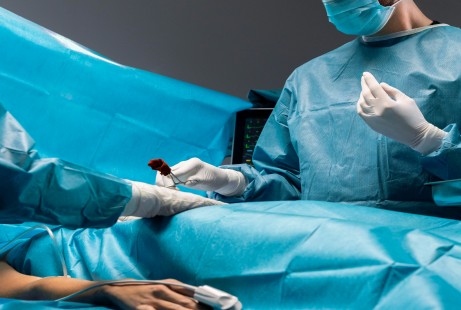
Most people hear the word surgery and immediately think of long cuts, stitches, and weeks of recovery. That image is still stuck in many minds. But if you ask someone who recently had laparoscopic surgery, their experience sounds very different. They’ll usually say something like - “It was not as big as I expected.”
And that’s because things have changed. Not completely… but enough to make a real difference.
What is laparoscopic surgery (in simple terms)
Laparoscopic surgery is minimally invasive technique where surgeons operate through small incisions. In laparoscopic surgery instead of a large cut, doctors make a few small openings. Through these, they insert a camera and instruments. The camera shows everything on a screen, and the surgeon operates while watching that. So the work inside is still precise… just done through smaller access. That’s what laparoscopic surgery is.
Why it’s commonly used for Gastrointestinal conditions or abdominal conditions.
Hollow viscus organs like the gallbladder, intestines, and appendix, are located in the abdomen. And many conditions here can be treated without opening the entire abdomen. That’s why laparoscopic methods are widely used for:
Laparoscopy is used to diagnose and treat certain conditions
It’s not about doing less work. It’s about doing the same work in a less invasive way.
When do doctors suggest this type of surgery?
Surgery is usually not the first step. People often go through medicines, diet changes, and observation first. But when symptoms don’t improve… or the condition becomes clear… surgery is advised. For example:
That’s when procedures like hernia surgery, Appendectomy, cholecystectomy or similar interventions are considered.
What actually happens during the procedure
From the patient’s side, it feels simple. You are under anesthesia. You don’t feel anything during the procedure. The surgeon works through small incisions, guided by the camera. Once the problem is treated, whether removing a gallbladder or repairing a hernia, the instruments are removed, and the small cuts are closed. The surgery may take a few hours depending on the case.
Recovery; this is where people notice the difference
This is the part patients care about the most. Compared to open surgery, recovery is usually smoother. You may notice:
Many people start walking within a day. That doesn’t mean full recovery instantly. But the initial phase feels easier.
What about more complex Abdominal surgeries
Not all procedures are simple. In cases like colorectal surgery Kozhikode, things can be more complicated. Sometimes laparoscopic methods are still used. Sometimes traditional surgery is required. It depends on:
There is no one-size-fits-all approach.
Are there risks?
Yes, and it’s important to know that. Even though cuts are small, it is still surgery. Possible risks include:
In some cases, doctors may switch to open surgery if needed during the procedure. That decision is made for safety.
A small thing many patients don’t expect
Even with smaller cuts, you still need to take care. Some people feel so much better that they try to return to routine too quickly. That’s not ideal. The body still needs time to heal internally. So, rest, diet, and follow-ups matter.
Life after laparoscopic surgery
Most patients return to normal life gradually. You may feel:
But long-term results also depend on lifestyle, Diet, activity, and habits still matter according to your doctor’s advice
Final thought
Laparoscopic surgery has changed how patients experience treatment. Smaller cuts. Less visible impact. Faster recovery. But the goal remains the same is to treat the condition safely and effectively. Whether it’s laparoscopic cholecystectomy Kerala, hernia surgery BMH, or Appendectomy, colorectal surgery Kozhikode, the decision depends on what your body needs. Because in the end, it’s not about choosing the smallest surgery. It’s about choosing the right one.