
- English
- عربي / Arabic
- മലയാളം / Malayalam

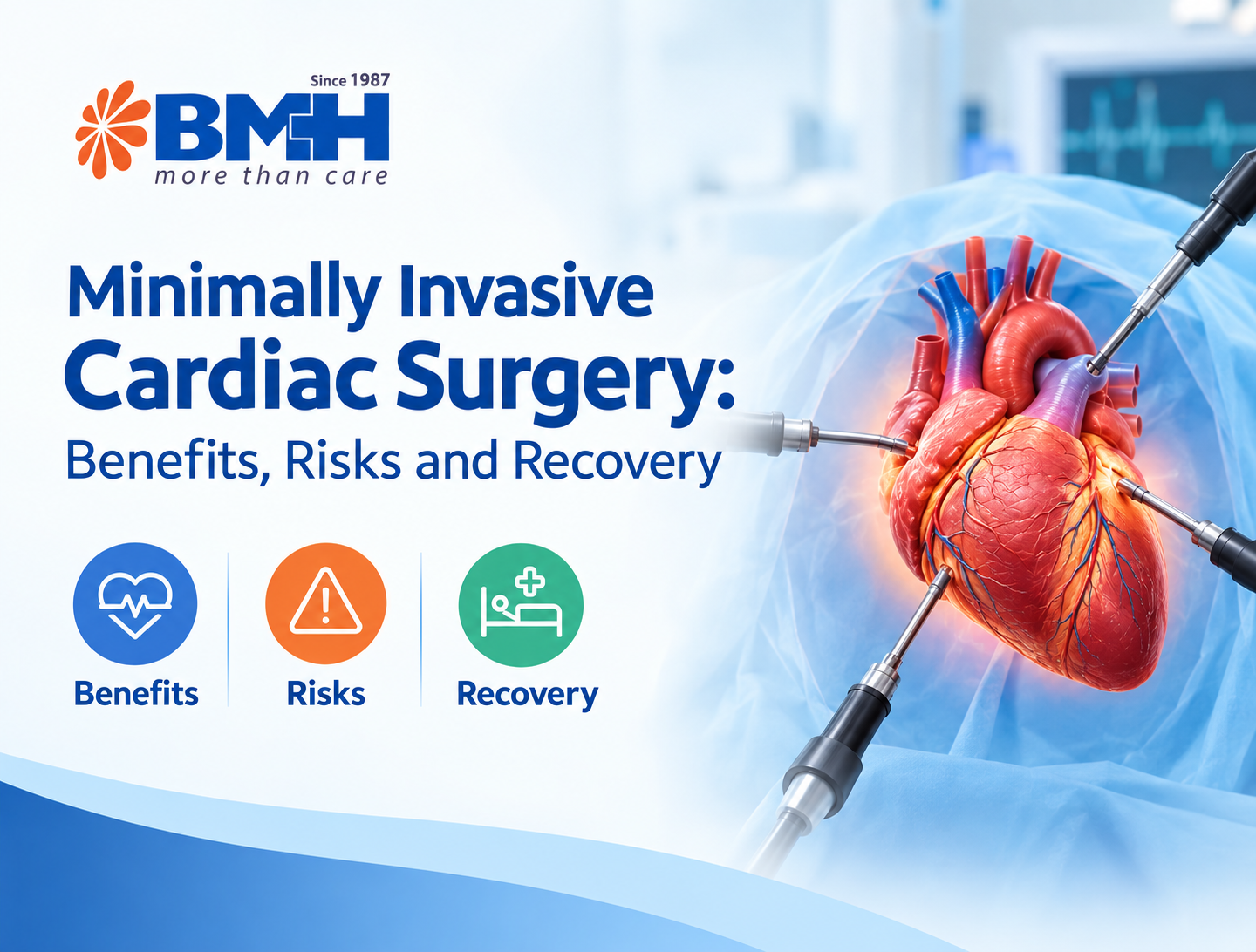
Heart surgery has traditionally been performed through a large incision in the centre of the chest. While that approach remains necessary for many patients, advances in surgical techniques now allow certain heart procedures to be performed through much smaller openings.
This approach is known as minimally invasive cardiac surgery.
Instead of opening the entire breastbone, surgeons use small incisions between the ribs or specialised instruments to reach the heart. In selected cases, robotic heart surgery may also be used to assist with precision and access.
What follows explains when minimally invasive surgery is considered, how it differs from traditional surgery, what benefits and risks to expect, and what recovery usually looks like.
Not every heart condition requires the same type of surgery.
Some patients need valve repair or replacement. Others may require treatment for certain congenital heart defects, heart rhythm problems, or selected coronary artery conditions.
Traditionally, these operations were performed through a full sternotomy, which involves dividing the breastbone to access the heart.
A minimally invasive approach aims to achieve the same surgical result through smaller incisions.
The decision depends on:
The goal is not to make surgery smaller.
The goal is to perform the safest and most effective operation for the individual patient.
The biggest difference is access.
Traditional surgery usually requires a larger incision through the centre of the chest. Minimally invasive surgery uses smaller openings, often between the ribs, allowing surgeons to reach the heart without fully opening the chest.
The work being performed inside the heart may be very similar.
The route used to reach it is different.
In selected hospitals and procedures, robotic heart surgery may be used. Robotic systems do not replace the surgeon. Instead, they provide enhanced precision and control through specialised instruments operated by the surgical team.
Minimally invasive techniques are commonly used for selected patients requiring:
Not every patient is a candidate.
Some conditions are better managed through conventional surgery because they provide wider access and greater flexibility during complex operations.
Your heart specialist determines which approach is most appropriate after reviewing scans and test results.
Benefits.
Smaller incisions; less disruption of surrounding tissues; reduced blood loss in selected cases; shorter hospital stay for many patients; less visible scarring; faster return to normal activities compared with some traditional procedures.
Many patients also experience less discomfort during recovery because the breastbone may not need to be divided.
These benefits are attractive.
But they are only meaningful if the procedure remains the safest option for the individual patient.
Every heart operation carries risks.
Minimally invasive surgery is no exception.
Risks may include:
The overall risk depends on age, heart function, kidney health, lung function, and the complexity of the underlying heart disease.
A smaller incision does not automatically mean a lower-risk operation.
The surgical team evaluates the complete picture before making a recommendation.
Several steps take place before the operation.
Blood tests are reviewed.
Heart imaging studies are examined carefully.
Medications are adjusted if necessary.
A member of the surgical team explains the procedure, expected recovery, benefits, risks, and alternatives.
You may be asked to stop eating and drinking for a number of hours before surgery.
These preparations help ensure the procedure proceeds as safely as possible.
The operation is performed under general anaesthesia.
You remain asleep throughout the procedure.
Small incisions are created to allow specialised instruments and cameras to reach the heart. Depending on the operation, a heart-lung machine may be used temporarily to maintain circulation while the surgeon performs the repair.
Throughout the procedure, the surgical team continuously monitors:
Once the repair or replacement is completed, the instruments are removed and the incisions are closed.
Most patients spend time in a cardiac recovery or intensive care unit immediately after surgery.
This allows close monitoring during the early recovery period.
Tubes and monitoring equipment are gradually removed as recovery progresses.
Walking usually begins early.
Breathing exercises are encouraged.
Pain is managed with medication when needed.
The exact length of stay depends on the procedure performed and how quickly recovery progresses.
Recovery continues after discharge.
Fatigue is common during the first few weeks.
That does not mean something is wrong.
The body is healing.
Most patients gradually increase their activity level under medical guidance. Walking becomes easier. Energy levels improve. Follow-up visits allow doctors to review healing and adjust medications if necessary.
Cardiac rehabilitation programmes are often recommended because they combine supervised exercise, education, and recovery support.
The pace of cardiac surgery recovery varies from person to person.
Some recover quickly.
Others need more time.
Both can be normal.
Am I a candidate for minimally invasive cardiac surgery?
Would traditional surgery provide any advantages in my case?
Is robotic heart surgery an option?
How long will I stay in hospital?
What restrictions will I have after discharge?
How long before I can return to work or driving?
What should I expect during recovery?
Minimally invasive cardiac surgery offers an alternative to traditional open-heart surgery for selected patients. By using smaller incisions and specialised techniques, surgeons can often perform complex heart procedures while reducing physical disruption to the body.
The best approach depends on the condition being treated, overall health, and surgical assessment. Whether the operation is performed through a traditional incision or with minimally invasive techniques, the goal remains the same: treating heart disease safely while supporting the best possible long-term outcome.
It is a type of heart surgery performed through smaller incisions rather than a large opening through the breastbone.
Not necessarily. The safest option depends on the patient's condition, anatomy, and type of heart disease. Your surgeon will recommend the most appropriate approach.
Robotic heart surgery uses specialised robotic instruments controlled by the surgeon to perform certain heart procedures with enhanced precision.
Many patients experience shorter hospital stays and quicker recovery compared with some traditional procedures, although recovery varies from person to person.
Many patients report less discomfort because the breastbone may not need to be divided, but some pain and soreness are still expected during healing.
No. Some complex heart conditions still require traditional open-heart surgery to provide the safest and most effective treatment.
Recovery varies depending on the procedure and individual health. Many patients gradually resume normal activities over several weeks under medical supervision.