
- English
- عربي / Arabic
- മലയാളം / Malayalam

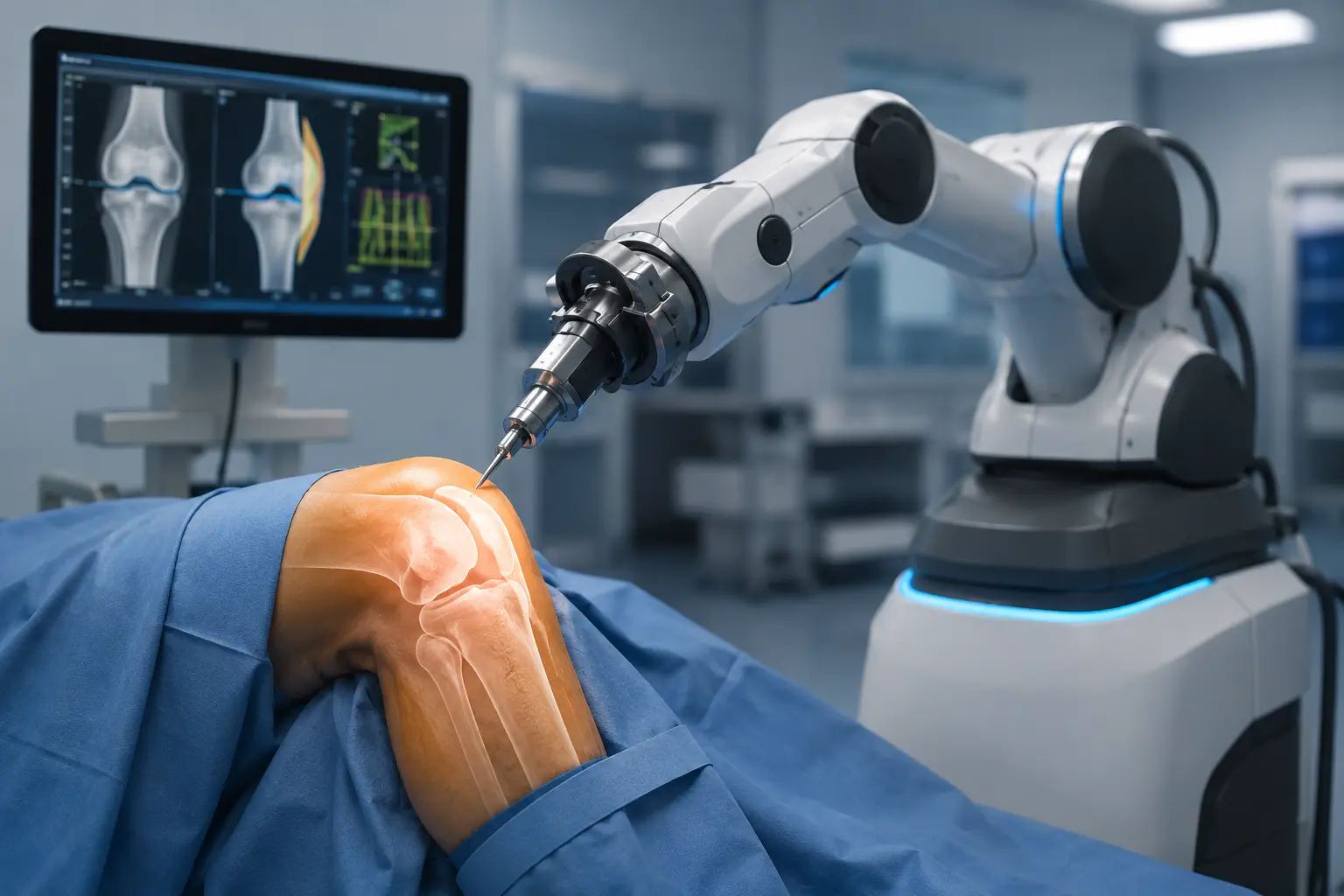
Knee replacement surgery has helped millions of people regain mobility and live with less pain. Today, advances in technology have made the procedure even more precise. Robotic total knee replacement combines the experience of the orthopaedic surgeon with robotic-assisted technology to improve surgical planning and implant positioning, helping patients achieve better function and long-term outcomes.
While the word "robotic" may suggest that a machine performs the surgery, that is not the case. The procedure is always carried out by an experienced surgeon, with the robotic system providing real-time guidance to enhance precision.
Not every knee problem requires surgery. Many patients improve with medications, physiotherapy, weight management and injections.
However, robotic total knee replacement may be recommended when:
The decision to undergo surgery depends on how much the condition affects a person's quality of life rather than age alone.
Before surgery, detailed imaging of the knee is used to create a three-dimensional model of the joint. This allows the surgeon to carefully plan the procedure, including the size and position of the artificial implant.
During robot-assisted knee surgery, the robotic system provides real-time feedback that helps the surgeon make highly accurate bone cuts and position the implant with greater precision.
The robotic arm does not operate independently. Every step remains under the complete control of the surgeon, who uses the technology as an advanced surgical tool.
Both conventional and robotic knee replacement aim to relieve pain and restore knee function.
The difference lies in the level of surgical planning and precision.
With robotic total knee replacement, the surgeon can:
These advantages may contribute to improved joint alignment and a knee that feels more natural after recovery.
For suitable patients, robot-assisted knee surgery offers several potential benefits.
These may include:
The exact outcome depends on factors such as the patient's overall health, the severity of arthritis and commitment to rehabilitation after surgery.
The procedure follows the same basic principles as a conventional total knee replacement.
The damaged cartilage and worn joint surfaces are removed and replaced with artificial components designed to restore smooth movement.
Throughout the surgery, the robotic system assists the surgeon by providing continuous guidance, helping ensure that each step matches the preoperative surgical plan as closely as possible.
The surgery is performed under appropriate anaesthesia, and most patients begin moving the knee within a day of the operation.
Recovery begins soon after surgery.
Patients are encouraged to stand and walk with assistance as early as possible, often on the same day or the following day. Early movement helps improve circulation, reduce stiffness and support faster rehabilitation.
Physiotherapy is an essential part of recovery and focuses on:
Most patients continue rehabilitation for several weeks, with steady improvements over the following months.
No surgical procedure is completely free of risk.
Possible complications include:
Although robot-assisted knee surgery improves surgical precision, successful outcomes also depend on proper patient selection, surgical expertise and postoperative rehabilitation.
Robotic technology offers important advantages, but it is not necessary for every patient.
The most appropriate surgical technique depends on:
An experienced orthopaedic specialist carefully evaluates each patient before recommending the most suitable treatment approach.
A successful knee replacement depends on much more than advanced technology.
Careful evaluation, accurate diagnosis, precise surgery and structured rehabilitation all play an equally important role in achieving good long-term results.
Patients seeking joint replacement Kozhikode services benefit from a multidisciplinary approach where orthopaedic surgeons, anaesthesiologists, physiotherapists and rehabilitation specialists work together throughout treatment and recovery.
Robotic total knee replacement represents an important advancement in modern orthopaedic care, offering greater surgical precision and personalised treatment for patients with advanced knee arthritis.
While the technology supports improved accuracy, the experience of the surgeon remains the most important factor in achieving successful outcomes. At Baby Memorial Hospital, our experienced orthopaedic specialist team provides advanced robot-assisted knee surgery and comprehensive joint replacement Kozhikode services, helping patients return to an active and pain-free life with confidence.
No. In robotic total knee replacement, the surgeon performs the operation while the robotic system provides real-time guidance to improve precision.
Yes. Robot-assisted knee surgery allows surgeons to plan the procedure in detail and position implants with greater accuracy compared to conventional techniques.
Most patients begin walking within a day after surgery. Full recovery varies but usually continues over several weeks to months with regular physiotherapy.
Many patients experience less early postoperative pain and quicker recovery, but individual results depend on several factors, including rehabilitation and overall health.
If knee pain, stiffness or arthritis significantly limits your daily activities despite conservative treatment, consulting an experienced orthopaedic specialist can help determine whether robotic total knee replacement is the right option.