
Most people don't think about their colon until it starts complaining.
A little blood after passing stool.
Some changes in bowel habits that are not settling on their own.
A gut feeling that something isn't quite right.
Sometimes these symptoms also come from piles or an infection. Or sometimes they point towards something else that deserves a closer look.
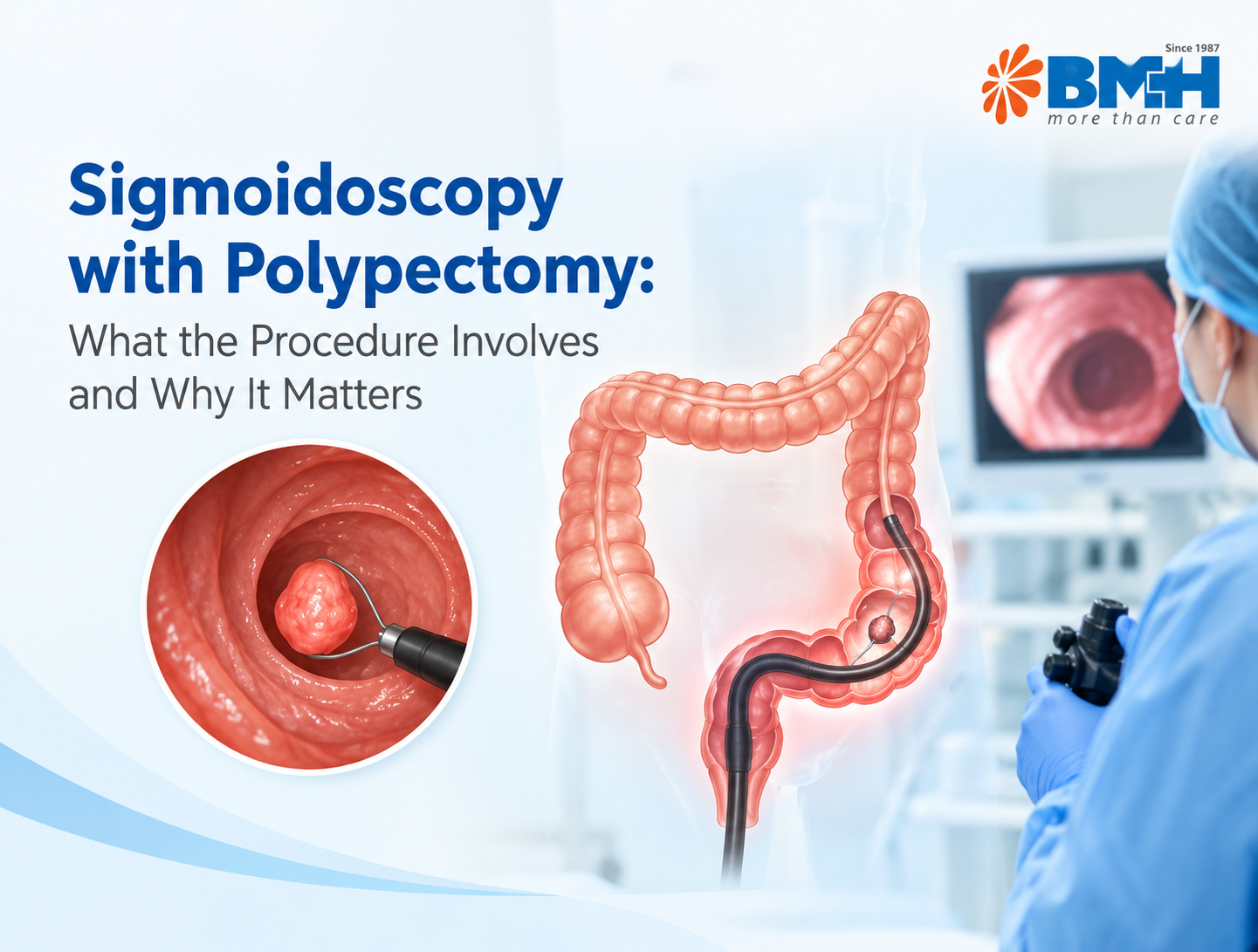
Now there are a few ways to take that closer look, one of them is a sigmoidoscopy procedure. This procedure allows doctors to examine the lower part of the large intestine to check whether there is something to worry about or not. And if they find a polyp during the examination, they can remove it then & there, if they think it is necessary. That's called sigmoidoscopy with polypectomy.
One procedure.
Two jobs.
Find the problem.
Treat it before it has the chance to become a bigger one.
What exactly is a sigmoidoscopy?
Your large intestine is longer than most people imagine.
A sigmoidoscopy looks only at its final section, called the sigmoid colon and the rectum.
A thin, flexible tube with a tiny camera is gently passed through the rectum.
The camera doesn't guess.
It shows.
Inflammation.
Bleeding.
Small growths.
Ulcers.
Polyps.
Your doctor is no longer relying on symptoms.
They are looking directly at the place where those symptoms may be coming from.
So, what is a polyp?
A polyp is a small growth that develops on the lining of the colon.
Most people don't know they have one.
Many polyps cause no pain.
No warning.
No obvious symptoms.
Most are harmless.
Some are not.
A few have the potential to slowly become cancer over several years.
That's why doctors don't like leaving them behind.
Not because every polyp is dangerous.
But because no one can tell just by looking at it which one might become a problem later.
Removing it early is often the safest choice.
Why remove something that isn't causing trouble?
This is where many people hesitate.
"If it's not bothering me, why touch it?"
Because colon cancer rarely begins as cancer.
It often begins as a small polyp.
Quiet.
Unnoticed.
Slowly changing over time.
Colon polyp removal interrupts that journey before it reaches its destination.
It's one of the few situations in medicine where a procedure can both diagnose a condition and help prevent a more serious one.
That's why it matters.
When might your doctor recommend a sigmoidoscopy?
Not everyone needs one.
But your doctor may suggest a sigmoidoscopy procedure if you have:
- bleeding from the rectum
- persistent changes in bowel habits
- ongoing diarrhoea
- unexplained constipation
- mucus in the stool
- pain in the lower abdomen
- suspected inflammatory bowel disease
- previously detected polyps that need follow-up
The recommendation depends on your symptoms, age, medical history, and examination findings.
Benefits and risks (up front)
Benefits: As we said earlier that, this procedure allows your doctor examine the lower part of your colon in real time. If a polyp is found, it can often be removed during the same examination, avoiding a separate procedure later. This procedure also helps doctors identify the cause of symptoms such as bleeding or persistent changes in bowel habits. Removing certain polyps early may reduce the future risk of colorectal cancer.
Risks: A mild bloating, or a feeling of cramping are common sign of this procedure. But these experinces settles within a short time. Some might experience a small amount of bleeding as well, that certainly can happen after colon polyp removal. Serious complications, such as infection or a tear in the bowel wall, are uncommon.
Serious complications are uncommon.
Your doctor will explain the risks based on your individual situation.
Preparing for the procedure
The camera can only show what it can see.
If stool is still present in the lower colon, small polyps or other changes can easily be hidden from view.
That's why preparing your bowel is an important part of the procedure, not just something to tick off before coming to the hospital.
Medical staff or your doctor's team will tell you exactly what to eat, what to avoid, whether any medicines need adjusting, and how to prepare the day before.
Following those instructions gives your surgeon the clearest possible view and further helps avoid having to repeat the examination.
What happens during sigmoidoscopy with polypectomy?
Many people expect it to be a big surgery.
But it doesn't feel like surgery.
You usually lie comfortably on your side.
The flexible scope is gently guided into the rectum and through the lower colon.
As the camera moves forward, the doctor examines the lining carefully.
If your doctor do find a polyp, then a very small instrument passed through the scope can remove it immediately.
You won't see any stitches.
There usually aren't any.
The removed tissue is sent to the laboratory so specialists can examine it under a microscope.
That report helps determine whether any further treatment or follow-up is needed.
Does the procedure hurt?
Not really, but it can be uncomfortable. As most patients describe the experience as uncomfortable rather than painful.
You may feel:
- pressure
- mild cramping
- a sensation of fullness
- the urge to pass gas
These feelings usually settle quickly once the procedure is over.
The healthcare team guides you through each step, explaining what is happening as the examination progresses.
After the procedure
Recovery is usually straightforward.
You may notice mild bloating for a short time because air is used to gently open the bowel during the examination.
If a polyp has been removed, you might notice a very small amount of bleeding afterwards.
This can be normal.
Your doctor will explain what to expect and which symptoms should prompt you to seek medical attention.
Many people return to their usual routine the same day, depending on whether sedation was used.
What happens to the removed polyp?
Removing the polyp is only part of the story.
The laboratory examination is equally important.
It tells your doctor:
- what type of polyp it was
- whether it showed any precancerous changes
- whether additional treatment is needed
- when your next colon examination should be planned
Not every removed polyp leads to further treatment.
Many simply require routine follow-up.
Why experience matters
A careful examination is about more than passing a camera through the bowel. It involves recognising subtle changes, removing polyps safely, and deciding whether further investigation is necessary.
That's why procedures like sigmoidoscopy with polypectomy are performed by specialists trained in GI endoscopy BMH Hospitals, where diagnosis and treatment happen together with patient safety at the centre of every decision.
Good questions to ask
- Why am I being advised to have a sigmoidoscopy instead of a colonoscopy?
- Will any polyps be removed during the procedure?
- Do I need sedation?
- How should I prepare beforehand?
- When will I receive the biopsy results?
- Will I need another examination in the future?
- What symptoms should I watch for after I go home?
A brief reminder
Most colon polyps never announce themselves.
They don't hurt.
They don't always bleed.
They simply sit there, growing quietly.
That's why sigmoidoscopy with polypectomy is valuable. It allows doctors to find these growths, remove many of them during the same examination, and understand exactly what they are before they become something more serious.
Sometimes the most important treatment isn't treating disease.
It's preventing it.
FAQs
1. What is sigmoidoscopy with polypectomy?
It is a procedure in which a doctor examines the rectum and lower part of the colon using a flexible camera and removes any suitable polyps found during the examination.
2. Why are colon polyps removed?
Most polyps are harmless, but some can gradually develop into colorectal cancer over time. Removing them early helps reduce that risk.
3. Is a sigmoidoscopy painful?
Most people experience mild discomfort, pressure, or cramping rather than significant pain. These sensations usually pass quickly after the procedure.
4. How long does a sigmoidoscopy procedure take?
The examination usually takes around 15 to 30 minutes, although the duration may vary if polyps need to be removed.
5. Will I need to stay in the hospital?
In most cases, no. Many patients return home the same day after the procedure.
6. What happens to the polyp after it is removed?
The polyp is sent to a laboratory, where it is examined under a microscope to determine its type and whether any abnormal changes are present.
7. When should I contact my doctor after the procedure?
Seek medical advice if you develop severe abdominal pain, heavy bleeding, fever, or symptoms that continue to worsen after returning home.