- English
- عربي / Arabic
- മലയാളം / Malayalam

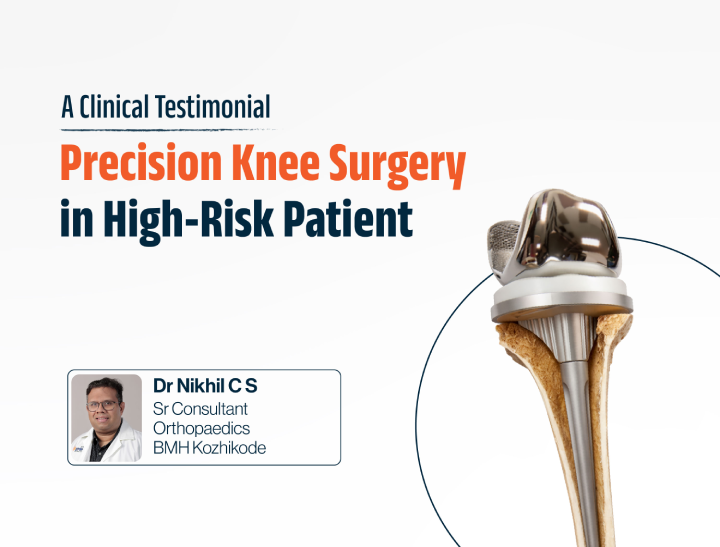
Complex Bilateral Total Knee Replacement in a High-Risk Dialysis Patient
23 July 2026A 62-year-old female presented with severe bilateral knee pain and significant difficulty in walking. She was largely dependent on a wheelchair and struggled even to transfer herself for her thrice-weekly hospital visits for dialysis.
She was a known case of chronic kidney disease requiring frequent dialysis, along with parathyroid adenoma, hyperparathyroidism, and high cardiac risk. She was also on dual antiplatelet therapy.
On examination, she had pallor, severe muscle wasting in both lower limbs due to prolonged disuse, and early signs of uremic myopathy. Local examination revealed gross deformity of both knees in both coronal and sagittal planes. She had a valgus deformity in the right knee and varus deformity in the left knee, resulting in a classic wind-swept deformity.
The case posed multiple challenges including severe deformity, osteopenia, poor bone quality, cardiac and renal complications, anesthetic risks, and the need to maintain hemodynamic stability throughout the procedure.
Treatment
Given her multiple comorbidities, extensive preoperative planning was carried out with a multidisciplinary team. Immediate pre- and post-operative dialysis was scheduled in consultation with nephrologists. Cardiology clearance was obtained, and clopidogrel was bridged to heparin during the perioperative period. A detailed anesthetic evaluation was also completed.
Due to the anticipated bone defects, the surgical team arranged additional screws, tibial stems, and backup implant options prior to surgery.
The patient underwent bilateral total knee replacement surgery. During the procedure, a bone defect of more than 15 mm was identified in the posterolateral aspect of the right tibia, along with severely osteoporotic surrounding bone. This was managed using screws and a tibial stem to provide additional stability.
The left knee was managed with screws and a regular cruciate-retaining prosthesis with a deep-dish model to improve stability and mobility.
The patient tolerated the procedure well, with minimal blood loss of approximately 120 ml and no perioperative complications.
Follow-Up and Recovery
Although patients are typically mobilized the day after surgery, her weight-bearing was delayed by two days due to muscle weakness, poor bone quality, and her underlying medical conditions.
Her three-day hospital stay remained uneventful, during which she underwent two dialysis sessions along with closely supervised physiotherapy. Her rehabilitation included walker-assisted gait training, full weight-bearing as tolerated, quadriceps strengthening, hip abductor exercises, and commode training.
During follow-up, the patient showed significant improvement in muscle strength and knee movement. Both knees remained stable, and she progressed from being wheelchair-dependent to walking with minimal support—regaining mobility and significantly improving her quality of life.
Indications for Stems in TKA
Obesity: Used in patients with a BMI >35 to prevent tibial component subsidence and loosening.
Severe Deformity: Crucial in cases with >8°–10° varus or high valgus deformity to stabilize the component.
Bone Loss: Indicated for severe (>10 mm) uncontained, metaphyseal defects requiring augments or cones.
Revision TKA: Standard practice to provide stability when bone quality/quantity is compromised.
Bone Weakness/Fracture: Used to bypass areas of weak bone, such as stress fractures, to prevent failure.
Component Constraint: Necessary when using highly constrained implants (like constrained condylar knees or hinges) to prevent excessive torque.