- English
- عربي / Arabic
- മലയാളം / Malayalam

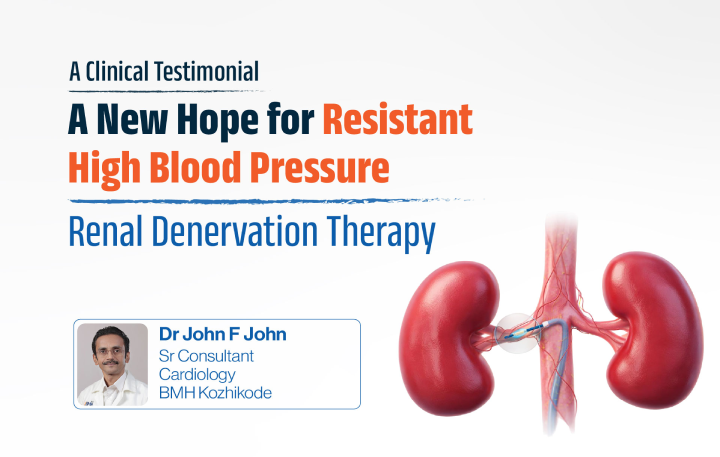
Renal denervation therapy for resistant hypertension in a female patient with background of peripartum cardiomyopathy: A case report.
22 July 2026Renal denervation therapy for resistant hypertension in a female patient with background of peripartum cardiomyopathy: A case report.
Abstract
Resistant hypertension (RH) is defined as above-goal elevated blood pressure in a patient despite the concurrent use of 3 antihypertensive drug classes, commonly including a long-acting calcium channel blocker, a blocker of the renin-angiotensin system (angiotensin-converting enzyme inhibitor or angiotensin receptor blocker), and a diuretic, at maximum or maximally tolerated daily doses. RH also includes patients whose BP achieves target values on ≥4 antihypertensive medications. (1).
Here we report a case of a 41 year old female with resistant hypertension with a past history of peripartum cardiomyopathy. The patient underwent successful bilateral renal denervation therapy. The patient had an uneventful postoperative course. This case demonstrates the effectiveness and feasibility of renal denervation therapy for resistant hypertension in selected patients.
Introduction
Several factors influence RH prevalence, such as the clinical setting, antihypertensives used, adherence and method of BP measurement. In a meta-analysis collecting data from 91 cohort or cross-sectional studies comprising more than 3.2 million patients, the prevalence of resistant hypertension was about 10% among patients treated for hypertension.(3) RH is associated with increased cardiovascular (CV) morbidity and mortality. Patients with RH generally require more frequent medical examinations, diagnostic tests and medication, resulting in increased healthcare costs and economic burden(2)
Patient Information and history
A 41-year-old female presented with uncontrolled hypertension despite optimal doses of concurrent use of multiple antihypertensive drug classes.She has history of peripartum cardiomyopathy diagnosed on 2013 .No secondary causes of hypertension were documented and medication compliance was considered adequate.No history of chronic kidney disease or renovascular abnormalities.
Case details
This was was initially admitted in our hospital in January 2023 for evaluation of resistant hypertension. During this admission secondary causes of hypertension were ruled out. Her renal function tests and electrolytes were within normal limits. Her plasma metanephrine, normetanephrine, aldosterone-renin ratio (ARR), Thyroid function test, PTH and beta HCG were within normal limits. CT abdomen and aortogram was normal, hence ruled out phaechromocytoma, renal artery stenosis and coarctation of aorta . The above investigations helped us in excluding all other possible secondary causes of hypertension, she was discharged with optimal doses of ARNI, betablocker, calcium channel blocker, alpha blocker and diuretic. Later on she was kept on OPD basis follow up. During her regular out-patient visits, she was found to have persistent uncontrolled hypertension despite being compliant to all the above medications. Hence she was planned for Renal Denervation Therapy and was admitted for the same on May 2025.
On examination, patient had pulse rate of 72/min, blood pressure of 180/100 mmHg and respiratory rate of 18/min. Systemic examination was unremarkable, with normal heart sounds, clear lung fields and no focal neurological deficits.
Lab investigations showed: Hb-9.7 gm/dl, TC: 7,900/ cm2 and Platelets: 2,18,000/cm2, INR: 0.84, creatinine: 0.83 mg/dL, Urea: 17, S. sodium: 140 mEq/L, S. potassium : 3.5 mEq/L. Electrocardiogram showed sinus rhythm with no significant ST- T changes. Echocardiogram showed mildly dilated left ventricle, no regional wall motion abnormality, mild mitral regurgitation, mild tricuspid regurgitation, fair left ventricular systolic function. LV EF: 51% and grade II LV diastolic dysfunction.
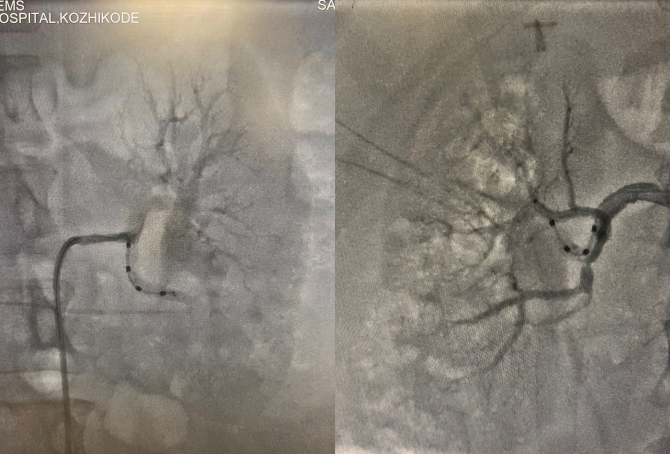
She underwent renal denervation via right femoral access using a Simplicity Spiral catheter with 21 ablations in the right and 20 in the left renal artery. Angiography confirmed single renal arteries without accessory vessels and post procedure imaging showed no spasm or dissection. The procedure was completed successfully without complications. The postoperative period was uneventful. The patient remained clinically and hemodynamically stable. She was discharged home with ARNi, betablocker and MRA.
On subsequent follow ups, her BP showed remarkable reduction, antihypertensives were down titrated and reduced to two medications, with improvement in overall wellbeing.
Discussion
Renal denervation (RDN) is a safe and effective interventional strategy for the management of resistant hypertension. Renal denervation (RDN) is a catheter-based procedure using radiofrequency, ultrasound, or chemical ablation to disrupt renal sympathetic nerves which helps in lowering the sympathetic activity and hence reducing blood pressure.
The rationale behind RDN lies in the modulation of sympathetic nervous system activity. The renal arteries are richly innervated by sympathetic fibers that contribute to blood pressure regulation through renin release, sodium retention, and vasoconstriction. Catheter-based renal denervation causes substantial and sustained blood-pressure reduction, without serious adverse events, in patients with resistant hypertension hence by ablating these nerves using catheter-based techniques (radiofrequency or ultrasound energy ) it reduces sympathetic activity, resulting in reduced blood pressure. (4)
Many studies were conducted to establish the efficacy of RDN. SYMPLICITY HTN-1 conducted in 2014 revealed drop of 10 mm Hg or more in systolic blood pressure in 69% of patients at 1 month, 81% at 6 months, 85% at 12 months, 83% at 24 months, and 93% at 36 months.(5) SYMPLICITY HTN-2 also showed long term reductions in blood pressure (6). However, the SYMPLICITY HTN-3 did not show a significant reduction of blood pressure in patients with resistant hypertension raising questions due to its unsatisfactory results (7). More recent sham-controlled trials, including SPYRAL HTN-OFF MED and ON MED, as well as RADIANCE-HTN SOLO, have demonstrated more consistent and statistically significant reductions in blood pressure, renewing the hope in successful RDN therapy. (8)
Renal denervation uses various technologies such as radiofrequency, ultrasound, and alcohol-mediated denervation.
(a)Radiofrequency-Based Renal Denervation-A medium-frequency alternating current is used to generate heat. The arterial wall tolerates this heat in the setting of blood flow around the catheter but it is toxic to the nerves surrounding the vessel wall.
(b)Ultrasound-Based Renal Denervation- Four ultrasound-emitting sources are mounted on a balloon-based catheter system. This allows for circumferential contact with the renal artery wall. A cooling solution helps to maintain safe temperatures within the lumen of the artery compared with the perivascular space.
(c)Alcohol-Mediated Renal Denervation-A catheter with 3 micro-needles is extended into the wall of the renal artery to reach the perivascular space. A small amount of liquid neurotoxin like ethanol, is injected into the perivascular space for chemical ablation of nerves(9)
There is generally low rates of procedural complications such as renal artery stenosis or vascular injury in RDT. No significant differences in renal adverse events were observed between the renal denervation and control groups (5). Studies were conducted to test the efficacy of RDN in CKD patients, which revealed an interruption to the progressive decline of renal function that is typically seen in CKD. (10) All this proves that RDN is a safe and efficient strategy to treat resistant hypertension.
This case contributes to the growing clinical experience with renal denervation and supports its undeniable role as a viable adjunctive therapy in selected patients diagnosed with resistant hypertension. Future advancements in technology, better patient selection criteria, and longer-term data will further clarify its place in hypertension management. Although not a cure for hypertension, an additional renal artery denervation will provide a reduction in the number of medications required to achieve BP control(9)
Conclusion
Renal Denervation Therapy is a safe and effective option in patients with resistant hypertension. This case supports the role of RDT as a viable adjunctive treatment option in carefully selected patients with resistant hypertension particularly when anatomical suitability and procedural adequacy are ensured.
REFERENCES
(1)Carey RM, Calhoun DA, Bakris GL, et al. Resistant hypertension: detection, evaluation, and management: a scientific statement from the American Heart Association. Hypertension. 2018;72(5):e53–90. https://doi.org/10.1161/HYP.0000000000000084
(2)Champaneria MK, Patel RS, Oroszi TL. When blood pressure refuses to budge: exploring the complexity of resistant hypertension. Front Cardiovasc Med. 2023;10:1211199.https://doi.org/10.3389/fcvm.2023.1211199
(3)Noubiap JJ, Nansseu JR, Nyaga UF, et al. Global prevalence of resistant hypertension: a meta-analysis of data from 3.2 million patients. Heart. 2019;105(2):98–105. https://doi.org/10.1136/heartjnl-2018-313599
(4)Krum H, Schlaich M, Whitbourn R, et al. Catheter-based renal sympathetic denervation for resistant hypertension: a multicentre safety and proof-of-principle cohort study. Lancet. 2009;373(9671):1275–81. https://doi.org/10.1016/s0140-6736(09)60566-3
(5)Esler MD, Krum H, Schlaich M, et al. Percutaneous renal denervation in patients with treatment-resistant hypertension: final 3-year report of the Symplicity HTN-1 study. Lancet. 2014;383(9917):622–29. https://doi.org/10.1016/s0140-6736(13)62192-3
(6)Esler MD, Krum H, Sobotka PA, et al. Renal sympathetic denervation for treatment of drug-resistant hypertension: one-year results from the Symplicity HTN-2 randomized, controlled trial. Circulation. 2012;126(25):2976–82. https://doi.org/10.1161/CIRCULATIONAHA.112.130880
(7)Bhatt DL, Kandzari DE, O’Neill WW, et al. A controlled trial of renal denervation for resistant hypertension. Glob Cardiol Sci Pract. 2014;2014(2):15. http://dx.doi.org/10.5339/gcsp.2014.15
(8)Townsend RR, Mahfoud F, Kandzari DE, et al. Catheter-based renal denervation in patients with uncontrolled hypertension in the absence of antihypertensive medications (SPYRAL HTN-OFF MED). Lancet. 2017;390(10108):2160–70. https://doi.org/10.1016/S0140-6736(17)32281-X
(9)Böhm M, Kario K, Kandzari DE, et al. Opportunities and limitations of renal denervation: where do we stand? Am J Med. 2024;137(8):889–97. https://doi.org/10.1016/j.amjmed.2024.04.006
(10)Kiuchi MG, Esler MD, Fink GD, et al. Effects of renal denervation on kidney function in patients with chronic kidney disease: a systematic review and meta-analysis. J Hum Hypertens. 2023;37(11):857–66. https://doi.org/10.1038/s41371-023-00857-3