- English
- عربي / Arabic
- മലയാളം / Malayalam

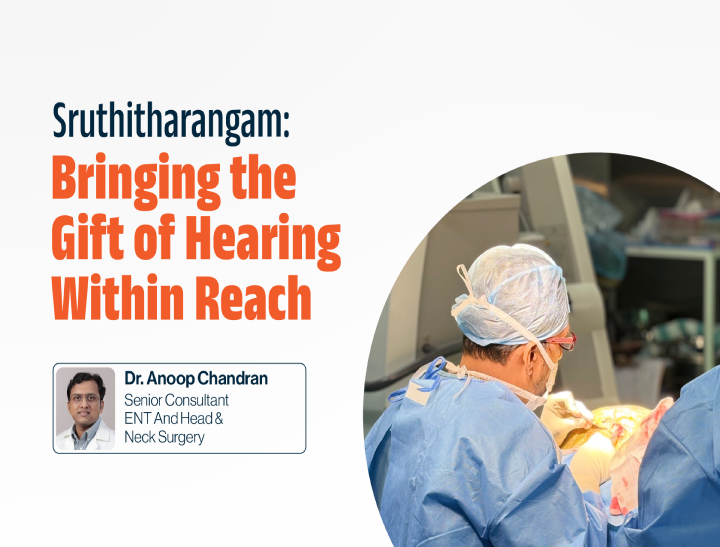
Cochlear Implantation Under Sruthitharangam Scheme at BMH Kozhikode
13 October 2026A cochlear implant is an advanced electronic hearing device designed to provide a sense of sound to individuals with severe to profound hearing loss, particularly when adequate benefit cannot be obtained from appropriately fitted hearing aids. Unlike hearing aids, which amplify sound, cochlear implants bypass damaged portions of the inner ear and directly stimulate the auditory nerve.
A cochlear implant consists of an external microphone and speech processor, along with an implanted receiver-stimulator and electrode array. The microphone picks up sounds from the environment, while the speech processor converts these sounds into coded electrical signals. These signals are transmitted to the implanted component and delivered through the electrode array to the auditory nerve, allowing the brain to perceive the signals as sound.
For children with congenital or early-onset severe-to-profound hearing loss, early identification, appropriate amplification, cochlear implantation when indicated, and consistent auditory-verbal rehabilitation are particularly important for speech and language development. Research has demonstrated that early intervention through amplification or cochlear implantation is associated with better language outcomes.
However, a cochlear implant does not restore normal hearing. Successful outcomes depend on several factors, including the age at implantation, duration and degree of hearing loss, auditory experience, device use, and participation in post-implant rehabilitation. Audiologists, ENT surgeons, speech-language pathologists, and other professionals work together throughout the assessment, implantation, programming, and rehabilitation process.
In essence, cochlear implantation is not merely a surgical procedure-it is the beginning of a long-term journey towards auditory development, communication, and greater participation in everyday life.
For families of children with profound hearing loss, access to cochlear implantation can be a significant financial challenge. Sruthitharangam, a Government of Kerala initiative, was established to make cochlear implantation and related rehabilitation services more accessible to eligible children with hearing impairment.
The scheme was initially implemented by the Kerala Social Security Mission (KSSM) and, as part of the convergence of publicly funded health-financing programmes, cochlear implantation for children under Sruthitharangam has been implemented by the State Health Agency, Kerala, from the financial year 2023–24.
Sruthitharangam provides support that extends beyond the surgery itself. The scheme includes cochlear implantation surgery, auditory-verbal habilitation, maintenance of cochlear implant spares and accessories, and processor upgrades, thereby supporting children throughout their post-implant rehabilitation journey.
The scheme is intended for eligible resident beneficiaries of Kerala, with specific eligibility conditions regarding age, family status, and hearing loss. According to the current Kerala Health Department information, cochlear implantation is preferably undertaken within 3 years of age, while special approval may extend eligibility up to 5 years in appropriate cases.
Applications are reviewed by a State Level Technical Committee, which evaluates the eligibility of candidates and guides implementation of the scheme. Services are provided through empanelled hospitals, and the programme also supports continued rehabilitation and device-related requirements following implantation.
A 2.5-year-old male child was brought to the Department of Audiology and Speech-Language Pathology for detailed audiological evaluation. Parents reported concerns regarding hearing loss since the age of 1.5 years. The child occasionally responds to extremely loud sounds and inconsistently responds to his name when called. He primarily communicates his needs through gestures and by taking adults towards desired objects. The child has not yet acquired meaningful words and is observed to imitate sounds during play. Previous audiological evaluation revealed congenital bilateral profound sensorineural hearing loss. The child has age-appropriate motor milestones and has been using a hearing aid. He is currently attending speech and language therapy.
Click and tone-burst BSERA results showed that auditory evoked potentials were absent at 90 dBnHL, consistent with bilateral congenital profound hearing loss.
Auditory Steady-State Response (ASSR) results showed no responses across the tested frequencies at 100–110 dB.
Behavioural Observation Audiometry (BOA) results showed no responses at the maximum intensity level, and no responses were obtained for speech stimuli presented at 6 feet.
Aided audiogram results showed thresholds outside the speech banana spectrum, indicating that the child was not receiving adequate benefit from the hearing aid for auditory and speech stimuli.
Detailed speech and language assessment revealed a spoken language disorder secondary to bilateral profound hearing loss.
The child was using hearing aids and underwent auditory-verbal therapy for two months; however, no significant improvement was noted. Hence, cochlear implantation was planned. An application was submitted under the Sruthitharangam Scheme on 15/10/2025, and approval was obtained.
The parents were counselled, and informed consent was obtained. The necessary preoperative investigations for cochlear implantation were completed. The child subsequently underwent right cochlear implantation under general anaesthesia on 18/10/2025.
The child was prepared for surgery under general anaesthesia, and infiltration was given in the post-auricular region. A right Lazy-S incision was made, followed by elevation of the musculoperiosteal flap and cortical mastoidectomy. Posterior tympanotomy was performed, and the round window was identified and adequately exposed. A bony well was created for implant placement, and a MED-EL CONCERTO 2 cochlear implant with FLEX 28 electrode was secured using Ethibond sutures. The electrode was inserted through the round window. Intraoperative NRT responses and impedance measurements were obtained and found to be satisfactory. The wound was closed in layers, and a mastoid dressing was applied.
Postoperative Auditory Response Telemetry (ART) was performed for the patient at the time of cochlear implantation surgery at Baby Memorial Hospital, Kozhikode.
Intraoperative ART Findings:
Intraoperative ART responses were successfully recorded from the implanted electrode array. Clear and replicable ECAP waveforms were obtained from the tested electrodes. ART could be elicited for all the electrodes, indicating good electrode interface. Impedance values were within normal limits across all electrodes at the time of surgery. The child was recommended to undergo post-operative device activation (switch-on) after 4 weeks.
Device switch-on and initial mapping were carried out 4 weeks after cochlear implantation. Following activation, the child regularly attended Auditory Verbal Therapy (AVT) at BMH twice a week.
The child is demonstrating emerging phrase-level communication with a vocabulary of approximately 20–25 words. The child responds appropriately to auditory stimuli. The child is able to produce front sounds but has difficulty producing back sounds. The child is able to name body parts (e.g., eyes and nose) and fruits and uses functional communication expressions such as “thaa,” “vaa,” “please,” “edukk,” and “please vaayo.”