- English
- عربي / Arabic
- മലയാളം / Malayalam

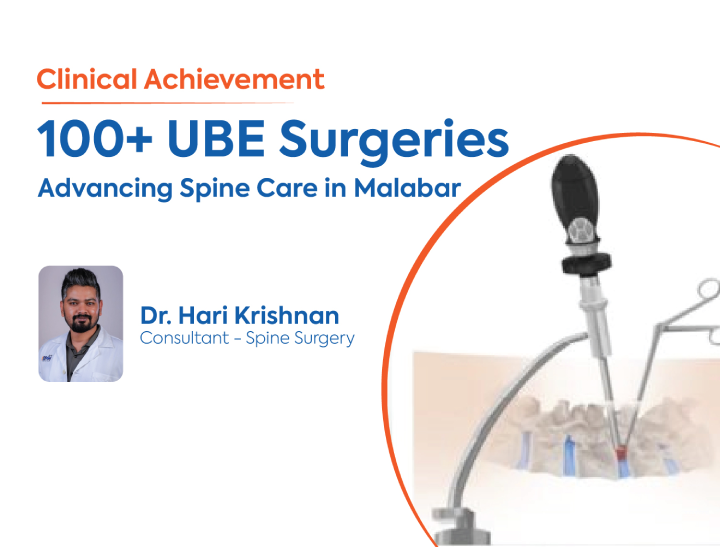
BMH Kannur Completes 100+ UBE Spine Surgeries, Advancing Minimally Invasive Spine Care in Malabar
30 September 2026Baby Memorial Hospital (BMH), Kannur, has successfully completed more than 100 Unilateral Biportal Endoscopic (UBE) spine surgeries, marking a significant milestone in minimally invasive spine care in the Malabar region.
The milestone was achieved under the leadership of Spine Surgeon Dr. Hari Krishnan, whose expertise and commitment to advanced spinal care have contributed to the growing adoption of UBE surgery at BMH Kannur. The hospital has also established itself as a centre that introduced UBE spine surgery in the Malabar region, offering patients access to an advanced minimally invasive approach for the management of complex spinal conditions.
Unilateral Biportal Endoscopy, commonly known as UBE surgery, is an advanced minimally invasive technique used to treat a range of spinal conditions, including disc compressions and selected cases requiring spinal decompression and fusion.
Unlike conventional open spine surgery, UBE uses two small incisions. One incision is used to introduce a camera that provides a magnified view of the surgical area, while specialised surgical instruments are introduced through the second incision.
This biportal approach allows the surgeon to visualise and access the spine while working through small openings, helping minimise disruption to the surrounding tissues.
Traditional open spine procedures may require a larger incision and greater exposure of the surgical area. UBE offers an alternative approach by allowing the surgeon to perform the procedure through smaller incisions.
The smaller access points can offer several potential benefits, including:
The specific benefits and recovery time can vary depending on the spinal condition, procedure performed and the individual patient's overall health.
Unilateral Biportal Endoscopy (UBE) offers a wider field of vision, greater instrument flexibility, and less radiation exposure than Percutaneous Endoscopic Lumbar Discectomy (PELD).
In spine surgery, UBE uses two small cuts instead of one. One cut holds the camera and the other holds the working tools. This separation gives UBE distinct clinical advantages
Better Visibility and Space
Two separate ports give the surgeon a larger, clearer view of the spine.
Greater Tool Movement
Surgeons can use standard surgical instruments instead of being locked into a narrow single-channel tube.
Less Radiation
Better sight lines mean the medical team uses the X-ray machine (fluoroscopy) less often during the operation.
Easier for Complex Cases
UBE works very well for severe spinal narrowing, hard-to-reach slipped discs, or unusual bone shapes
Completing more than 100 UBE spine surgeries represents an important milestone in the development of advanced minimally invasive spine care at BMH Kannur.
The experience gained through performing these procedures enables the spine team to manage patients with a range of spinal conditions requiring decompression and, where clinically appropriate, fusion procedures through minimally invasive techniques.
The milestone also reflects the importance of specialist expertise, appropriate patient selection and a multidisciplinary approach to achieving safe and effective outcomes in spine surgery.
Expanding Access to Advanced Spine Care in Malabar
BMH Kannur's experience with UBE surgery marks an important development in minimally invasive spine care in Malabar. By incorporating advanced endoscopic techniques into spinal surgery, the hospital aims to provide patients with treatment options that can potentially reduce the physical impact of surgery and support an earlier return to everyday activities.
Speaking about the benefits of the technique, Spine Surgeon Dr. Hari Krishna highlighted that UBE provides a minimally invasive alternative to conventional open spine surgery and can support improved recovery and an earlier return to daily life for appropriately selected patients.
A Milestone in the Journey of Minimally Invasive Spine Surgery
The completion of 100+ UBE procedures at BMH Kannur is more than a numerical milestone. It represents the growing role of minimally invasive techniques in modern spine surgery and the hospital's continued efforts to expand advanced treatment options for patients across Malabar.