- English
- عربي / Arabic
- മലയാളം / Malayalam

Complex Laparoscopic Splenectomy with Cholecystectomy in Hereditary Spherocytosis
24 September 2026A Complex Laparoscopic Splenectomy with Cholecystectomy in a 29-Year-Old Patient with Hereditary Spherocytosis
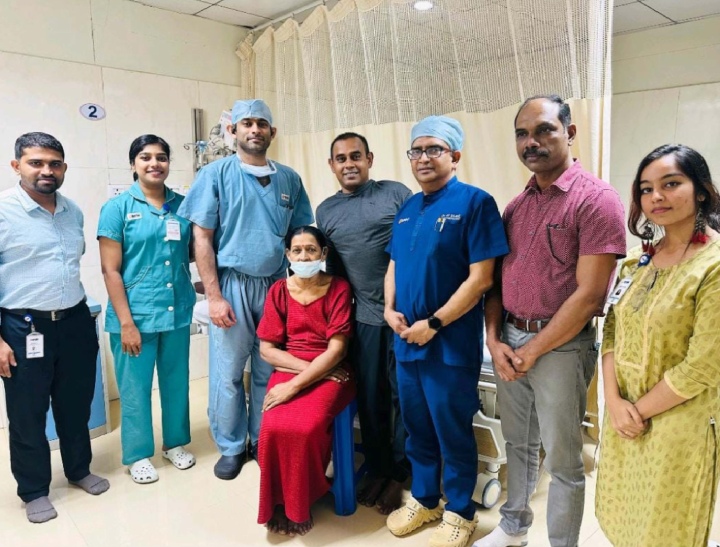
A 29-year-old male from Eramala presented with recurrent left-sided abdominal pain and discomfort. He was a known case of hereditary spherocytosis with massive splenomegaly and associated gallstone disease.
Clinical evaluation revealed a markedly enlarged spleen, extending below the left costal margin and occupying a significant portion of the left upper abdomen. Considering the extent of splenomegaly and gall stone disease, definitive surgical management was planned.
A Challenging Laparoscopic Procedure
On 20 May 2026, the patient underwent laparoscopic splenectomy with cholecystectomy under general anaesthesia.
Intraoperatively, the spleen was found to be grossly enlarged, occupying the left upper abdomen and extending below the costal margin. The splenic hilum was stretched with multiple enlarged hilar vessels, and dense adhesions were present around the spleen, adding to the technical complexity of the procedure.
The surgical team meticulously released the adhesions and carefully controlled the splenic hilar vessels before achieving complete mobilisation of the enlarged spleen. The spleen was then placed in a retrieval bag and removed through an enlarged port incision using a controlled laparoscopic technique.
The gallbladder was also found to be tense, distended and thick-walled, with multiple gallstones. Following careful dissection and identification of the relevant structures, laparoscopic cholecystectomy was successfully completed during the same procedure.
Successful Outcome
Despite the significant splenomegaly, enlarged hilar vessels and dense perisplenic adhesions, both procedures were successfully completed through a minimally invasive laparoscopic approach.
The patient's postoperative recovery was uneventful. He progressed well following surgery, tolerated oral intake and was discharged in a clinically stable condition. At follow-up, his surgical wounds were healing well and he reported significant clinical improvement.
Clinical Significance
This case demonstrates the role of advanced laparoscopic surgical expertise in managing technically challenging cases of massive splenomegaly. Careful preoperative planning, meticulous dissection and appropriate vascular control enabled the surgical team to safely perform splenectomy through a minimally invasive approach, along with simultaneous removal of the diseased gallbladder.
The successful outcome highlights how advanced laparoscopic techniques can be effectively utilised in selected complex surgical cases, while supporting recovery through a minimally invasive approach.
A Complex Surgical Challenge Successfully Managed
A complex surgical challenge successfully managed through advanced laparoscopic expertise and meticulous surgical planning.