- English
- عربي / Arabic
- മലയാളം / Malayalam


Renal Recovery Enabling Definitive Chemoradiation in Advanced Cervical Cancer
24 November 2026Renal Recovery Enabling Definitive Chemoradiation in Locally Advanced Cervical Cancer with Malignant Ureteric Obstruction: A Case Report
Cervical cancer remains an important global health problem, particularly in low- and middle-income countries. A substantial proportion of patients present with locally advanced disease requiring definitive chemoradiation.
Advanced cervical cancer can cause ureteric obstruction and secondary renal dysfunction. Renal impairment is clinically important because it may limit the use of cisplatin-based concurrent chemotherapy and can compromise the ability to deliver definitive treatment. Current guidelines recognize urinary diversion with ureteric stenting or percutaneous nephrostomy as an option for renal failure caused by malignant ureteric obstruction
Case Presentation
A 50-year-old perimenopausal woman presented with a history of postcoital bleeding for three months. She also reported difficulty in passing stools for one week and limb edema for one week.
On general examination, pallor was present. There was no generalized lymphadenopathy and no supraclavicular lymph node enlargement.
Per-rectal examination revealed involvement of both parametrium up to the pelvic sidewalls. The rectal mucosa was clinically free.
Laboratory investigations revealed significant anemia and renal dysfunction:
• Hemoglobin: 8 g/dL
• Serum creatinine: 4 mg/dL
• Blood urea: 86 mg/dL
Biopsy of the cervical lesion revealed squamous cell carcinoma
Biopsy of the cervical lesion revealed squamous cell carcinoma. Contrast-enhanced CT of the pelvis demonstrated a cervical mass infiltrating the bladder with bilateral parametrial involvement.
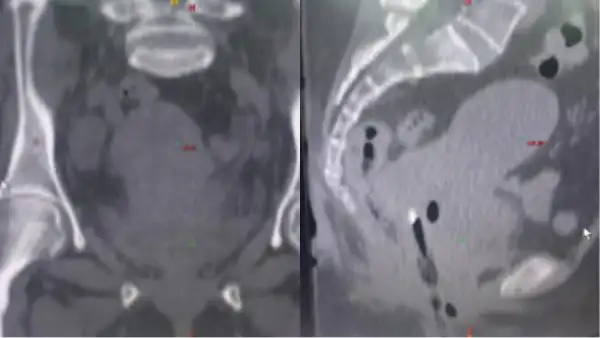
The patient was clinically documented as having FIGO stage IVA cervical carcinoma Initial Management
In view of the severe anemia, blood transfusion was administered.
Because of the significant renal dysfunction, the patient underwent urological evaluation. Percutaneous nephrostomy (PCN) was advised for urinary decompression.
Following PCN, there was a marked improvement in renal function, with serum creatinine decreasing from 4 mg/dL to 1.2 mg/dL.
The patient was subsequently evaluated jointly by the radiation oncology, urology and nephrology teams. In view of the improvement in renal function, definitive radical radiation therapy with concurrent chemotherapy was planned.
Definitive Oncological Treatment
She received external beam radiation therapy to the pelvis to a dose of 45 Gy in 25 fractions with concurrent carboplatin-based chemotherapy. Following completion of chemoradiation, clinical evaluation demonstrated a small residual cervical lesion measuring approximately 0.5 × 0.5 cm. She subsequently underwent intracavitary high-dose-rate brachytherapy, receiving 7 Gy in four fractions prescribed to the high-risk target volume.
Following completion of definitive treatment and improvement in urinary obstruction, the PCN was removed and ureteric stenting was performed. MRI of the pelvis with contrast performed six months after completion of treatment demonstrated complete response.
MRI Pelvis
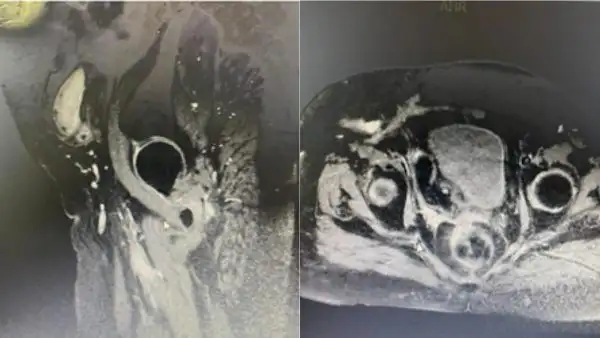
Following completion of definitive treatment and improvement in urinary obstruction, the PCN was removed and ureteric stenting was performed. MRI of the pelvis with contrast performed six months after completion of treatment demonstrated complete response.
The patient was subsequently followed clinically and has remained disease-free during 7 years of follow-up.
Discussion
Malignant ureteric obstruction is a recognized complication of advanced cervical cancer and may result in severe renal dysfunction. Renal impairment can limit the use of cisplatin-based concurrent chemotherapy and may compromise the delivery of definitive treatment.
In our patient, severe renal dysfunction with a serum creatinine of 4 mg/dL was successfully managed with percutaneous nephrostomy. Following urinary decompression, renal function improved significantly, with creatinine decreasing to 1.2 mg/dL. This allowed the patient to proceed with definitive radical chemoradiation.
The patient received pelvic radiotherapy with concurrent carboplatin followed by intracavitary brachytherapy for residual disease. MRI performed six months after treatment demonstrated complete response. Importantly, she remained under follow-up for seven years, highlighting the possibility of durable disease control despite severe renal dysfunction at presentation.
This case emphasizes that renal dysfunction secondary to malignant ureteric obstruction may be potentially reversible. Early urinary decompression and multidisciplinary management can restore renal function and may allow appropriately selected patients to receive curative-intent treatment rather than being excluded from definitive therapy