- English
- عربي / Arabic
- മലയാളം / Malayalam

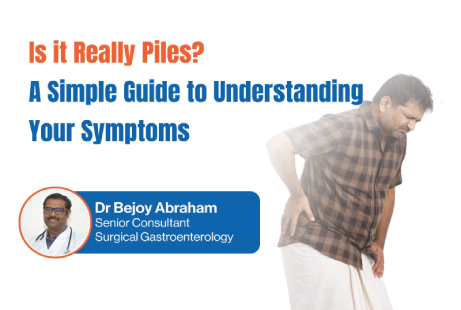
The word "piles" is often misused to describe any discomfort in the anal region, leading to unnecessary fear. While many people club every symptom bleeding, swelling, pain, or itching, under this single term, the clinical reality usually points to one of three distinct conditions: Hemorrhoids, Fissures, or Abscesses (collection of pus) or Fistula.
Dr. Bejoy Abraham (Senior Consultant – Surgical Gastroenterology, BMH Thodupuzha) explains that understanding these based on symptoms can help you seek the right treatment early and without anxiety.
1. Hemorrhoids (The True "Piles")
Scientifically, "heme" means blood and "roids" means swelling. These are blood-containing swellings that originate in an area of the anal canal that does not perceive pain.
Key Symptoms: Painless bleeding (often a spurting jet or dripping after stool passage) and a soft swelling that may protrude.
The Four Grades:
Grade 1: Bleeding only.
Grade 2: Swelling protrudes but returns inside on its own.
Grade 3: Swelling stays out but can be pushed back manually.
Grade 4: Prolapsed swelling that stays outside the anus ,causing significant discomfort.
Treatment: Most cases are treated in an office setting without surgery. Options include Sclerotherapy (shrinking injections) or Banding. For advanced stages, a Stapler Haemorrhoidectomy offers a painless surgical solution with quick discharge.
2. Anal Fissures
Unlike hemorrhoids, a fissure is defined by severe pain.
Key Symptoms: Sharp pain during or after bowel movements, often compared to passing "broken glass." It may involve minor bleeding and difficulty passing stools.
The Cause: A tear in the sensitive anal lining caused by hard stools, leading to a painful muscle spasm.
Treatment: 80-90% of cases heal with stool softeners and specialized creams. Botox injuctions are used to relax anal muscels as an effective non-surgical option. If surgery is needed, it is a minor procedure to relax the sphincter muscle, allowing the tear to heal.
3. Abscesses and Fistulas
These represent the infectious side of anorectal issues.
Abscess: A painful, pus-filled swelling caused by a blocked gland. It requires incision and drainage.
Fistula: A "tunnel" that forms if an abscess doesn't heal completely, connecting the internalside anal canal to the external skin.
Key Symptoms: Intermittent discharge or pus that stains underwear unexpectedly, sometimes accompanied by fever.
Treatment: Abscesses are drained under anastatia. Fistulas rarely heal on their own. Treatment depends on whether the tract is "Low" or "High" (determined by an MRI). Surgery is straightforward for low tracts, while high tracts may require a staged approach to protect muscle function.
Most of these conditions are easily treatable, often without pain or long hospital stays if caught early. Don't let fear or embarrassment delay your consultation with the gastrosurgeon.a surgeon.
The Preventive Path: Habits for Long-Term Comfort
While medical treatments are highly effective, the best approach is preventing these conditions from recurring or worsening. Most anorectal issues stem from chronic strain and poor digestive habits. By incorporating a few simple changes, you can significantly reduce your risk:
The Fiber Factor: Aim for 25–35 grams of fiber daily through whole grains, legumes, and leafy greens to ensure soft, easy-to-pass stools.
Hydration is Key: Fiber needs water to work; without it, fiber can actually worsen constipation. Drink plenty of fluids throughout the day.
Listen to Your Body: Never ignore the "urge to go." Delaying bowel movements leads to harder stools and increased pressure.
The Two-Minute Rule: Avoid spending excessive time on the toilet (especially with a smartphone), as prolonged sitting increases pelvic pressure and engorges blood vessels.
By combining these habits with early clinical intervention, you can maintain long-term comfort and digestive health.